


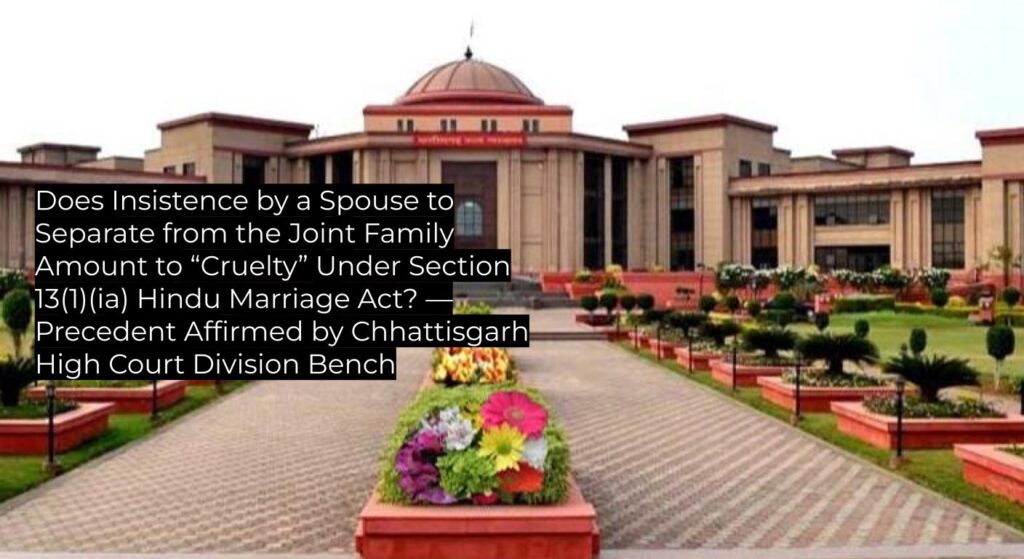
The Division Bench of the Chhattisgarh High Court holds that a wife’s insistence that her husband abandon his parents and live separately constitutes “mental cruelty” within the meaning of Section 13(1)(ia) of the Hindu Marriage Act, reaffirming existing legal principles. This decision confirms that persistent demands for separate residence, substantiated by evidence and admissions, justify a decree of divorce and stands as binding authority for subordinate courts across Chhattisgarh.
Summary
| Category | Data |
|---|---|
| Case Name | FA(MAT)/10/2019 of SMT. MONIKA TAMRAKAR Vs PRASHANT KUMAR TAMRAKAR |
| CNR | CGHC010327972019 |
| Date of Registration | 20-09-2019 |
| Decision Date | 02-09-2025 |
| Disposal Nature | ALLOWED |
| Judgment Author | Hon’ble Shri Justice Amitendra Kishore Prasad |
| Concurring or Dissenting Judges | Hon’ble Smt. Justice Rajani Dubey (concurring) |
| Court | High Court of Chhattisgarh, Bilaspur |
| Bench | Division Bench (Justice Rajani Dubey, Justice Amitendra Kishore Prasad) |
| Precedent Value | Binding authority for all subordinate courts in Chhattisgarh |
| Overrules / Affirms | Affirms the judgment and decree of Family Court, Raipur dated 23.08.2019 |
| Type of Law | Family Law / Matrimonial Law |
| Questions of Law | Whether persistent demands to separate from joint family and live apart, as well as conduct amounting to mental cruelty, constitute valid grounds for divorce under Section 13(1)(ia) of the Hindu Marriage Act, 1955. |
| Ratio Decidendi | The court held that proof of a spouse’s insistence upon living separately from the joint family, coupled with corroborated allegations of abusive conduct and desertion, amounts to mental cruelty within Section 13(1)(ia) of the Hindu Marriage Act, 1955. The appellant’s own admissions and the evidence on record conclusively established both cruelty and desertion. The court also clarified that a pending petition for restitution of conjugal rights does not override established findings of cruelty and desertion reached on the evidence. The Family Court’s decree of dissolution of marriage was affirmed, and permanent alimony awarded was enhanced in consideration of the child’s welfare and both parties’ incomes. The judgment establishes binding precedent on the scope of mental cruelty in joint family contexts. |
| Judgments Relied Upon | Rajnesh v. Neha, 2021 AIR 569 SC |
| Logic / Jurisprudence / Authorities Relied Upon by the Court | Principles regarding cruelty, desertion, and alimony as laid down in prior Supreme Court judgments, including evaluation of evidence (oral, documentary, and admissions in cross-examination) |
| Facts as Summarised by the Court | Marriage solemnized on 28.06.2009; male child born 05.06.2010; disputes arose leading to wife’s departure to her parental home in August 2010, with only brief return in 2011; husband alleged cruelty and desertion and wife denied allegations; evidence and cross-examination revealed insistence to separate, abusive texts, and desertion. |
| Citations | Rajnesh v. Neha, 2021 AIR 569 SC; Exhibit P-7 (text message evidence) |
Practical Impact
| Category | Impact |
|---|---|
| Binding On | All subordinate courts in Chhattisgarh |
| Persuasive For | Other High Courts and the Supreme Court, particularly in matrimonial cruelty cases involving joint family systems |
| Follows | Rajnesh v. Neha, 2021 AIR 569 SC (regarding maintenance/alimony affidavits and principles) |
What’s New / What Lawyers Should Note
- Reaffirms that a spouse’s persistent demand to abandon the joint family can constitute mental cruelty warranting divorce under Section 13(1)(ia) HMA, especially when corroborated by evidence and admissions.
- The court clarifies the evidentiary value of admissions in cross-examination, even if the party denies allegations directly.
- Pending applications under Section 9 (Restitution of Conjugal Rights) do not override clear findings of cruelty and desertion on merits.
- Enhanced scrutiny of financial affidavits in light of Rajnesh v. Neha for determination of permanent alimony.
- Lawyers can cite this judgment as binding within Chhattisgarh on issues involving cruelty by insistence on nuclearization.
Summary of Legal Reasoning
- The court closely examined the oral and documentary evidence, including cross-examination admissions and text message Exhibit P-7.
- Testimony from respondent’s family consistently indicated that the appellant demanded separation and used abusive language.
- The appellant in cross-examination admitted to both sending a conditional message demanding the husband leave his parents and failing to return to the marital home except briefly.
- The Division Bench held that such evidence collectively established mental cruelty, especially with regard to the cultural context of joint families in India—citing that forcing a spouse to abandon parents meets the threshold for cruelty under Section 13(1)(ia).
- The court also found continuous desertion for over two years prior to the filing of the divorce petition, satisfying Section 13(1)(ib).
- On the matter of restitution under Section 9, the court held that mere pendency of that application is not by itself a defense against proved cruelty and desertion.
- Regarding alimony, the court considered the income of both parties and the child’s welfare, referencing the methodology and mandates laid out in Rajnesh v. Neha.
- The decree of divorce was thus affirmed, and permanent alimony fixed at Rs. 5,00,000 in addition to maintenance already awarded.
Arguments by the Parties
Petitioner (Appellant/Wife):
- Denied all allegations of cruelty and desertion.
- Claimed emotional and financial neglect by husband and mistreatment by in-laws.
- Argued that the Family Court failed to appreciate evidence properly; findings were perverse.
- Asserted she never demanded separate residence or misbehaved.
- Maintained her pending petition under Section 9 for restitution should have been considered.
Respondent (Husband):
- Alleged persistent misbehavior and demands by appellant to separate from his parents.
- Claimed appellant used abusive language, assaulted him, and attempted to harm pregnancy.
- Submitted corroborating oral evidence and text messages.
- Stated desertion was continuous since August 2010, with only a brief return.
- Argued the Family Court correctly applied the law and judicial discretion.
Factual Background
The parties were married on 28.06.2009 under Hindu rites. They had a son on 05.06.2010. Disputes arose over the wife’s alleged insistence on living away from the husband’s parents. The wife left the matrimonial home on 24.08.2010 after the festival of Teej and did not return except for a brief period in 2011. The husband filed for divorce in 2016 on grounds of cruelty and desertion. The Family Court decreed divorce; the wife appealed.
Statutory Analysis
- Section 13(1)(ia) of Hindu Marriage Act, 1955: Interpreted to include persistent demands for separation from joint family as mental cruelty.
- Section 13(1)(ib) of Hindu Marriage Act, 1955: Continuous desertion for over two years established as a valid ground.
- Section 9, Hindu Marriage Act: The pendency of a petition for restitution of conjugal rights does not preclude a finding of cruelty/desertion.
- Section 125, CrPC: Considered in computation of maintenance and alimony, following the approach in Rajnesh v. Neha.
- The court applied both statutory provisions and jurisprudence from the Supreme Court on financial disclosure in alimony matters.
Dissenting / Concurring Opinion Summary
Both judges concurred in the findings and reasoning; no dissenting or separate concurring opinion provided.
Procedural Innovations
- Affidavits of both parties regarding income and assets filed and evaluated as per Rajnesh v. Neha guidelines.
- No other new procedural directions issued.
Alert Indicators
- ✔ Precedent Followed – Existing principles regarding mental cruelty, desertion, and alimony under the Hindu Marriage Act and Supreme Court guidelines were reaffirmed.
Citations
- Rajnesh v. Neha, 2021 AIR 569 SC
- Exhibit P-7 (Text message evidence)