


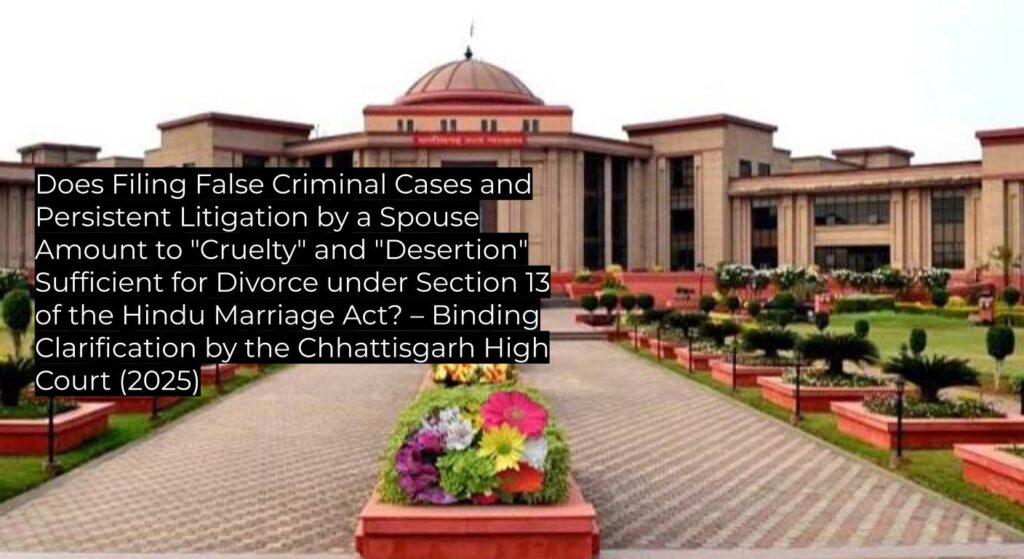
The Chhattisgarh High Court holds that repeated false criminal complaints and sustained refusal to resume matrimonial cohabitation, without reasonable cause, constitute “cruelty” and “desertion” under Section 13(1)(i-a) of the Hindu Marriage Act, warranting divorce. This judgment follows and applies Supreme Court precedents, and serves as binding authority for subordinate courts on similar facts.
Summary
| Category | Data |
|---|---|
| Case Name | FAM/40/2018 of GUHA SINGH Vs SMT. KIRAN JANGDE |
| CNR | CGHC010059492018 |
| Date of Registration | 22-02-2018 |
| Decision Date | 03-09-2025 |
| Disposal Nature | ALLOWED |
| Judgment Author | Hon’ble Smt. Justice Rajani Dubey |
| Concurring or Dissenting Judges | Hon’ble Shri Justice Amitendra Kishore Prasad (concurring) |
| Court | High Court of Chhattisgarh, Bilaspur |
| Bench | Division Bench (Justice Rajani Dubey and Justice Amitendra Kishore Prasad) |
| Precedent Value | Binding for subordinate courts in Chhattisgarh; persuasive elsewhere |
| Overrules / Affirms | Sets aside Family Court’s dismissal; follows Supreme Court precedents |
| Type of Law | Hindu matrimonial law, especially dissolution of marriage under Hindu Marriage Act |
| Questions of Law | Whether persistent false criminal complaints and withdrawal from matrimonial cohabitation constitute “cruelty” and “desertion” sufficient for divorce under Section 13 of the Hindu Marriage Act, 1955. |
| Ratio Decidendi | The court held that the wife’s conduct of persistently filing false criminal complaints, including under Section 498-A IPC and Domestic Violence Act—where the husband and family were acquitted and complaints dismissed—constitutes “cruelty” under Section 13(1)(ia) of the Hindu Marriage Act. Further, the wife’s continuous separation since 2011, despite repeated bona fide efforts by the husband for reconciliation (including social meetings and legal proceedings), established “desertion” within the statutory meaning. The court clarified that acquittal in criminal cases, delayed complaint, and failure of the wife to show reasonable cause for her refusal to return all coalesce to meet conditions for mental cruelty and animus deserendi. Relying on Supreme Court precedents (K. Srinivas Rao, Dr. Nirmal Singh Panesar, Debananda Tamuli), the bench reaffirmed that such conduct suffices for divorce on grounds of cruelty and desertion. Permanent alimony of Rs. 15,00,000 was directed. |
| Judgments Relied Upon |
|
| Logic / Jurisprudence / Authorities Relied Upon by the Court | Cited and relied upon Supreme Court authorities defining “cruelty” and “desertion”, explained that deliberate false litigation and refusal to cohabit without reasonable cause are established grounds for divorce; discussed legal definition and elements of desertion, including “factum of separation” and “animus deserendi” per Supreme Court. |
| Facts as Summarised by the Court | Marriage solemnized on 11.02.2010; daughter born. Wife left matrimonial home in 2011 and refused to return despite efforts (social meetings, applications under Cr.P.C.), and filed criminal and domestic violence complaints, leading to husband’s acquittal. Wife received maintenance, but did not substantiate allegations of cruelty. |
| Citations |
|
Practical Impact
| Category | Impact |
|---|---|
| Binding On | All subordinate courts in Chhattisgarh; binding as precedent under Article 227 of the Constitution. |
| Persuasive For | Other High Courts and as persuasive reasoning in matrimonial disputes involving false criminal complaints/cruelty/desertion. |
| Follows |
|
What’s New / What Lawyers Should Note
- Reaffirms that acquittal in 498-A IPC and domestic violence cases, when accompanied by persistent false complaints and refusal to resume cohabitation without reasonable justification, amounts to “mental cruelty” under Section 13(1)(ia) HMA.
- Failure of a spouse to prove reasonable cause for living separately, despite repeated bona fide reconciliation efforts by the other spouse, constitutes “desertion” under Section 13(1)(i-b).
- The fact that criminal cases ended in acquittal and complaints were dismissed is critical evidence supporting allegations of cruelty and desertion.
- The Chhattisgarh High Court explicitly applies and follows Supreme Court precedents, making its ruling binding within the State and strongly persuasive elsewhere.
- Lawyers may cite this judgment to support divorce petitions based on similar fact patterns, especially where respondents have initiated unsubstantiated criminal proceedings or deserted without valid cause.
- Permanent alimony can be awarded in addition to maintenance previously granted under Section 125 Cr.P.C., guided by Supreme Court reasoning.
Summary of Legal Reasoning
- The court reviewed the factual matrix, highlighting that the wife left the matrimonial home in 2011 and did not return despite multiple efforts by the husband (social meetings, applications under Sections 97 and 98 Cr.P.C.).
- Noted that the wife initiated multiple criminal complaints, including 498-A IPC and Domestic Violence cases; all resulted in acquittal/dismissal.
- Relied on K. Srinivas Rao v. D.A. Deepa (2013) 5 SCC 226 to hold that persistently filing false/unsubstantiated criminal complaints and failing to prove cruelty inflicts “mental cruelty” on the other spouse.
- Quoted Bipinchandra Jaisinghbhai Shah v. Prabhavati (AIR 1957 SC 176) and Dr. Nirmal Singh Panesar v. Paramjit Kaur Panesar @ Ajinder Kaur (2025) 3 SCC 790 to explain that “desertion” requires both separation and intention to remain apart (animus deserendi) with no reasonable justification.
- Found that both “cruelty” and “desertion” were established by the evidence (factum of separation, failed reconciliation, conduct of the parties, and absence of reasonable cause).
- The Family Court’s contrary finding was held perverse and unsupported by the evidence.
- Followed Supreme Court guidelines on permanent alimony by awarding Rs. 15,00,000.
Arguments by the Parties
Petitioner (Applicant-Husband)
- The wife lived separately since 2011 without reasonable cause and refused reconciliation attempts.
- The wife filed repeated false criminal cases including under Section 498-A IPC, all of which ended in acquittal.
- The wife’s conduct, including abusive behavior and violence, constituted cruelty and led to irretrievable breakdown of marriage.
- The wife assaulted the husband in court premises, further evidencing cruelty.
Respondent (Non-Applicant-Wife)
- The husband and his family demanded dowry and harassed her, including after birth of a female child.
- She was compelled to leave matrimonial home due to ill-treatment.
- Denied allegations of refusing reconciliation; alleged it was the husband who did not take her back.
- Claimed the husband and his family ousted her and did not permit her return despite assurances and social meetings.
Factual Background
The marriage between the parties was solemnized in February 2010, and a daughter was born from the wedlock. In 2011, the wife left the matrimonial home, asserting harassment and dowry demands, while the husband claimed she did so without justifiable cause. The husband made several efforts to reconcile, including convening social meetings and filing applications under Sections 97 and 98 Cr.P.C., but the wife did not return. The wife initiated criminal and domestic violence complaints against the husband and his family, all of which resulted in acquittal. Meanwhile, the husband paid the wife maintenance as ordered in separate proceedings.
Statutory Analysis
- Section 13(1)(ia) of the Hindu Marriage Act, 1955 (“cruelty”): The court interpreted “mental cruelty” to include persistent filing of unsubstantiated criminal complaints by one spouse, following K. Srinivas Rao (2013) and relevant Supreme Court directions.
- Section 13(1)(i-b) (“desertion”): The statutory requirements—factum of separation, animus deserendi, absence of consent, and no reasonable cause—are analyzed based on Supreme Court pronouncements and found to be satisfied.
- Explanation to Section 13(1): Court referred to the statutory explanation of “desertion” including wilful neglect.
Dissenting / Concurring Opinion Summary
No dissenting opinion; both judges concurred in the judgment and reasoning.
Procedural Innovations
- Allowed fresh additional evidence (judgment of acquittal in criminal case) at appellate stage under Order 41 Rule 27 CPC, recognizing necessity for proper adjudication in light of delayed availability of crucial criminal judgment.
Alert Indicators
- ✔ Precedent Followed – The bench followed and applied existing Supreme Court precedent on the interpretation of “cruelty” and “desertion” in matrimonial disputes.
Citations
- 2025:CGHC:44824-DB (Neutral Citation)
- K. Srinivas Rao v. D.A. Deepa (2013) 5 SCC 226
- Dr. Nirmal Singh Panesar v. Paramjit Kaur Panesar @ Ajinder Kaur (2025) 3 SCC 790
- Debananda Tamuli v. Kakumoni Kataky (2022) 5 SCC 459
- Bipinchandra Jaisinghbhai Shah v. Prabhavati, AIR 1957 SC 176