


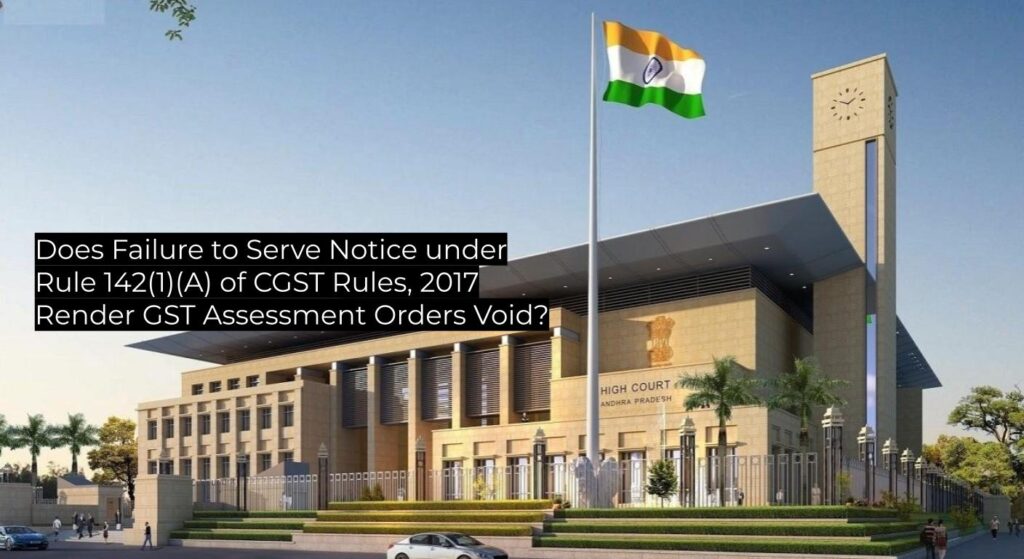
The Andhra Pradesh High Court reiterates and applies its prior holding that omission of notice under Rule 142(1)(A) vitiates assessment under GST laws. The decision firmly upholds earlier precedent and operates as binding authority within its jurisdiction, with direct impact on GST assessment proceedings.
Summary
| Category | Data |
|---|---|
| Case Name | WP/21950/2025 of SHRI VAARI ELECTRICALS PRIVATE LIMITED Vs THE ADDITIONAL COMMISSIONER |
| CNR | APHC010422362025 |
| Date of Registration | 18-08-2025 |
| Decision Date | 02-09-2025 |
| Disposal Nature | ALLOWED NO COSTS |
| Judgment Author | R. RAGHUNANDAN RAO, J (for the Bench) |
| Concurring or Dissenting Judges | T.C.D. SEKHAR, J (concurring) |
| Court | High Court of Andhra Pradesh |
| Bench | R. RAGHUNANDAN RAO, J and T.C.D. SEKHAR, J |
| Precedent Value | Binding within the jurisdiction of Andhra Pradesh High Court |
| Overrules / Affirms | Affirms prior Division Bench judgment in New Morning Star Travels v. Deputy Commissioner (ST) (2023) 12 Centax 198 (A.P) |
| Type of Law | GST/Taxation/Administrative Law |
| Questions of Law | Whether assessment orders under Section 74 of the APGST Act, 2017 are valid when made without prior notice under Rule 142(1)(A) of CGST Rules, 2017. |
| Ratio Decidendi |
An assessment order passed without serving prior notice in Form GST DRC-01 under Rule 142(1)(A) of the CGST Rules, 2017 is invalid. The mandatory nature of the notice is a precondition to a lawful assessment. The matter must be remanded for fresh assessment in accordance with law, following the prescribed procedure. The period between the impugned order and receipt of the remand order is to be excluded for computing limitation. |
| Judgments Relied Upon | New Morning Star Travels v. Deputy Commissioner (ST) (2023) 12 Centax 198 (A.P) |
| Logic / Jurisprudence / Authorities Relied Upon by the Court | Statutory requirement of notice under Rule 142(1)(A); adherence to principles of natural justice. |
| Facts as Summarised by the Court |
Petitioner challenged assessment orders for FY 2019-20 to 2021-22; contended non-issuance of mandatory notice under Rule 142(1)(A). The State did not dispute the omission. |
Practical Impact
| Category | Impact |
|---|---|
| Binding On | All subordinate courts and authorities within Andhra Pradesh |
| Persuasive For | Other High Courts, particularly on procedural compliance in GST assessment |
| Follows | New Morning Star Travels v. Deputy Commissioner (ST) (2023) 12 Centax 198 (A.P) |
What’s New / What Lawyers Should Note
- The decision reiterates that serving notice under Rule 142(1)(A) of CGST Rules, 2017 before passing an assessment order is mandatory.
- Authorities cannot proceed to levy tax, interest, or penalty under Section 74 of the APGST Act, 2017 unless notice is first served.
- Omission to serve such notice renders the assessment order void and susceptible to being set aside on judicial review.
- The prescribed procedure must be strictly followed irrespective of the merits of the underlying tax demand.
- The limitation period for completing reassessment is paused from the date of the invalid order until the date of the remand order’s receipt.
Summary of Legal Reasoning
- The petitioner challenged the assessment order on grounds of absence of notice under Rule 142(1)(A), which was not disputed by the authorities.
- The Court relied squarely on its earlier Division Bench decision in New Morning Star Travels, which held that such oversight invalidates the resulting order.
- The Court reaffirmed that the statutory requirement of serving a show cause notice in Form GST DRC-01 is foundational to the process under GST law and forms part of the principles of natural justice.
- Without compliance with Rule 142(1)(A), any adjudication is arbitrary and must be quashed.
- The matter is to be remanded for fresh assessment, with the exclusion of the limitation period corresponding to the pendency of the impugned order.
Arguments by the Parties
Petitioner:
- The assessment proceedings were initiated without issuing the mandatory notice under Rule 142(1)(A) of the CGST Rules, 2017.
- The failure to provide such notice constitutes a violation of statutory procedure and principles of natural justice.
- Sought setting aside of the assessment and all consequential actions, including bank attachment.
Respondent:
- The omission of notice under Rule 142(1)(A) was not disputed.
Factual Background
The petitioner, a private limited company, challenged assessment orders passed for the financial years 2019-20 to 2021-22 by GST authorities. The impugned assessment order was issued without serving prior notice under Rule 142(1)(A) of the CGST Rules, 2017. The petitioner contended this omission was fatal to the order. Related appellate proceedings and subsequent garnishee (bank attachment) orders were also the subject of challenge.
Statutory Analysis
The Court focused on Rule 142(1)(A) of the CGST Rules, 2017, which mandates issuance of a show cause notice in Form GST DRC-01 before final assessment under Section 74 of the APGST Act, 2017. The Court endorsed a narrow, mandatory reading: the requirement is foundational and omission is not a curable defect. The assessment process cannot proceed without compliance.
Dissenting / Concurring Opinion Summary
No dissenting or separate concurring opinions were recorded; both judges concurred in granting relief and following the binding precedent.
Alert Indicators
- ✔ Precedent Followed – The Court explicitly follows and applies existing binding precedent from within its own jurisdiction.
Citations
- New Morning Star Travels v. Deputy Commissioner (ST) (2023) 12 Centax 198 (A.P)