


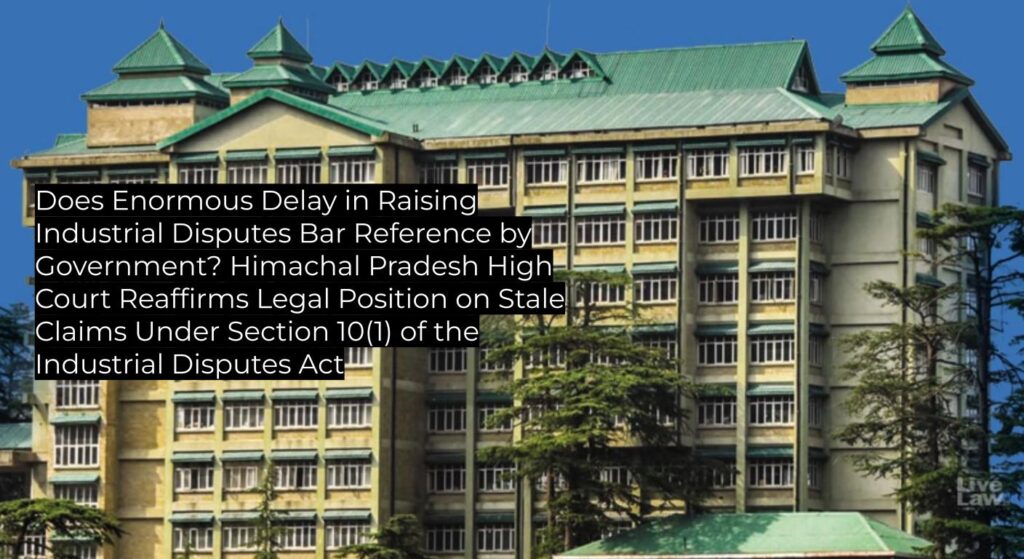
The Himachal Pradesh High Court has upheld the State’s discretion to refuse reference of industrial disputes that are stale or raised after inordinate delay, affirming binding Full Bench and Supreme Court precedents. This judgment clarifies the law for all similar future disputes, reaffirming that unexplained delay and acquiescence by workmen can defeat their claim to reference under Section 10(1) of the Industrial Disputes Act, 1947.
Summary
| Category | Data |
|---|---|
| Case Name | LPA/564/2025 of JAGDISH KUMAR Vs STATE OF HP AND ORS |
| CNR | HPHC010426172025 |
| Date of Registration | 20-08-2025 |
| Decision Date | 02-09-2025 |
| Disposal Nature | Disposed Off |
| Judgment Author | HON’BLE THE CHIEF JUSTICE GURMEET SINGH SANDHAWALIA (oral judgment), with HON’BLE MR. JUSTICE RANJAN SHARMA, Judge |
| Court | High Court of Himachal Pradesh |
| Bench | HON’BLE THE CHIEF JUSTICE G.S. SANDHAWALIA, HON’BLE MR. JUSTICE RANJAN SHARMA |
| Precedent Value | Binding authority within Himachal Pradesh High Court and all subordinate courts in the State |
| Overrules / Affirms | Affirms Full Bench judgment in Liaq Ram (2011) and subsequent Full Bench and Supreme Court precedents |
| Type of Law | Labour & Industrial Law — Industrial Disputes Act, Section 10(1), Delay and Laches, Government’s discretion for reference |
| Questions of Law | Whether a stale or belated industrial dispute, raised after long acquiescence and regularization, mandates reference by the Government under Section 10(1) of the Industrial Disputes Act, 1947. |
| Ratio Decidendi | The Court held that the Government is not a post office and must apply its mind before making a reference; an unexplained and inordinate delay or acquiescence by workmen may justifiably dissuade the Government from making a reference. The right to raise an industrial dispute must be exercised within a reasonable time. Stale, non-existent or dead disputes cannot be referred. The fact that the employees accepted regularization and did not raise the issue for several years constitutes acquiescence and bars later claims for reference based on old grievances. The law as settled by Supreme Court and Full Bench of the High Court remains binding. |
| Judgments Relied Upon |
|
| Logic / Jurisprudence / Authorities Relied Upon by the Court | The principle that Government’s discretion under Section 10(1) of the Industrial Disputes Act requires active application of mind, particularly when claims are stale or suffer from laches or acquiescence; repeated reliance on Supreme Court’s age-old bar against reference of frivolous, stale, or settled disputes; affirmation of Full Bench judgments establishing that delay may defeat the right to seek reference. |
| Facts as Summarised by the Court | Appellants were initially engaged as Beldars in 1999, regularized in service in 2013 after working for over a decade, and later sought reference in 2021 regarding artificial breaks given from 1998–2005. No complaints were made at the time of breaks or regularization. The delay in making the demand notice was 16 years after the cause of action and 8 years after regularization. The Government declined reference; Single Judge dismissed the writ petitions; appeals were filed. |
Practical Impact
| Category | Impact |
|---|---|
| Binding On | All subordinate courts and Labour Courts/Industrial Tribunals within Himachal Pradesh jurisdiction |
| Persuasive For | Other High Courts and Labour Courts across India |
| Follows |
|
What’s New / What Lawyers Should Note
- Reaffirms that Government is not a “post office”; reference under Section 10(1) of the Industrial Disputes Act is not automatic, especially when claims are stale, belated, or involve acquiescence.
- Emphasizes that delay and laches defeat the right to seek reference & relief, even if similar claims were decided differently for others in prior years.
- Lawyers must advise clients that acceptance of regularization and long inaction may operate as acquiescence and bar subsequent industrial claims.
- Provides clear procedural guidance: stale claims, raised after regularization and years of inactivity without explanation, will not succeed in compelling Government to make a reference.
- Offers robust precedent to counter late claims for regularization or seniority based on old grievances.
Summary of Legal Reasoning
- The Court examined the facts: the workmen had not challenged fictional breaks from 1998–2005 until 2021, despite having been regularized in 2013.
- Relied upon the Full Bench in Liaq Ram and subsequent decisions (including Jai Singh), establishing that Government’s discretion under Section 10(1) is not a mere formality. Reference can be denied for stale or non-existent disputes.
- Repeated reliance was placed on Supreme Court authority, including Bombay Union of Journalists (AIR 1964 SC 1617), holding that Government may refuse to refer patently frivolous or clearly belated claims.
- The Court found that, per Supreme Court cases (Nedungadi Bank Ltd.; Sudamdih Colliery; Raghubir Singh; Ravi Kumar), delay/acquiescence justifies refusal to refer and bars revived claims.
- The Court distinguished the present facts from Tarlesh Bali (2010) and held that, unlike in that case, the workmen here neither protested at the time of the breaks nor at regularization, and thus acquiesced.
- Ultimately, the Court reaffirmed the principle that only subsisting, live disputes may be referred for adjudication; claims that have faded away with time are barred.
Arguments by the Parties
Petitioners (Appellants):
- Cited Tarlesh Bali to argue that artificial/fictional breaks previously were condoned for purposes of seniority.
- Asserted they were similarly situated and deserved the same benefit.
- Challenged the State’s refusal to refer the dispute, arguing for parity and condonation of delay in light of precedent.
Respondents (State):
- Argued that demand was raised after 16 years and 8 years post-regularization, with no explanation for the delay.
- Emphasized that the claim had become stale and petitioners had acquiesced by accepting regularization.
- Relied on established legal principle that Government could refuse to refer claims that were non-existent or dead.
Factual Background
The appellants were initially engaged as Beldars in 1999 in the I&PH Department, Himachal Pradesh. Alleged artificial/fictional breaks in service occurred between 1998 and 2005. Despite these breaks, the workmen were regularized as employees on 03.10.2013. No protest was lodged at the time of breaks or regularization. Only in 2021, almost 16 years after the cause of action and 8 years post-regularization, did the appellants raise a demand for reference regarding these breaks. The Government refused to refer the dispute citing staleness and acquiescence. The appellants challenged this refusal in writ petitions, which were dismissed, resulting in the present appeals.
Statutory Analysis
- The core provision considered was Section 10(1) of the Industrial Disputes Act, 1947, which vests discretion in the ‘appropriate Government’ to refer “any industrial dispute, which exists or is apprehended,” for adjudication “at any time.”
- The Court interpreted “at any time” as subject to the live existence of the dispute; Government must consider whether the dispute is current or has become stale, dead, or non-existent.
- The judgment reaffirms that the statutory power to refer is not mechanical and is circumscribed by judicially recognized principles of delay, laches, and acquiescence.
- No constitutional provisions were cited or analyzed.
Dissenting / Concurring Opinion Summary
No separate dissenting or concurring opinions are recorded in the judgment.
Procedural Innovations
None noted; the Court followed established procedure for Letters Patent Appeals in industrial disputes.
Alert Indicators
- Precedent Followed
Citations
- Liaq Ram v. State of H.P. & others, Full Bench, CWP No.1486 of 2007, decided 06.01.2011
- Jai Singh v. State of H.P. & others, 2022 SCC OnLine HP 1020 (Full Bench)
- Bombay Union of Journalists v. State of Bombay, AIR 1964 SC 1617
- Bichitrananda Behera v. State of Orissa, 2023 SCC OnLine SC 1307
- Marinmoy Maity v. Chanda Koley, AIR 2024 SC 2717
- Raghubir Singh v. GM, Haryana Roadways, (2014) 10 SCC 301
- Workmen v. I.I.T.I. Cycles of India Ltd., 1995 Supp (2) SCC 733
- Ajaib Singh v. Sirhind Cooperative-Marketing-cum-Processing Service Society, (1999) 6 SCC 82
- S.M. Nilajkar v. Telecom District Manager, Karnataka, (2003) 4 SCC 27
- State of Karnataka v. Ravi Kumar, (2009) 13 SCC 746
- Nedungadi Bank Ltd. v. K.P. Madhavankutty, (2000) 2 SCC 455
- Sudamdih Colliery of Bharat Coking Coal Ltd. v. Workmen, (2006) 2 SCC 329