


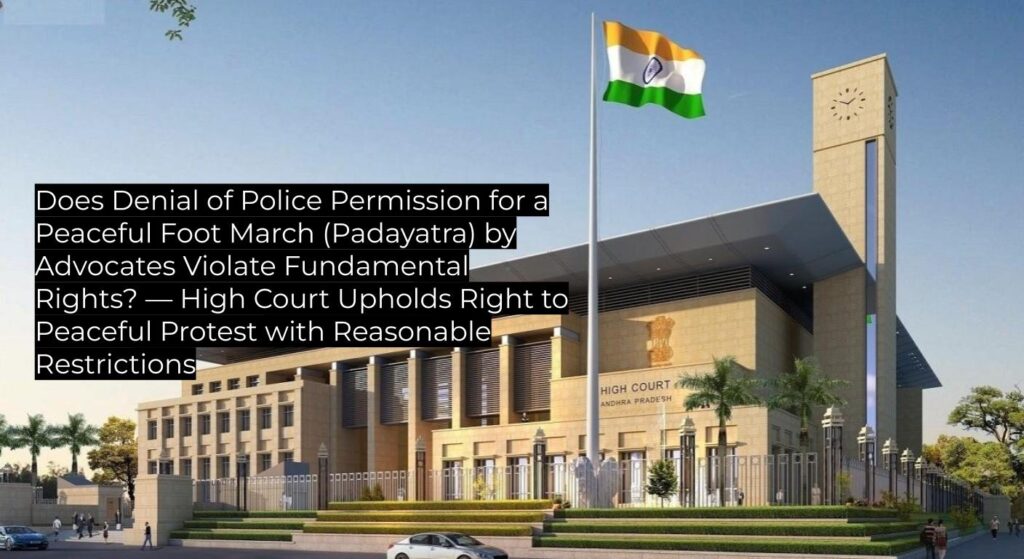
The High Court clarified that police inaction or blanket denial of permission for a peaceful advocates’ padayatra, without reasonable justification, infringes Articles 14, 19, and 21 of the Constitution. The Court permitted the march with safeguards and affirmed the right to peaceful protest. This precedent upholds existing law on freedom of assembly and protest, with operational guidelines for future cases involving peaceful demonstrations by professional groups.
Summary
| Category | Data |
|---|---|
| Case Name |
WP/28131/2025 of L KRISHNA PRASAD Vs THE STATE OF AP CNR APHC010539682025 |
| Date of Registration | 10-10-2025 |
| Decision Date | 15-10-2025 |
| Disposal Nature | DISPOSED OF NO COSTS |
| Judgment Author | Dr. Justice Venkata Jyothirmai Pratapa |
| Court | High Court of Andhra Pradesh |
| Precedent Value |
|
| Type of Law |
|
| Questions of Law | Whether police inaction or refusal to permit peaceful foot march for advocates violates fundamental rights under Articles 14, 19, and 21. |
| Ratio Decidendi | The Court held that the right to peaceful protest, including padayatras by advocates for a public cause, is protected under Articles 14, 19, and 21 of the Constitution. Blanket denial of permission without due consideration is not permissible. Reasonable restrictions, including providing participant details and ensuring no disruption of public order, are valid. The Court directed the police to facilitate the march with proper precautions, thereby balancing fundamental rights and public order. |
| Facts as Summarised by the Court | Petitioners, comprising an individual advocate and the Andhra Lawyers Association, sought permission to conduct a padayatra from Dhone to Amaravati in support of passing a bill for the protection of advocates. The police, via communication dated 09.05.2025, did not grant permission or consider the request. The petitioners approached the High Court for the safeguarding of their constitutional rights. |
Practical Impact
| Category | Impact |
|---|---|
| Binding On | All subordinate courts in Andhra Pradesh |
| Persuasive For | Other High Courts, potentially the Supreme Court and professional associations |
What’s New / What Lawyers Should Note
- High Court clarified that refusal or inaction by police in permitting peaceful professional protests (such as advocates’ padayatra) can be unconstitutional.
- Lays down operational protocol: Marches must furnish identity details of participants and cooperate with police-imposed safeguards such as videography and non-disruption of public order.
- Petitioners’ right to protest upheld alongside mechanisms for maintaining law and order.
- Lawyers representing professional associations can cite this order when seeking permission for peaceful protest marches that are denied or ignored by authorities.
Summary of Legal Reasoning
- The Court noted the petitioners’ right to peaceful protest, rooted in Articles 14, 19, and 21 of the Constitution, especially when such protest serves a public or professional cause.
- Observed that the police response in rejecting or failing to act on the permission request, without due consideration, was arbitrary and contrary to law.
- The Court struck a balance: permitted the padayatra subject to reasonable restrictions—namely, participant information to police, non-disruption to public, videography, and compliance with law and order.
- Directed the police to facilitate the event and to take lawful action only if untoward incidents occur.
- No costs were imposed; all pending miscellaneous petitions were closed.
Arguments by the Parties
Petitioner
- Sought permission for a foot march to press for the passage of an advocates’ protection bill.
- Contended that denial or inaction by police violated their fundamental rights under Articles 14, 19, and 21.
- Submitted that the padayatra was peaceful and conducted for a rightful professional cause.
Respondent (State / Police)
- No detailed arguments of the respondents are recorded in the judgment.
Factual Background
The petitioners, one being a practicing advocate and the other an advocates’ association via its general secretary, proposed to undertake a nearly 20-person foot march (padayatra) from Dhone to Amaravati. The stated purpose was to press for the passage of a bill for the protection of advocates. Their request for permission, communicated to the police on 09.05.2025, was not considered. Aggrieved by this inaction, the petitioners filed a writ petition under Article 226 before the Andhra Pradesh High Court.
Statutory Analysis
- The judgment centers on interpretation and application of Articles 14, 19, and 21 of the Constitution, relating to equality, freedom of speech and assembly, and the right to life and personal liberty.
- The Court reaffirmed that these rights empower citizens to peaceful assembly and protest, subject to reasonable restrictions for law and order.
- There is no detailed exegesis of particular statutes; the Court’s directions flow primarily from constitutional principles.
Procedural Innovations
- The order operationalizes constitutional rights by requiring advance submission of participant details and authorizing videography of the protest.
- Mandates police to facilitate peaceful conduct and prescribes steps for dealing with untoward incidents.
- Directs closure of miscellaneous petitions pending in the matter.
Alert Indicators
- ✔ Precedent Followed – Existing law on the right to peaceful protest and assembly affirmed, subject to reasonable restrictions.