


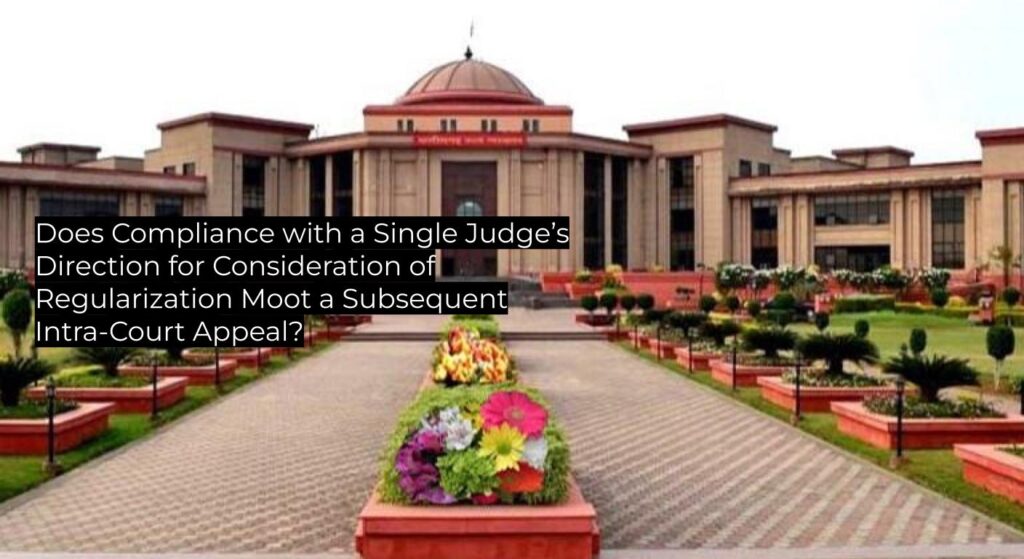
Where an authority complies with the High Court’s directive to consider an employee’s claim, and issues a speaking order, the subsequent intra-court appeal cannot be pursued on the merits of the original writ petition. The judgment upholds established principles, notes the appellant’s liberty to pursue remedies against the new order, and carries binding value for Chhattisgarh courts.
Summary
| Category | Data |
|---|---|
| Case Name | WA/710/2025 of Dr ANIL KUMAR TRIPATHI Vs State Of Chhattisgarh |
| CNR | CGHC010421982025 |
| Date of Registration | 24-09-2025 |
| Decision Date | 30-10-2025 |
| Disposal Nature | DISMISSED |
| Judgment Author | Hon’ble Shri Ramesh Sinha, Chief Justice |
| Concurring or Dissenting Judges | Hon’ble Shri Bibhu Datta Guru (concurring) |
| Court | High Court of Chhattisgarh |
| Bench | Division Bench: Hon’ble Shri Ramesh Sinha, Chief Justice, and Hon’ble Shri Bibhu Datta Guru, Judge |
| Precedent Value | Binding on subordinate courts in Chhattisgarh |
| Overrules / Affirms | Affirms existing procedural law regarding consequences of compliance with court’s directions |
| Type of Law | Service Law; Administrative Law |
| Questions of Law | Whether an intra-court appeal survives once the authority complies with the court’s earlier direction and issues a fresh speaking order on the same issue. |
| Ratio Decidendi | The Division Bench clarified that where the State Government has acted in compliance with the Single Judge’s directions—by considering and passing a speaking order on the appellant’s regularization claim—the intra-court appeal against the earlier order becomes infructuous. The appellant retains liberty to challenge the new order, but not within the disposed appeal. The Court affirmed that further remedies should be sought as appropriate under the law, post-compliance. |
| Facts as Summarised by the Court | The appellant’s claim for regularization was earlier directed to be considered by the Single Judge. The Government subsequently issued a reasoned (speaking) rejection order. The appellant produced this rejection order before the Division Bench during the appeal. |
Practical Impact
| Category | Impact |
|---|---|
| Binding On | All subordinate courts in Chhattisgarh |
| Persuasive For | Other High Courts considering similar procedural circumstances |
| Follows | Established principles regarding the effect of compliance with court orders |
What’s New / What Lawyers Should Note
- Clarifies that when administrative authorities comply with the court’s directive (here, by passing a speaking order), the pending appeal on the original cause becomes infructuous.
- Reinforces the necessity for litigants to challenge the new (speaking) order through proper legal remedies rather than continuing with the inert appeal.
- Confirms that courts will not entertain appeals where the impugned order has already been fully complied with and new cause of action arises instead.
Summary of Legal Reasoning
- The Court noted the specific sequence: the Single Judge directed the State to consider the regularization claim; the State passed a speaking order rejecting it.
- The appellant produced the rejection order before the Division Bench.
- The Court concluded that the writ appeal challenging the prior order did not survive after compliance.
- The Court expressly granted liberty to the appellant to pursue any remedy available against the fresh rejection order under law.
Arguments by the Parties
Petitioner
- Submitted that, pursuant to the Single Judge’s order, the State Government had already considered and disposed of his regularization claim by a speaking order dated 13.10.2025.
Respondent
- No specific adversarial submissions are recorded in the judgment; representation made by Government Advocate.
Factual Background
The appellant, a doctor working under the State Government in the Ayurveda department, sought regularization of his services. The Single Judge directed the State to “consider” his claim. The State issued a speaking order declining regularization. The appellant, appearing in person, produced this order in the intra-court appeal challenging the original Single Judge decision.
Statutory Analysis
The judgment refers to the procedural aspect of compliance with court directions in service matters. The court did not engage with statutory interpretation but noted compliance with the judicial directive and the effect this has on pending litigation.
Dissenting / Concurring Opinion Summary
No dissenting or separate concurring opinion provided. Both judges concurred.
Procedural Innovations
- The Court formally recorded production of the subsequent speaking order as part of the record and determined the continuation of the appeal based on compliance with earlier judicial directions.
Alert Indicators
- ✔ Precedent Followed – The judgment affirms and applies settled principles regarding the effect of compliance with judicial directions in administrative/service matters.