


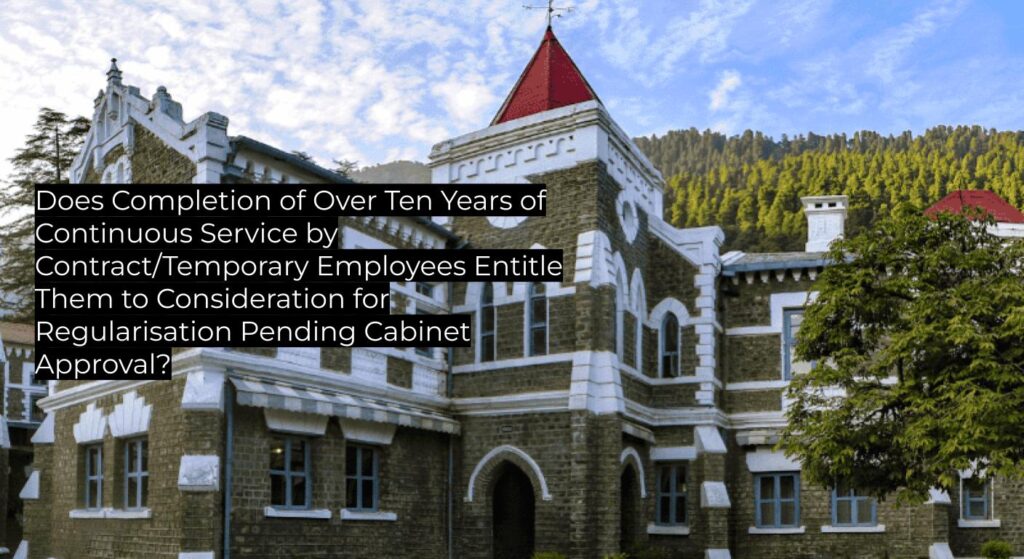
The Uttarakhand High Court reiterated that contract employees with over a decade of continuous service on sanctioned posts must have their claims for regularisation examined in accordance with prevailing rules, directing the competent authority to decide such representation within a set timeframe. The Court did not overrule any precedent but aligned with prior Division Bench views, maintaining the current legal position pending governmental policy decisions and serving as binding authority within the jurisdiction.
Summary
| Category | Data |
|---|---|
| Case Name |
WPSS/1152/2025 of NARESH KUMAR Vs STATE OF UTTARAKHAND CNR UKHC010103432025 |
| Date of Registration | 08-07-2025 |
| Decision Date | 28-10-2025 |
| Disposal Nature | DISPOSED |
| Judgment Author | HON’BLE MR. JUSTICE MANOJ KUMAR TIWARI |
| Court | High Court of Uttarakhand |
| Bench | Single Judge Bench |
| Precedent Value | Binding within the jurisdiction of the Uttarakhand High Court for similar factual situations |
| Overrules / Affirms | Affirms prior Division Bench judgment in Writ Petition (S/B) No. 616 of 2018 |
| Type of Law | Service Law — Regularisation of Contract Employees |
| Questions of Law | Whether contract employees serving on sanctioned posts for over a decade are entitled to have their regularisation claims considered under prevailing rules, even as government policy awaits Cabinet decision. |
| Ratio Decidendi | The Court held that where contract employees claim to have served continuously for over a decade on sanctioned Group ‘C’ posts, their claims for regularisation must be examined by the competent authority in accordance with applicable regularisation rules. The pendency of a Cabinet decision on policy-related cut-off dates does not absolve the authority from considering the representation within a reasonable period as per law. The direction ensures that eligible employees are given fair consideration within an explicit timeframe. The Court expressly relied on its earlier Division Bench decision for this conclusion. |
| Judgments Relied Upon | Division Bench Judgment in Writ Petition (S/B) No. 616 of 2018 |
| Logic / Jurisprudence / Authorities Relied Upon by the Court | Reference to previous Uttarakhand High Court Division Bench orders establishing eligibility for regularisation based on tenure and sanctioned status. |
| Facts as Summarised by the Court | The petitioners were engaged on contract against sanctioned Group ‘C’ posts in the O/o Director, Rehabilitation/District Magistrate, Tehri Garhwal, and have served continuously for over a decade. Reliefs sought included directions for regularisation in accordance with an earlier judgment and for consideration of their representations. The State submitted that Cabinet was considering the matter of policy cut-off date for regularisation eligibility. |
Practical Impact
| Category | Impact |
|---|---|
| Binding On | All subordinate courts and authorities in Uttarakhand |
| Persuasive For | Other High Courts considering similar fact situations |
| Follows | Division Bench Judgment in Writ Petition (S/B) No. 616 of 2018 |
What’s New / What Lawyers Should Note
- The judgment directs the competent authority to consider claims for regularisation by contract employees with over ten years of continuous service on sanctioned posts, irrespective of pending policy decisions, within a specific four-month timeframe.
- Lawyers should note that pendency before the State Cabinet regarding eligibility cut-off dates does not preclude timely, rule-based consideration of regularisation claims.
- Explicit reliance on the Division Bench’s earlier order ensures continuity and predictability in the law concerning regularisation, reinforcing the procedural pathway for similarly situated employees.
Summary of Legal Reasoning
- The Court considered the petitioners’ long-term contractual service on sanctioned Group ‘C’ posts and their reliance on a prior Division Bench ruling supporting eligibility for regularisation.
- The learned Counsel for the petitioners referred to Writ Petition (S/B) No. 616 of 2018, asserting eligibility according to precedent.
- The State acknowledged the issue but cited pendency before the State Cabinet concerning finalisation of the eligibility cut-off date for regularisation.
- The Court reasoned that despite policy-level deliberations, petitioners’ claims must be examined by the competent authority in accordance with extant regularisation rules.
- The matter was disposed of with a direction to the Director, Rehabilitation/District Magistrate, Tehri Garhwal, to examine the claims and pass appropriate orders in four months, with reference to regularisation rules and past judicial guidance.
- The judgment neither overruled nor departed from existing precedent, but reinforced the legal framework established earlier by the Division Bench.
Arguments by the Parties
Petitioner
- Claimed to have served continuously for more than a decade on contract against sanctioned Group ‘C’ posts.
- Sought writ of mandamus for regularisation as per the High Court’s previous judgment dated 22.02.2024.
- Requested direction for prompt decision on representation dated 05.02.2024.
Respondent/State
- Contended that the issue of regularisation and determination of eligibility cut-off date was pending before the State Cabinet.
- Stated the petitioners’ claim would be considered after the Cabinet’s decision.
Factual Background
The petitioners, engaged as contractual employees against sanctioned Group ‘C’ posts in the O/o Director, Rehabilitation/District Magistrate, Tehri Garhwal, have been serving continuously for over ten years. They approached the Court seeking regularisation of their services in line with a previous judgment and for consideration of their representation. The State cited pendency of Cabinet-level decisions regarding the eligibility cut-off date for regularisation of contractual employees.
Statutory Analysis
- The judgment directed application of the prevailing regularisation rules to assess eligibility of contract employees for regularisation.
- No specific statutes or statutory sections were cited or interpreted in detail; the Court referred to the regularisation rules and requirement for timely administrative determination.
- The Court reinforced that administrative authorities must proceed under existing legal frameworks, even while broader policy is under government consideration.
Dissenting / Concurring Opinion Summary
No dissenting or concurring opinions were expressed in the judgment.
Procedural Innovations
No new procedural innovations were noted in the judgment.
Alert Indicators
- ✔ Precedent Followed – The judgment affirms and applies existing law as laid down by a prior Division Bench decision of the Uttarakhand High Court.