


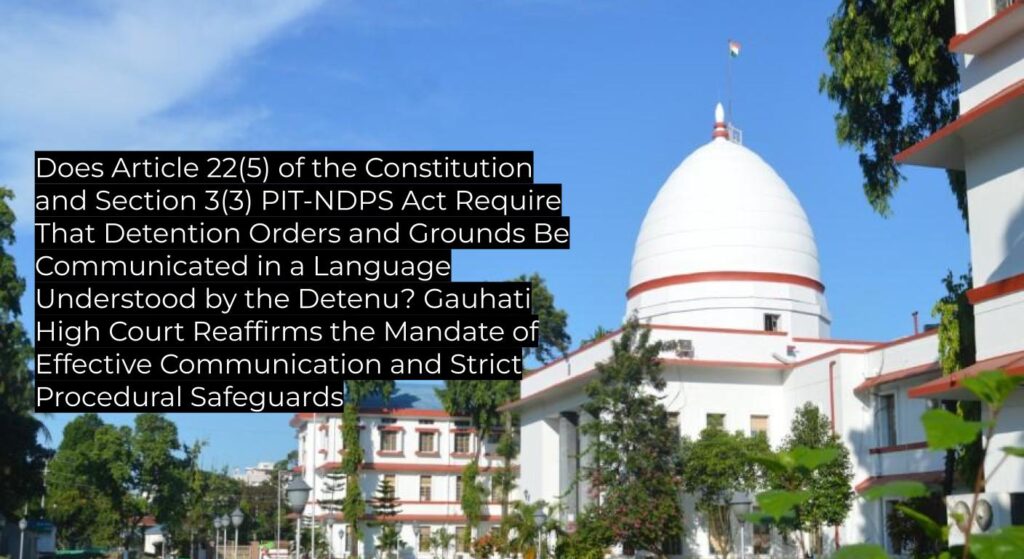
The Gauhati High Court decisively reaffirmed that detention orders, grounds, and supporting documents under the PIT-NDPS Act must be supplied to the detenu in a language understood by them, clarifying that oral explanation alone does not suffice. This judgment upholds existing Supreme Court precedent, emphasizing strict compliance with constitutional and statutory safeguards in preventive detention. Lawyers can now rely on this as binding authority within Assam, Nagaland, Mizoram, and Arunachal Pradesh, with broader persuasive weight elsewhere.
Summary
| Category | Data |
|---|---|
| Case Name |
W.P.(Crl.)/14/2025 of MD. SELIM FARAZI Vs THE UNION OF INDIA AND 11 ORS. CNR GAHC010090752025 |
| Date of Registration | 30-04-2025 |
| Decision Date | 11-09-2025 |
| Disposal Nature | Disposed Of |
| Judgment Author | HON’BLE MR. JUSTICE MANISH CHOUDHURY |
| Concurring or Dissenting Judges | HONOURABLE MR. JUSTICE KALYAN RAI SURANA (Concurring) |
| Court | Gauhati High Court |
| Bench | Division Bench: HON’BLE MR. JUSTICE KALYAN RAI SURANA and HON’BLE MR. JUSTICE MANISH CHOUDHURY |
| Precedent Value | Binding authority within the Gauhati High Court jurisdiction |
| Overrules / Affirms | Affirms Supreme Court and Constitution Bench precedents; applies and clarifies them on facts |
| Type of Law | Preventive Detention Law (PIT-NDPS Act); Constitutional Law (Articles 21, 22) |
| Questions of Law |
|
| Ratio Decidendi | The court held that for effective exercise of the right to representation under Article 22(5) of the Constitution and Section 3(3) of the PIT-NDPS Act, the detenu must be supplied with the order of detention, grounds, and all relied-upon documents in a language which they understand. Oral translation at the time of service does not suffice. Failure to do so is a constitutional violation, vitiating the detention. Additionally, the court found that unexplained delay in making the detention order, and failure of authorities to promptly consider the detenu’s representation also renders preventive detention unsustainable. |
| Judgments Relied Upon |
|
| Logic / Jurisprudence / Authorities Relied Upon by the Court | Emphasizes that preventive detention laws must be strictly construed, with scrupulous compliance with procedural safeguards; reiterates that constitutional and statutory rights of detenu (Articles 21, 22(5); Section 3(3) PIT-NDPS Act) necessitate communication in a language the detenu understands; recognizes personal liberty as a high constitutional value; clarifies roles of Detaining Authority, State Government, and Advisory Board in considering representations; understands “communication” as actual, practical knowledge enabling effective representation. |
| Facts as Summarised by the Court | Detention order under PIT-NDPS Act was passed against the detenu, citing multiple prior cases under the NDPS Act and other statutes; detenu received detention order, grounds, and documents only in English, although he did not understand English; order and grounds were orally explained in Assamese, his known language, but no translations were supplied; detenu made representations which were not considered by the detaining authority or State Government. |
Practical Impact
| Category | Impact |
|---|---|
| Binding On | All subordinate courts and authorities within Gauhati High Court’s jurisdiction (Assam, Nagaland, Mizoram, and Arunachal Pradesh) |
| Persuasive For | Other High Courts and the Supreme Court of India |
| Follows | Kamleshkumar Ishwardas Patel v. Union of India, [1995] 4 SCC 51; Harikisan v. State of Maharashtra, AIR 1962 SC 911; Ankit Ashok Jalan v. Union of India, [2020] 16 SCC 127; Supreme Court Constitution Bench precedents |
What’s New / What Lawyers Should Note
- The court made clear that mere oral explanation of the detention order, grounds, or relied-upon documents is insufficient; written translations in a language understood by the detenu are mandatory.
- Failure to supply the detention order, grounds, and all relied-upon documents in the detenu’s language is a constitutional infraction that vitiates the detention.
- The detaining authority, State Government, and Advisory Board must individually and promptly consider representations made by the detenu; silence or delay is not excusable.
- Lawyers may cite this as binding authority for strict application of procedural safeguards in preventive detention, especially regarding language and communication.
- Reaffirms that procedural lapses (including delay in making detention orders and failure to forward Section 3(2) reports) can invalidate detention even on technical grounds.
- The practical approach to “communication” under Article 22(5) requires actual understanding by the detenu — not mere signature or receipt.
- This ruling can be used to challenge detentions where orders and grounds are supplied only in English (or another unfamiliar language) and no effective translation accompanies.
Summary of Legal Reasoning
- The court first examined the statutory and constitutional framework for preventive detention, focusing on Article 21, Article 22(5) of the Constitution, and Section 3(3) of the PIT-NDPS Act.
- It laid out that “communication” must enable the detenu to understand and effectively make a representation; oral explanation is insufficient (Harikisan, Hadibandhu Das, Nafisa Khalifa Ghanem, Tsering Dolkar, Hina Khan, Kamleshkumar Ishwardas Patel and others).
- Noted the detenu was served exclusively English documents, and though orally explained, was never given translations in Assamese, the only language he understood; his signature did not establish effective communication.
- Applied the “live-link/proximity” doctrine (T.A. Abdul Rahman, Sushanta Kumar Banik), finding unexplained delay in passing the detention order after a gap from the last alleged offence, and an absence of reasonable explanation from the authorities.
- The court stressed the independent and mandatory obligation of the detaining authority and State Government to consider representations expeditiously, citing Kamleshkumar Ishwardas Patel, Pankaj Kumar Chakrabarty, Jayanarayan Sukul, Haradhan Saha, and Ankit Ashok Jalan.
- It noted that reports required by Section 3(2) PIT-NDPS Act (from State to Central Government) had not been sent, amounting to another procedural violation.
- Upon finding violations of the core constitutional and statutory safeguards—specifically, non-supply of translated documents and non-consideration of representations—the court declared the detention “illegal, invalid and unconstitutional,” quashing the orders.
Arguments by the Parties
Petitioner
- Detenu was not supplied with the detention order, grounds, and supporting documents in Assamese, the only language he understood.
- Authorities merely read over the contents orally; detenu cannot read or write English (except for signature).
- This prevented effective representation, violating Article 22(5) and Section 3(3) PIT-NDPS Act.
- The documents served were also not legible.
- All criminal cases listed had resulted in bail, with no evidence of re-offending or violation of bail conditions.
- The detention order was passed mechanically without real or proximate satisfaction; the live-link was broken by unexplained delay.
- Representations were not considered or decided by the detaining authority, State Government, or Advisory Board.
Respondents — Union of India
- Representation to the Central Government was duly considered and rejected.
Respondents — State of Assam and Authorities
- All procedural safeguards were adhered to; detaining authority satisfied itself from material placed before it.
- Detenu acknowledged receipt of documents; contents were read over and explained in Assamese under videography.
- No violation of Article 22(5) or Section 3(3) occurred; relied on G. Reddeiah (2012) for subjective satisfaction and validation.
Factual Background
Md. Selim Uddin @ Faraji was preventively detained under the PIT-NDPS Act by a detention order dated 22.01.2025, based on allegations of repeated involvement in offences relating to narcotic drugs, the NDPS Act, the Arms Act, and IPC (with cases dating from 2016 to 2023). The detenu was on bail in all referred cases at the time of preventive detention. Upon receiving the detention order and grounds—only in English, a language he could not understand—he submitted representations to multiple authorities, but these were not considered. The only oral explanation of the detention order was provided in Assamese; no written translations were given.
Statutory Analysis
- Article 21 & 22(5) Constitution: Personal liberty can only be curtailed by procedure established by law; detenu must be informed “as soon as may be” of grounds for detention and afforded earliest opportunity to make a representation.
- Section 3(1), 3(2), 3(3) PIT-NDPS Act: Authorizes preventive detention; mandates that grounds and order be communicated together, “as soon as may be… but not later than five days/exceptionally fifteen,” and report sent to Central Government within ten days.
- Section 9, PIT-NDPS Act: Lays down the role of the Advisory Board; detention cannot exceed statutory periods unless Board affirms “sufficient cause.”
- Sections 12, 21 PIT-NDPS Act and General Clauses Act: Provide for revocation of detention order by authority or government.
- Interpretation: The court gave a purposive reading to “communicate”—requiring written, not only oral, supply of materials in the detenu’s language; strict, not liberal, interpretation of procedural requirements.
Dissenting / Concurring Opinion Summary
No dissenting opinion is recorded. Both justices are in full agreement that non-supply of translated documents, unexplained delay, and failure to consider representations vitiate the detention order.
Procedural Innovations
- The court emphasized that detenu must be informed, at the time of service, of their right to representation to all relevant authorities (detaining authority, State, Central Government).
- Clarifies that even technical or “minor” procedural lapses (e.g., non-forwarding of Section 3(2) report, non-supply of translations) can be fatal to detention orders.
- Reiterates the need for written translations of every document relied upon, not just grounds or orders.
Alert Indicators
- ✔ Precedent Followed – The decision strictly follows and applies existing binding Supreme Court and Constitution Bench precedent on Article 22(5), communication requirements, and representation in preventive detention.