


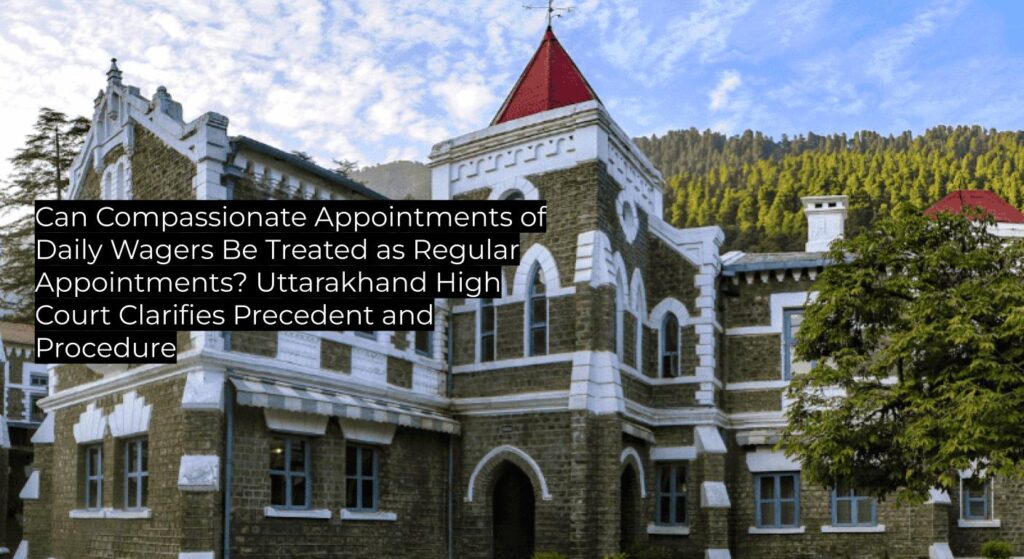
The High Court clarified that petitioners appointed as daily wagers on compassionate grounds, following the death of work charged employees, do not automatically acquire rights to regular appointment under the Dying in Harness Rules. The judgment upholds prior Full Bench precedent and instructs that such individuals may seek regularisation through separate representation, to be decided on merits. This maintains the existing legal position with precedential value for future cases involving compassionate appointments in engineering departments and similar sectors.
Summary
| Category | Data |
|---|---|
| Case Name | WPSS/239/2024 of ANAND MANI Vs STATE OF UTTARAKHAND |
| CNR | UKHC010022822024 |
| Date of Registration | 21-02-2024 |
| Decision Date | 02-09-2025 |
| Disposal Nature | DISPOSED |
| Judgment Author | HON’BLE MR. JUSTICE MANOJ KUMAR TIWARI |
| Court | High Court of Uttarakhand |
| Precedent Value | Binding within Uttarakhand; follows existing Full Bench precedent |
| Overrules / Affirms | Affirms Full Bench decision in Special Appeal No. 7 of 2011 |
| Type of Law | Service Law – Compassionate Appointment, Regularisation, Dying in Harness Rules |
| Questions of Law | Whether appointment as daily wager on compassionate ground under policy guidelines entitles regularisation. |
| Ratio Decidendi |
The Court held that dependents appointed as daily wage workers, following the death of work charged employees, do not automatically qualify for regular appointment under Dying in Harness Rules. It reaffirmed the position that such dependents are not covered under “Government Servant” as per Rule 2(a)(iii) of the Rules, as per Full Bench precedent. The Court allowed representations for regularisation to be considered by the competent authority, relying on the possibility of other precedents and policy documents being applicable. The main legal principle reaffirmed is that regularisation is not an automatic consequence of compassionate daily wage appointment, but must be considered afresh. |
| Judgments Relied Upon |
|
| Logic / Jurisprudence / Authorities Relied Upon by the Court | Interpretation of Dying in Harness Rules, especially Rule 2(a)(iii); policy G.O. dated 04.12.2002; application of precedent and existing schemes for regularisation. |
| Facts as Summarised by the Court | Petitioners, dependents of deceased work charged employees, were appointed as daily wagers on compassionate grounds per government order. They claim long service and a right to regularisation, citing prior precedent. The State opposes, citing Full Bench authority. |
| Citations | 2025:UHC:7813 |
Practical Impact
| Category | Impact |
|---|---|
| Binding On | All subordinate courts in Uttarakhand |
| Persuasive For | Other High Courts, especially in service matters involving similar facts and application of Dying in Harness Rules |
| Overrules | None – affirms Special Appeal No. 7 of 2011 (Full Bench) |
| Distinguishes | Distinguishes Division Bench view in Special Appeal No. 408 of 2021 to the extent it may conflict with Full Bench |
| Follows | Follows Full Bench decision in Special Appeal No. 7 of 2011 |
What’s New / What Lawyers Should Note
- Reaffirms that compassionate appointments as daily wagers due to death of work charged employees do not by themselves confer a right to regular appointment under the Dying in Harness Rules.
- Confirms the binding effect of Full Bench authority (Special Appeal No. 7 of 2011) over inconsistent Division Bench conclusions.
- Suggests that individual claims for regularisation must be considered on merits if representation is made, with reference to applicable policies and relevant prior judgments.
- Allows reliance on Division Bench judgment (Special Appeal No. 408 of 2021) in pending regularisation claims, but within the boundaries set by Full Bench law.
- Holds practical importance for compassionate appointment litigation in engineering/public works and similar governmental departments.
Summary of Legal Reasoning
- The Court noted that petitioners were dependents of work charged employees who died in service and were appointed as daily wagers on compassionate grounds as per government order dated 04.12.2002.
- Petitioners contended for regularisation based on long years of service and precedent set by Division Bench in Special Appeal No. 408 of 2021.
- The State relied on the Full Bench decision in Special Appeal No. 7 of 2011, which definitively held that dependents of daily wage employees are not “Government Servants” per Rule 2(a)(iii) and thus ineligible under the Dying in Harness Rules.
- The Court, bound by the Full Bench authority, declined the petitioners’ direct claim for regular status under the Rules.
- However, in the interests of justice, the Court permitted petitioners to make representations for regularisation, which should be considered by competent authority with reference to the judgments cited and law applicable.
Arguments by the Parties
Petitioner
- The deceased parent was a work charged employee, eligible for regularisation, but died prior to being regularised.
- Petitioner was appointed as a daily wager on compassionate grounds, has served over ten years.
- Cites Division Bench judgment (Special Appeal No. 408 of 2021) to argue that such compassionate appointment should be treated as regular.
- Points to similar cases where appointments were regularised following court orders.
Respondent (State)
- Relies on Full Bench judgment (Special Appeal No. 7 of 2011) holding dependents of daily wagers not covered under “Government Servant” in Dying in Harness Rules.
- Argues that duration of service as daily wager is irrelevant to the claim under the Rules.
- Asserts that no automatic right to regularisation arises from such compassionate appointment.
Factual Background
The petitioners are dependents of deceased work charged employees in various engineering departments of the State. Upon the death of their breadwinners — who, though eligible for regularisation, died while still classified as work charged employees — the petitioners were appointed as daily wagers on compassionate grounds pursuant to a government order. After serving as daily wagers for more than ten years, the petitioners sought regularisation and legitimate salary, referencing favourable precedent.
Statutory Analysis
The primary statutory provision discussed is Rule 2(a)(iii) of the U.P. Recruitment of Dependents of Government Servants (Dying in Harness) Rules, 1974. The Full Bench precedent interprets “Government Servant” strictly, excluding daily wage employees’ dependents. The policy letter dated 04.12.2002 by the Additional Secretary, Irrigation Department, was also reviewed for its impact on appointments and regularisation procedures.
Procedural Innovations
- The Court formulated a remedy allowing petitioners to file representations for regularisation to the competent authority, to be resolved within five months. This balances the application of binding legal precedent with the opportunity for the administrative authority to assess regularisation eligibility on a case-by-case basis.
Alert Indicators
- ✔ Precedent Followed – Full Bench authority under Special Appeal No. 7 of 2011 is expressly reaffirmed and followed.
Citations
- 2025:UHC:7813
- Special Appeal No. 7 of 2011 (Full Bench, Uttarakhand High Court)
- Special Appeal No. 408 of 2021 (Division Bench, Uttarakhand High Court)