


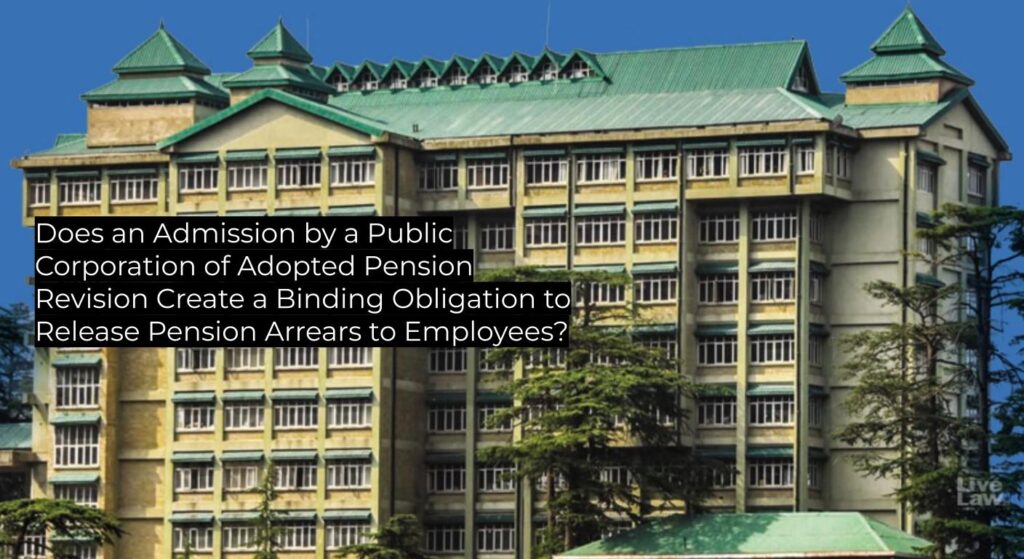
Where a public corporation admits to the adoption of government pension revision notifications, courts may direct implementation and disbursement of arrears within a fixed timeframe. This judgment reaffirms, not overrules, existing precedent—clarifying that administrative admission coupled with admitted entitlement justifies immediate judicial direction, establishing a strong precedent for similar cases involving public sector pensioners.
Summary
| Category | Data |
|---|---|
| Case Name | CWP/16129/2025 of CHAMAN LAL Vs HRTC AND OTHERS |
| CNR | HPHC010623352025 |
| Date of Registration | 13-10-2025 |
| Decision Date | 15-10-2025 |
| Disposal Nature | Disposed Off |
| Judgment Author | Hon’ble Mr. Justice Sandeep Sharma |
| Court | High Court of Himachal Pradesh |
| Bench | Single Bench (Justice Sandeep Sharma) |
| Precedent Value | Binding on similar disputes within the jurisdiction of Himachal Pradesh High Court |
| Overrules / Affirms | Affirms admitted administrative decisions and established precedents regarding release of pension arrears upon admission |
| Type of Law | Service Law / Administrative Law |
| Questions of Law | Whether an admitted decision by a public body to revise pension/family pension as per government notification creates a binding obligation to release arrears timely? |
| Ratio Decidendi |
When a public corporation admits adopting a government pension revision—conveyed via official communication—and acknowledges employees’ entitlement, the High Court may direct immediate implementation and time-bound release of arrears. Respondents’ admissions eliminate the need for further adjudication on entitlement, restricting inquiry solely to the timeline of implementation. Failure to comply within the stipulated period triggers liability for statutory interest on the due amounts. |
| Facts as Summarised by the Court |
Petitioners sought direction for implementation of HRTC’s admitted pension revision decision, based on adoption of a government notification, seeking release of arrears from July 2023 onward. The corporation admitted both adoption of the policy and the petitioners’ entitlement; delay was attributed to financial crunch. The court accepted the respondents’ commitment to release the arrears within 12 weeks and prescribed interest for default. |
Practical Impact
| Category | Impact |
|---|---|
| Binding On | All subordinate courts within Himachal Pradesh; parties similarly placed in HRTC or other PSUs under the court’s jurisdiction |
| Persuasive For | Other High Courts and tribunals adjudicating similar issues regarding admitted administrative entitlements |
| Follows | Established principle that uncontested admissions regarding service benefits by public bodies entitle petitioners to direct relief |
What’s New / What Lawyers Should Note
- Clarifies that when a public sector respondent admits adoption of a government notification or order, and petitioner’s entitlement stands uncontested, courts may direct implementation without a detailed inquiry.
- Provides a time-bound framework (12 weeks) for release of admitted pension arrears with interest (6% p.a.) in case of non-compliance.
- Acknowledges financial crunch as not a sufficient ground to delay statutory or admitted payments to employees post-admission.
- Establishes that mere admission by the respondent, even with explanation of delay, is sufficient for the court to grant relief without necessitating further evidence or elaborate proceedings.
Summary of Legal Reasoning
- The Court noted the admitted adoption of relevant government pension revision notification by the HRTC, as communicated through an official letter by its Managing Director.
- Since entitlement to the revised pension/family pension was expressly admitted by the respondent corporation, and delay was attributed solely to financial issues—without dispute on legal entitlement—no reply was deemed necessary.
- The Court observed that the admitted position, along with respondent’s commitment to process arrears within a fixed period, justified issuing a direct, time-bound order for disbursement.
- The Court further ordered that, upon failure to comply within the stipulated 12 weeks, the corporation would be liable to pay interest at 6% per annum on the delayed amounts, reinforcing the enforceability of admitted claims.
- The case thus stands as reinforcement of the principle: when entitlement is admitted, judicial direction for implementation becomes a matter of right, not discretion.
Arguments by the Parties
Petitioner:
- Sought implementation of HRTC’s own order revising pension as per government notification.
- Requested time-bound release of arrears along with interest on delayed payment.
Respondent (HRTC and Others):
- Admitted the adoption of the government notification relating to pension revision.
- Admitted petitioners’ entitlement to the revised pension and arrears.
- Cited financial crunch as reason for delay.
- Undertook to release arrears for pension/family pension from July 2023 within 12 weeks and to pay monthly pension thereafter.
Factual Background
Petitioners, retired employees of HRTC, approached the Court seeking enforcement of a communication dated 22.07.2023, issued by HRTC’s Managing Director, whereby HRTC adopted HP State Government’s notification revising pension/family pension to 50%/30% of the pay matrix effective 01.01.2016. Despite adoption of this policy, payment of arrears from July 2023 onward was delayed, leading the petitioners to seek court intervention for prompt execution and release of dues.
Statutory Analysis
- The judgment references and relies upon the H.P. State Government Notification No.Fin(Pen)A(3)-1/2021 dated 08.09.2022, regarding revision of pension/family pension at specified percentages of the pay matrix.
- Analyzed the binding effect of officially adopted administrative/government notifications on public sector undertakings.
- Determined that once adopted and communicated, the relevant administrative order creates a statutory liability, enforceable through judicial directive.
- No expansive or restrictive interpretation of statutory provisions, but direct application of the admitted notification and its binding nature.
Dissenting / Concurring Opinion Summary
No dissenting or concurring opinions detailed in the judgment.
Procedural Innovations
- The judgment dispensed with the need for a formal reply by the respondents, given their express admission as to fact and entitlement.
- Established that where entitlement is admitted, courts may forgo prolonged pleadings and grant relief through an immediate, oral order.
- Prescribed a structured, time-bound compliance mechanism, including automatic interest penalty upon default.
Alert Indicators
- ✔ Precedent Followed – The judgment applies and reaffirms the established legal rule that admitted administrative decisions, when uncontested, must be enforced without elaborate inquiry.