


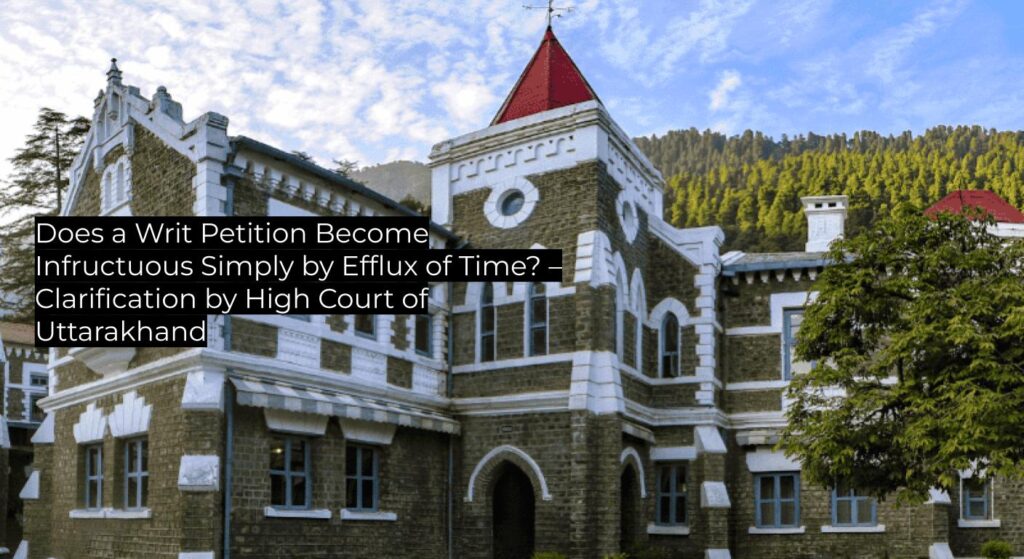
The court held that when the petitioners themselves declare their writ petitions infructuous due to passage of time, such petitions shall be dismissed as infructuous; this order is a straightforward application of established procedural law and does not overrule, modify, or clarify any substantive principle. The judgment serves as a practical reaffirmation of standard court procedure, holding only persuasive value for future cases with similar circumstances.
Summary
| Category | Data |
|---|---|
| Case Name | WPMS/2502/2023 of MAHAVEER SINGH Vs EXCISE COMMISSIONER CNR UKHC010144172023 |
| Date of Registration | 05-09-2023 |
| Decision Date | 15-10-2025 |
| Disposal Nature | DISMISSED AS INFRUCTUOUS |
| Judgment Author | HON’BLE MR. JUSTICE MANOJ KUMAR TIWARI |
| Court | High Court of Uttarakhand |
| Precedent Value | Persuasive authority for future cases where petitions become infructuous by efflux of time |
| Type of Law | Procedural Law |
| Ratio Decidendi |
The court noted a statement made by the petitioners’ counsel at the bar, declaring the writ petitions had become infructuous due to the passage of time. In view of this specific statement, the court dismissed the batch of writ petitions as infructuous. No substantive legal question was examined. The order reiterates the standard practice that courts may dismiss a matter as infructuous when petitioners so indicate, reflecting judicial efficiency and respect for parties’ acknowledgments. |
| Facts as Summarised by the Court | The petitioners, through counsel, made a statement in open court that the writ petitions in question had become infructuous due to efflux of time. The court acted upon this statement and dismissed the petitions accordingly. |
Practical Impact
| Category | Impact |
|---|---|
| Binding On | Not binding as precedent; applicable to petitions in the High Court of Uttarakhand under similar factual situations |
| Persuasive For | Other courts may refer to this for procedural dismissal of infructuous petitions |
What’s New / What Lawyers Should Note
- Dismissal on grounds of infructuousness expressly admitted by the petitioners is formalized by court order.
- Lawyers are reminded to inform the court promptly if litigation has become pointless due to the passage of time, allowing for swift disposal.
- No substantive or procedural right is determined; the order preserves judicial resources where relief is no longer possible.
Summary of Legal Reasoning
- The petitioner’s advocate made a clear statement at the bar that the writ petitions had become infructuous owing to the passage of time.
- The court accepted this submission and dismissed the writ petitions as infructuous on the same ground, without entering into any merits or legal analysis.
- The order is based solely on the acknowledgment of infructuousness by the petitioners’ side and does not involve any legal debate, statutory interpretation, or precedent-setting deliberations.
Arguments by the Parties
Petitioner
- The learned counsel for the petitioners made a statement that the writ petitions have become infructuous by efflux of time.
Respondent/State
- No detailed argument is recorded from the State, as the order was based upon the petitioner’s statement.
Factual Background
The writ petitions were filed and listed before the High Court of Uttarakhand. On the date of hearing, the petitioners’ counsel stated that, due to the efflux of time, the writ petitions were now infructuous. The court, noting this express statement, proceeded to dismiss the petitions as infructuous.
Statutory Analysis
- The judgment does not reference or interpret any statute, rule, or constitutional provision. The order is procedural, grounded in acknowledgment by the parties.
Dissenting / Concurring Opinion Summary
- No dissenting or concurring opinions are present in the order.
Procedural Innovations
- No new procedural guidance or innovations were set by this judgment; the action taken follows established judicial practice on declarations of infructuousness.
Alert Indicators
- ✔ Precedent Followed – The court followed standard procedural precedent regarding dismissal of infructuous matters.