


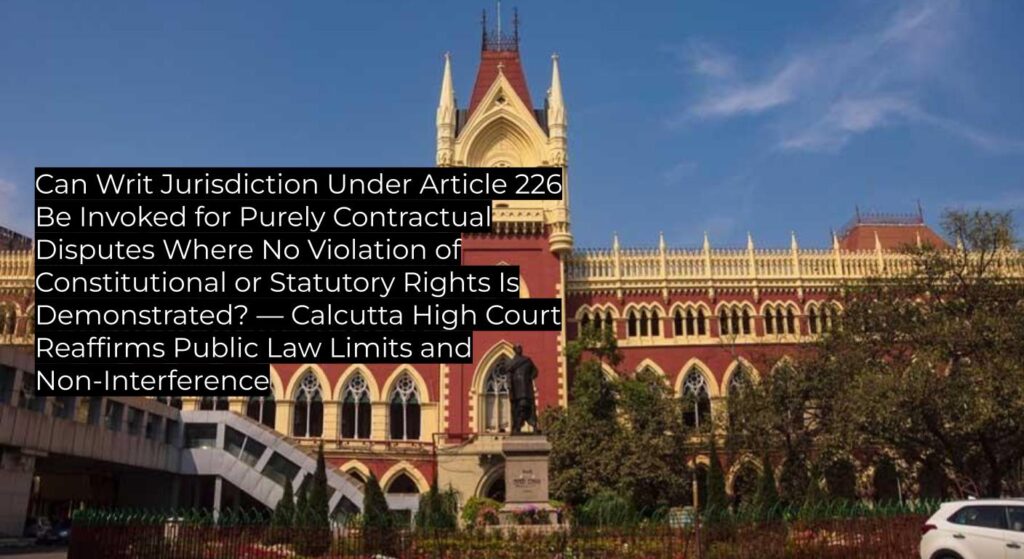
The Calcutta High Court reaffirmed that contractual disputes without evidence of arbitrariness, illegality, or breach of constitutional or statutory rights are not amenable to writ jurisdiction under Article 226. The judgment follows the clear line of Supreme Court precedents and clarifies the public law test, serving as binding authority for contractual disputes involving state entities and public corporations.
Summary
| Category | Data |
|---|---|
| Case Name | WPA/15166/2025 of JEKAY INTERNATIONAL TRACK PRIVATE LIMITED AND ANR Vs UNION OF INDIA AND ORS. |
| CNR | WBCHCA0310172025 |
| Date of Registration | 07-07-2025 |
| Decision Date | 28-10-2025 |
| Disposal Nature | DISMISSED |
| Judgment Author | HON’BLE JUSTICE AMRITA SINHA |
| Court | Calcutta High Court |
| Precedent Value | Binding authority for contractual disputes under public law principles |
| Overrules / Affirms | Affirms existing Supreme Court precedent |
| Type of Law | Constitutional Law (Article 226) / Administrative Law / Contract Law |
| Questions of Law | Whether purely contractual disputes, absent violation of constitutional/statutory rights or arbitrariness, can be adjudicated in writ proceedings under Article 226. |
| Ratio Decidendi |
The Court held that disputes arising purely from the terms of a contract, without allegations of violation of constitutional or statutory rights, and where no palpable arbitrariness or irrationality is demonstrated, are not suitable for adjudication under writ jurisdiction. The judgment emphasizes that the writ Court’s jurisdiction under Article 226 is a public law remedy and should not be invoked for private contractual matters requiring detailed evidence or factual adjudication. The necessity for evidence and document appreciation makes the writ forum inappropriate for such disputes. Established Supreme Court authorities were followed to delineate the boundaries of writ jurisdiction in contract-related matters. |
| Judgments Relied Upon |
|
| Logic / Jurisprudence / Authorities Relied Upon by the Court | Relied on the principle that writ jurisdiction is primarily for enforcement of public law rights, not for adjudicating private contractual obligations. Applied tests laid down by the Supreme Court regarding arbitrariness, violation of Article 14, and the need for factual/evidentiary foundation. |
| Facts as Summarised by the Court | The case involved a contractual dispute regarding the imposition of a penalty due to alleged defect and adverse performance in the supply of railway clips. The goods were supplied in 2020, defect intimated in 2024 post-warranty, and the petitioners later replaced the goods, requesting non-imposition of penalty and return of unused goods. The railway authorities invoked penalty clauses, deducted amounts, and delisted the petitioning firm for poor performance; the petitioners challenged this in writ proceedings. |
Practical Impact
| Category | Impact |
|---|---|
| Binding On | All subordinate courts within the jurisdiction of the Calcutta High Court |
| Persuasive For | Other High Courts and may be cited before the Supreme Court in similar fact situations |
| Follows |
|
What’s New / What Lawyers Should Note
- The judgment provides a clear reaffirmation that breach of contract claims, absent allegations of arbitrariness, public law violation, or breach of constitutional/statutory rights, are not maintainable under Article 226.
- Lawyers cannot rely on writ jurisdiction for contractual enforcement when the dispute requires factual investigation or involves no public law element.
- The case highlights that only actions of authorities that are palpably arbitrary or irrational and violative of Article 14 may warrant intervention under Article 226, even in matters involving state instrumentalities.
- The Court distinguished situations where public safety might justify scrutiny, but found no such element requiring judicial review here.
- Reinforces that documentary and evidentiary disputes in contracts must be tried before a civil court and not in writ proceedings.
Summary of Legal Reasoning
- The Court first analyzed the factual matrix, noting that the dispute revolved around contractual terms, defect notification outside the warranty period, and penalty imposition.
- It observed that resolution depended on factual appreciation and evidence, not possible in writ proceedings.
- The judgment extensively relied upon the Supreme Court’s rulings in M.P. Power Management and Unitech Ltd., reiterating that writ jurisdiction is a public law remedy, appropriate only when state action is arbitrary, unreasonable, or violative of constitutional/statutory rights.
- The Court noted that no public element or breach of constitutional/statutory rights was shown: the dispute was purely contractual.
- It declined to interpret contractual terms or adjudicate on entitlement to return or value of goods, as such issues require oral and documentary evidence.
- Action by the state authority was found not to be arbitrary, illegal, or in breach of Article 14.
- Accordingly, judicial review was refused, and the writ petition was dismissed.
Arguments by the Parties
Petitioner
- The defect was notified after the expiration of the contractual warranty/guarantee period, so penalty imposition is contrary to contract terms.
- Replacement of defective goods was made by petitioners as a gesture, given the business relationship.
- Petitioners sought directions to prevent penalty, and for return of the defective/unused goods.
Respondent
- The delivered goods were essential for public safety and were defective.
- The penal provision was invoked strictly as per contract.
- Petitioners failed to cooperate in joint inspection and replacement.
- Penalty deduction followed proper procedure and contract stipulations.
Factual Background
The parties entered into a contract for the supply of elastic railway clips, vital for passenger and track safety. The petitioners supplied goods in 2020, but a defect was notified by the railway authorities only in 2024, after the warranty period had expired. Despite a request, the petitioners did not initially replace the defective goods. Subsequently, penalties were imposed pursuant to the contract, a part of which was deducted by the authorities, and the petitioners’ firm was delisted for one year. The petitioners challenged the penalties and sought return of goods via a writ petition before the High Court.
Statutory Analysis
- The Court examined contractual clauses regarding the warranty/guarantee period and penalty provisions.
- Article 226 of the Constitution was discussed in light of leading Supreme Court judgments, establishing that writ jurisdiction lies primarily for violation of constitutional or statutory rights and is not intended for enforcement of purely private contractual obligations unless public law elements are present.
- The jurisprudence on judicial review’s limits in contractual settings was reinforced.
Dissenting / Concurring Opinion Summary
No dissenting or concurring opinions are recorded in the judgment.
Procedural Innovations
No new procedural innovations or guidelines were set forth in the judgment.
Alert Indicators
- ✔ Precedent Followed – The judgment affirms existing Supreme Court precedent on the limits of writ jurisdiction in contractual disputes.