


Summary
| Category | Data |
|---|---|
| Court | Supreme Court of India |
| Case Number | Crl.A. No.-001624-001624 – 2011 |
| Diary Number | 5380/2011 |
| Judge Name | HON’BLE MR. JUSTICE PRASHANT KUMAR MISHRA |
| Bench | HON’BLE MR. JUSTICE PRASHANT KUMAR MISHRA; HON’BLE MR. JUSTICE VIPUL M. PANCHOLI |
| Precedent Value | Binding on subordinate courts in criminal appeals under Article 136 |
| Overrules / Affirms | Affirms the High Court judgment |
| Type of Law | Criminal Law |
| Questions of Law |
|
| Ratio Decidendi |
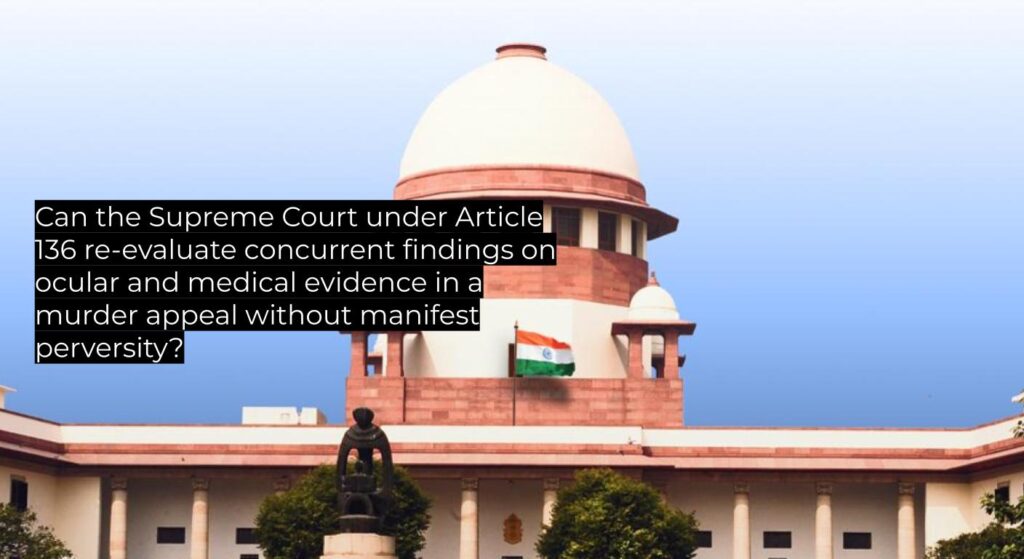
The Supreme Court will not reappraise concurrent findings of fact by lower courts in criminal appeals under Article 136 except where findings are manifestly perverse or unsupported by evidence. Injured eyewitness testimony, supported by medical evidence, carries special weight. Delay in filing an FIR, if satisfactorily explained, is not fatal. Non-recovery of weapons does not undermine conviction when ocular and medical evidence are consistent. The fourth exception to Section 300 IPC does not apply where sharp-edged weapons are used with clear intent to cause death. |
| Judgments Relied Upon |
|
| Logic / Jurisprudence / Authorities Relied Upon by the Court |
|
| Facts as Summarised by the Court | A boundary-ridge dispute on 19.05.1988 led to a group clash in which two persons died. Two FIRs were lodged, but Session Trial No. 56 (arising from the complainant’s FIR) convicted seven accused under Sections 302/149 and 307/149 IPC. The High Court dismissed appeals. |
Practical Impact
| Category | Impact |
|---|---|
| Binding On | All subordinate courts in criminal appeals under Article 136 |
| Persuasive For | Criminal benches of High Courts |
| Overrules | None |
| Distinguishes | None |
| Follows |
|
What’s New / What Lawyers Should Note
- Reaffirms that the Supreme Court, under its plenary power in Article 136, will not reappraise concurrent factual findings in criminal appeals absent manifest perversity.
- Confirms the special status and high reliability of injured eyewitness testimony when supported by medical evidence.
- Clarifies that a delay in lodging an FIR, if satisfactorily explained, is not fatal to the prosecution.
- Holds that non-recovery of the weapon does not undermine conviction where ocular and medical evidence are consistent.
- Affirms that the fourth exception to Section 300 IPC does not apply when sharp weapons are used with intent to cause fatal injuries.
Summary of Legal Reasoning
-
Scope of Article 136
Article 136 powers are wide but in criminal appeals concurrent findings of fact will not be disturbed except in exceptional circumstances (manifest perversity, misreading of evidence). Cited Mekala Sivaiah, Shahaja, Balak Ram, Arunachalam, Nain Singh, Babul Nath. -
Ocular and Injured Eyewitness Evidence
Ocular evidence is best evidence unless unreliable. Injured eyewitness testimony has inbuilt reliability and stamps presence at the scene. Cited Jarnail Singh, Shivalingappa, Kishan Chand, Abdul Sayeed. -
Motive
Proof of motive strengthens eyewitness testimony but is not indispensable when eyewitness accounts are credible. Cited Sheo Shankar Singh. -
Fourth Exception to Section 300 IPC
Intention to cause death is inferred from weapon nature, force, number of blows, use of sharp weapons. Sharp-edged weapons used with clear intent exclude the fourth exception. Cited Pulicherla Nagaraju. -
Delay in FIR
Delay, if satisfactorily explained (e.g., treatment of injured) cannot be a ground to discard prosecution. Cited Gian Chand, Raghbir Singh. -
Non-recovery of Weapons
Non-recovery of weapon is not fatal when ocular and medical evidence are consistent and reliable. Cited Arjun Singh, Nankaunoo.
Arguments by the Parties
Petitioner
- It was a free fight with reciprocal injuries; possible self-defence.
- No specific act attributable to each accused; first FIR lodged by appellants.
- Delay in lodging cross-FIR by complainant side; terming it afterthought.
- Eyewitness testimonies unreliable; case falls under Section 304 Part II IPC only.
Respondent
- Appellants had motive from pending boundary dispute and consolidation proceedings.
- Appellants were aggressors, armed with sharp weapons; injured eyewitness and medical evidence corroborate.
- Fourth exception to Section 300 IPC not attracted; delay in FIR adequately explained.
- Relying on precedents (Nagaraju, Abdul Sayeed) to uphold conviction.
Factual Background
On 19.05.1988, a dispute over a field boundary (“mendh”) led to two groups exchanging blows with lathis, axes and spades. Two FIRs were registered—one by the appellants and one by the complainant side. Session Trial No. 56 convicted seven accused under Sections 302/149 and 307/149 IPC, sentencing them to life imprisonment and additional terms. The Uttarakhand High Court dismissed their appeals on 29.11.2010. The appellants then filed Criminal Appeal No. 1624 of 2011 under Article 136.
Statutory Analysis
- Article 136, Constitution: Grants plenary but discretionary power to the Supreme Court; limited in criminal appeals to exceptional cases.
- Section 300, IPC (Fourth Exception): Not applicable where wounds are intentionally inflicted with sharp weapons aimed at vital parts.
- Section 302/149 IPC: Murder by an unlawful assembly; affirmed.
- Section 307/149 IPC: Attempt to murder by an unlawful assembly; affirmed.
- Principles on delay in FIR and non-recovery: Delay admissible if explained; non-recovery not fatal when evidence consistent.
Alert Indicators
- ✔ Precedent Followed