


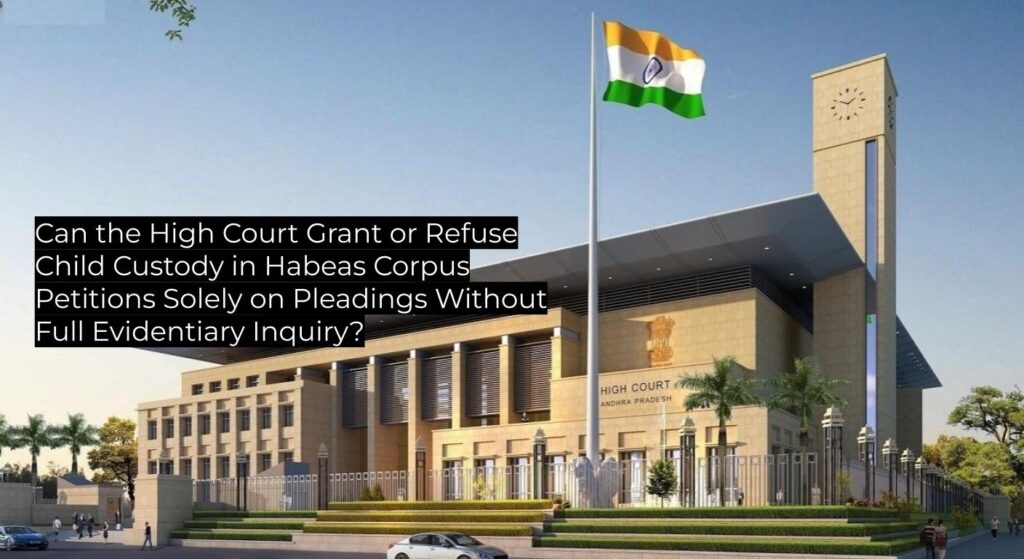
The Andhra Pradesh High Court reiterated that, while the child’s best interests are paramount, final custody cannot be granted in habeas corpus jurisdiction based on mere pleadings without a full trial. The judgment leaves the matter open for appropriate forums to determine custody after recording evidence, reaffirming settled law on the scope of habeas corpus in child custody disputes. This decision carries binding precedential value within Andhra Pradesh and serves as persuasive guidance elsewhere.
Summary
| Category | Data |
|---|---|
| Case Name | WP/13359/2025 of Y ANUSHA CHOWDHARY Vs THE STATE OF AP |
| CNR | APHC010269682025 |
| Date of Registration | 09-05-2025 |
| Decision Date | 30-10-2025 |
| Disposal Nature | DISPOSED OF NO COSTS |
| Judgment Author | R. Raghunandan Rao, J (per Hon’ble Sri Justice R. Raghunandan Rao). Concurring: T.C.D. Sekhar, J |
| Court | High Court of Andhra Pradesh |
| Bench | R Raghunandan Rao, J & T.C.D. Sekhar, J |
| Precedent Value | Binding on subordinate courts in Andhra Pradesh; persuasive for other High Courts and family courts. |
| Type of Law | Family Law, Constitutional Law (Article 226 – Habeas Corpus) |
| Questions of Law | Whether custody of a minor child can be determined by the High Court in writ of habeas corpus jurisdiction, solely on the basis of pleadings, or should be left to the appropriate forum based on full evidence. |
| Ratio Decidendi | The High Court held that the best interest of the child is the paramount consideration. However, the determination of the best interest requires a full evidentiary inquiry, which can only be done in a properly constituted proceeding before the appropriate court, not under a writ of habeas corpus. Interim custody can be arranged based on circumstances, but final custody must be determined by the competent forum after trial. Allegations between the parties cannot be resolved in the writ jurisdiction on pleadings alone. |
| Logic / Jurisprudence / Authorities Relied Upon by the Court | The court emphasized the limitation of habeas corpus jurisdiction in complex child custody disputes involving disputed facts, requiring a full evidence-based inquiry before competent forums. |
| Facts as Summarised by the Court | The petitioner (mother) sought custody of her 2½-year-old son via habeas corpus, alleging the father (husband) had forcibly taken the child and was denying access. The father denied these allegations, claiming he had lawful custody since March 2025 and the mother had abandoned the child. Mediation failed. The court found the child was in the father’s custody prior to the writ, and interim custody had been with the mother by court order. The court restored custody to the father, allowing the mother to approach the appropriate forum for determination. |
Practical Impact
| Category | Impact |
|---|---|
| Binding On | All subordinate courts and family courts in Andhra Pradesh. |
| Persuasive For | Family Courts, other High Courts, and tribunals handling child custody cases outside Andhra Pradesh. |
What’s New / What Lawyers Should Note
- Reaffirms that habeas corpus jurisdiction in child custody is limited; disputed facts and allegations between parents require adjudication by competent forums (e.g., family courts), not writ courts.
- The child’s best interests remain paramount, but cannot be determined conclusively on disputed pleadings without recording evidence.
- Interim custody may be regulated by High Court in exceptional circumstances, but such orders are not substitutes for final custody orders.
- Restoration of status quo ante (previous custody) is favored when the child’s custody predated the writ petition and was altered only by interim court order.
- Counsel should advise clients to approach the appropriate forum (e.g., family court) for final determination of custody and visitation rights.
Summary of Legal Reasoning
- The court acknowledged the petitioner’s claim that the child’s best interests are the paramount concern and mother’s custody is preferable for a young child.
- However, the court found there were sharply conflicting factual allegations by both parties, each accusing the other of improper conduct regarding the child.
- The court concluded it could not decide the child’s best interests solely on pleadings and allegations since full evidence had not been led and factual disputes were unresolved.
- The writ jurisdiction under Article 226 and a habeas corpus petition is not the appropriate forum for deciding complex questions of custody where evidence is required.
- The court emphasized that only the competent forum, after trial and evidence, can determine where the child’s best interests lie.
- Interim custody had been with the mother by virtue of a court order; however, the pre-writ status was custody with the father, and there was no forcible removal proven.
- As reconciliation failed, the court restored custody to the father and left the mother free to approach the relevant forum for custody determination.
Arguments by the Parties
Petitioner
- The 4th respondent (father) forcibly took away the child from the petitioner’s custody in Bangalore.
- Photographic evidence shows the respondent running away with the child.
- The best interest of the child, who is 2½ years old, would be better served by the mother.
Respondent (Father)
- Denied forcible removal; claimed the petitioner had abandoned the child.
- Asserted that, after a failed reconciliation attempt, he lawfully retained custody.
- Alleged that the petitioner’s family acted aggressively and left the child with his family in Hyderabad.
- Stated that he brought the child to Bangalore voluntarily and that the petitioner tried to take the child to Hyderabad, prompting him to leave with the child.
Factual Background
The petitioner and the 4th respondent married in February 2022 and had a son, now 2½ years old. Due to marital discord, they began living apart. The petitioner alleged that in March 2025, after moving to Hyderabad, her husband took their son from her custody and subsequently refused her access. She filed a habeas corpus petition after her complaint to the police was not acted upon. Both parents made allegations regarding abandonment and forcible removal of the child. Interim custody orders were passed by the High Court during the proceedings. Mediation failed to resolve the dispute.
Statutory Analysis
- The court exercised jurisdiction under Article 226 of the Constitution of India for a writ of habeas corpus, specifically regarding child custody.
- Emphasized the limitation that such writs are not substitutes for full trial on disputed facts.
- Reiterated the legal position that best interests of the child, while paramount, must be determined in proper proceedings, not in summary writ jurisdiction.
Dissenting / Concurring Opinion Summary
No separate or dissenting opinion; both judges (R. Raghunandan Rao, J and T.C.D. Sekhar, J) concurred in the judgment.
Procedural Innovations
- The court appointed a mediator in hope of reconciliation but, upon failure, reverted to legal merits.
- Interim custody was granted through interlocutory order pending decision, then reversed to pre-petition custody upon disposal.
Alert Indicators
- ✔ Precedent Followed – The decision affirms existing law regarding the limits of habeas corpus jurisdiction in child custody disputes and the necessity of full inquiry by competent forums.