


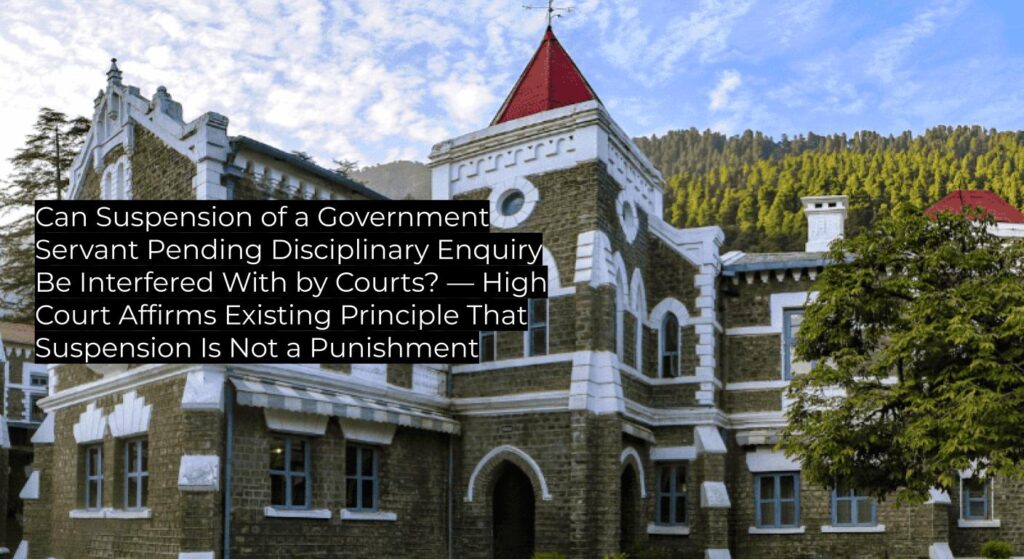
The High Court of Uttarakhand has reaffirmed that suspension of a government employee pending a disciplinary enquiry is not a punishment and ordinarily does not warrant judicial interference. The judgment upholds settled precedent and clarifies that courts should not intervene unless the suspension is shown to be without application of mind or mala fide. This decision serves as binding authority within Uttarakhand for future cases involving service suspension orders.
Summary
| Category | Data |
|---|---|
| Case Name | WPSS/1769/2025 of SHANKAR DEEP Vs STATE OF UTTARAKHAND |
| CNR | UKHC010169002025 |
| Date of Registration | 27-10-2025 |
| Decision Date | 29-10-2025 |
| Disposal Nature | DISMISSED |
| Judgment Author | Hon’ble Mr. Justice Manoj Kumar Tiwari |
| Court | High Court of Uttarakhand |
| Precedent Value | Binding within the High Court of Uttarakhand and subordinate courts |
| Overrules / Affirms | Affirms existing legal position |
| Type of Law | Service Law / Administrative Law |
| Questions of Law | Whether court can interfere with the suspension of a government servant pending enquiry. |
| Ratio Decidendi |
|
| Facts as Summarised by the Court |
Petitioner, a Village Panchayat Development Officer, was suspended for alleged negligence resulting in sub-standard road construction and subsequent attempts to destroy evidence by reconstructing the road during an enquiry. The petitioner contended lack of responsibility, while the State argued suspension is precautionary. |
Practical Impact
| Category | Impact |
|---|---|
| Binding On | All subordinate courts in Uttarakhand |
| Persuasive For | Other High Courts and similar service matters outside Uttarakhand |
| Follows | Affirms settled law that suspension pending enquiry is not punishment and should not be normally interfered with |
What’s New / What Lawyers Should Note
- Reaffirms that suspension pending a disciplinary enquiry is not a punishment in the eyes of law.
- Clarifies courts should not interfere with suspension orders unless lack of application of mind or mala fides is demonstrated.
- Highlights that, upon exoneration in enquiry, a government servant is entitled to all benefits after revocation of suspension.
- Provides service law practitioners with clear authority against challenging routine suspension orders absent procedural impropriety.
Summary of Legal Reasoning
- The court considered the petitioner’s challenge to suspension and the State’s argument that suspension only prevents interference with ongoing enquiry.
- It recognized that the allegation involved alleged negligence in construction work and attempted destruction of evidence.
- The court found substance in the State’s submission that suspension is not punishment and is a mechanism to ensure a free and fair enquiry.
- It held that there was no evidence the suspension order lacked application of mind.
- The court concluded that if exonerated, the petitioner would receive the benefits due and the suspension would be revoked.
- Accordingly, interference in the suspension order was unwarranted and the writ petition was dismissed.
Arguments by the Parties
Petitioner
- Asserted he was not responsible for the sub-standard road construction, attributing responsibility to the Junior Engineer.
Respondent (State)
- Argued that suspension is not a punishment and is meant to prevent interference with disciplinary proceedings.
- Maintained that the question of innocence or culpability is to be determined in the enquiry.
- Contended that court interference at the suspension stage would set a wrong precedent.
Factual Background
The petitioner, serving as Village Panchayat Development Officer in a Gram Panchayat in District Haridwar, was suspended via order dated 10.10.2025, pending disciplinary enquiry. The allegations included negligence resulting in sub-standard road construction and, during an official enquiry, alleged destruction of evidence by reconstructing the road along with a Junior Engineer. The petitioner claimed non-responsibility for the construction, placing the blame on the Junior Engineer, and challenged the suspension before the High Court.
Statutory Analysis
The judgment discussed the legal status of suspension as distinct from punishment under service jurisprudence. The court affirmed that suspension pending an enquiry is a measure to ensure a free investigation, and not a penalty in itself. No specific statutory provision was interpreted; rather, established principles of service law regarding suspension were reiterated.
Dissenting / Concurring Opinion Summary
No concurring or dissenting opinions are recorded in the judgment.
Procedural Innovations
No new procedural directions or innovations are set out in the judgment.
Alert Indicators
- ✔ Precedent Followed – The decision upholds existing precedent that suspension pending a disciplinary enquiry is not a punishment and judicial interference is not warranted except in cases of procedural impropriety or mala fides.