


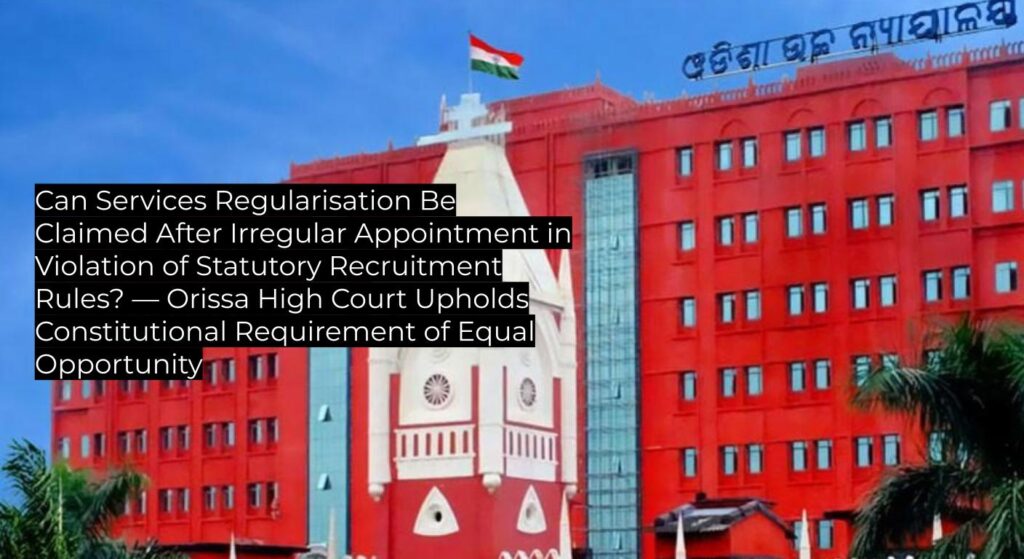
The Orissa High Court reaffirmed that appointments made in disregard of applicable recruitment rules and constitutional mandates of Articles 14 and 16 are void ab initio and cannot be regularised. This judgment follows Supreme Court precedent and stands as binding authority for service law matters involving public employment in subordinate courts.
Summary
| Category | Data |
|---|---|
| Case Name |
WP(C)/28669/2019 of SAROJ KUMAR MOHANTY Vs STATE OF ODISHA,LAW DEPT. CNR ODHC010777742019 |
| Date of Registration | 30-12-2019 |
| Decision Date | 31-10-2025 |
| Disposal Nature | Dismissed |
| Judgment Author | Mruganka Sekhar Sahoo, J. |
| Court | Orissa High Court |
| Bench | Mr. Justice Dixit Krishna Shripad, Mr. Justice Mruganka Sekhar Sahoo |
| Precedent Value | Binding Authority for service-related matters in subordinate judiciary/services in Orissa |
| Overrules / Affirms | Affirms existing Supreme Court precedents (Renu v. District & Sessions Judge; State of J&K v. District Bar Association, Bandipora) |
| Type of Law | Service law; Constitutional law; Recruitment Rules |
| Questions of Law | Whether services can be regularised when initial appointment was made contrary to statutory recruitment rules and in violation of Article 14 & 16 of the Constitution. |
| Ratio Decidendi |
|
| Judgments Relied Upon |
|
| Logic / Jurisprudence / Authorities Relied Upon by the Court |
|
| Facts as Summarised by the Court |
Petitioner was engaged as Junior Typist in Family Court, Bhubaneswar on contractual basis after an advertisement in 2012, with yearly extensions up till 2019. The appointment was made by the Judge, Family Court, not following recruitment rules. Petitioner’s request for regularisation was rejected. Petitioner claimed entitlement under 2013 contractual appointment rules. State/respondents argued selection was illegal, violating statutory rules and constitutional guarantees under Articles 14 & 16. |
Practical Impact
| Category | Impact |
|---|---|
| Binding On | All subordinate courts in Odisha and authorities governed by Orissa District and Subordinate Courts’ Service Rules |
| Persuasive For | Other High Courts addressing similar service law/judicial appointment disputes |
| Follows | Renu v. District and Sessions Judge (2014) 14 SCC 50; State of J&K v. District Bar Association, Bandipora (2017) 3 SCC 410 |
What’s New / What Lawyers Should Note
- Appointments made outside the statutory recruitment process, even if continued on contract for years, cannot be regularised as a matter of right.
- The Family Court or any authority cannot bypass the mandated recruitment mechanism (District Recruitment Committee) under the 2008 Rules; such appointments are void ab initio.
- “Head of office” status for financial purposes does not extend to recruitment or appointment powers.
- Equity principles provide no relief where appointments breach statutory and constitutional requirements (Articles 14, 16).
- This judgment offers robust authority for defending challenges to the cancellation or non-regularisation of irregular contractual appointees in subordinate courts.
Summary of Legal Reasoning
- Interpretation and Applicability of Statutory Rules: The bench examined the 2008 recruitment rules mandating competitive examination, District Recruitment Committee selection, and broad-based advertisement.
- No Exception for Family Court: The Judge, Family Court’s “head of office” status under financial rules does not permit independent recruitment outside the 2008 Rules.
- Supreme Court Precedents: Reliance on Renu (2014), State of J&K v. District Bar Association (2017), and Umadevi (2006) emphasizing that illegal appointments are null and void and cannot be regularised.
- Principle of Equal Opportunity: Failure to follow public notification and selection process violates constitutional equality and recruitment rules.
- Doctrine of “Void ab initio”: The entire appointment process is a nullity from inception.
- No Scope for Equity or Regularisation: Equity cannot validate a patently illegal arrangement.
- Petition Dismissed: The petitioner’s claim for regularisation or continuation was dismissed as devoid of merit.
Arguments by the Parties
Petitioner
- The appointment followed creation of posts by government notification and extensions from 2012 to 2019, justifying regularisation.
- Protection sought under Odisha Group-C and Group-D posts (contractual appointment) Rules, 2013.
- Alternatively argued that 2008 and 2010 Rules were inapplicable since recruitment was by the Judge, Family Court, as head of office.
Respondent (State and Judicial Administration)
- The initial advertisement and appointment were made by an incompetent authority, contrary to 2008 Rules requiring a District Recruitment Committee and open examination.
- The process disregarded other eligible candidates’ rights under Articles 14 and 16.
- The Judge, Family Court’s “head of office” status is limited to financial matters and does not confer recruitment powers.
Factual Background
An advertisement dated 27.04.2012 was issued by the Judge, Family Court, Bhubaneswar for Junior Clerk (Record Keeper) and Junior Typist posts on a contractual basis after creation of posts in 2010. The petitioner was appointed as Junior Typist from 01.06.2012, with annual extensions up to 2019. The District Judge, Khurda rejected the petitioner’s representation for regularisation, prompting the writ petition. The process did not follow statutorily mandated procedures; appointment orders were temporary and terminable at any time.
Statutory Analysis
- The 2008 Rules require competitive examination by a District Recruitment Committee, not by an individual Family Court judge.
- Vacancies must be broadly advertised to ensure equal opportunity.
- Selection includes written tests, computer skills, and viva voce with merit lists.
- The Judge, Family Court’s “head of office” status does not extend to recruitment powers.
- Articles 14 and 16 of the Constitution reinforce equality and non-discrimination in public employment.
Dissenting / Concurring Opinion Summary
No dissenting or separate concurring opinions were delivered; the judgment is unanimous.
Procedural Innovations
No new procedural innovations or changes to existing legal procedures were introduced in this judgment.
Alert Indicators
- ✔ Precedent Followed – Existing Supreme Court law (Renu, Umadevi, Mamata Mohanty, State of J&K v. District Bar Association) is affirmed and rigorously applied.