


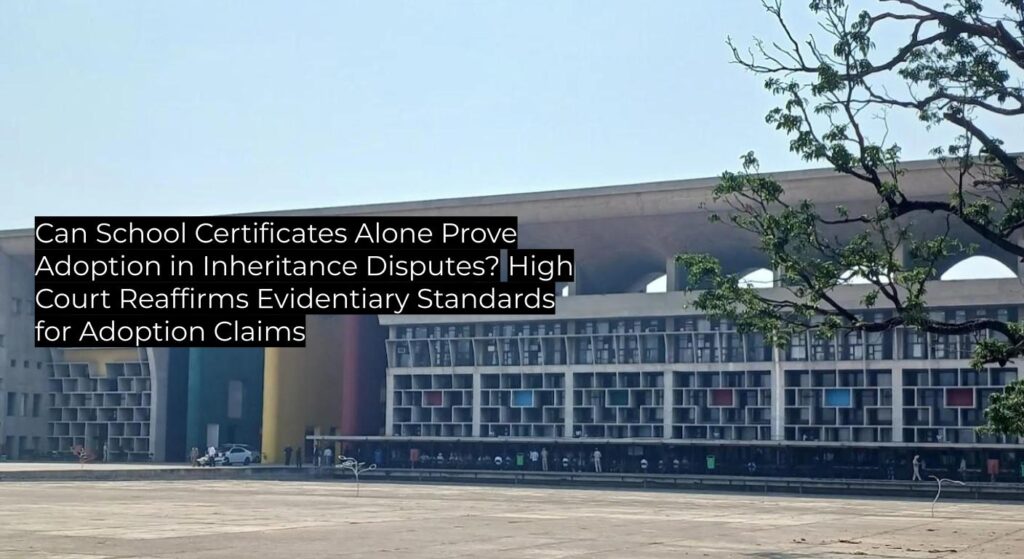
The court held that, in the absence of cogent evidence of an adoption ceremony or adoption deed, a mere entry in a school certificate showing a person as a child of someone does not suffice to establish adoption. This judgment upholds existing precedent on evidentiary standards in inheritance and succession disputes, and serves as binding authority for courts within its jurisdiction regarding proof required to substantiate adoption.
Summary
| Category | Data |
|---|---|
| Case Name | RSA/1406/2023 of KULWINDER KAUR Vs GULZAR SINGH AND OTHERS |
| CNR | PHHC010589972023 |
| Date of Registration | 11-05-2023 |
| Decision Date | 29-10-2025 |
| Disposal Nature | DISMISSED |
| Judgment Author | MR. JUSTICE DEEPAK GUPTA |
| Court | High Court of Punjab and Haryana |
| Precedent Value | Binding authority for subordinate courts within the Punjab & Haryana High Court’s jurisdiction |
| Overrules / Affirms | Affirms concurrent findings of trial and first appellate court |
| Type of Law | Civil; Inheritance; Succession; Adoption |
| Questions of Law | Whether mere entry in a school certificate is sufficient evidence to establish adoption in inheritance claims |
| Ratio Decidendi | The court reaffirmed that, in the absence of documentary or substantial oral evidence regarding adoption—including details of any adoption deed, adoption ceremony, or corroborative witnesses—a mere entry in a school certificate is insufficient to prove that a child was adopted. The court emphasized the necessity of cogent evidence, particularly in disputes over inheritance, and found that the plaintiff bore the burden to prove the alleged adoption but failed to do so. The rejection of the school certificate as conclusive evidence was upheld, and, finding no illegality or perversity in the concurrent findings, the second appeal was dismissed. |
| Facts as Summarised by the Court | Plaintiff, one of the daughters from the second wife of Faquir Singh, challenged the mutation and revenue records by alleging that defendant no.3 had been adopted by another couple and was therefore not entitled to inheritance. The adoption was claimed as having occurred when the child was two years old, but no documentary evidence of such adoption was produced; only a school certificate was relied upon. Both trial and appellate courts rejected the adoption claim due to lack of cogent evidence. Appeal was dismissed. |
Practical Impact
| Category | Impact |
|---|---|
| Binding On | All subordinate courts within Punjab and Haryana |
| Persuasive For | Other High Courts and Supreme Court (regarding evidentiary requirements for proof of adoption) |
| Follows | Follows and reaffirms established evidentiary principles on adoption claims |
What’s New / What Lawyers Should Note
- Reiterates that mere entries in school certificates are not sufficient to prove adoption in inheritance/succession disputes.
- Stresses the burden on the party asserting adoption to bring cogent oral or documentary evidence (adoption deed, ceremony, corroborative testimony).
- The absence of particulars of adoption (date, year, witnesses, or deed) renders adoption claims legally unsustainable.
- Lawyers should ensure strong, independent evidence before advancing adoption pleas in civil disputes.
Summary of Legal Reasoning
- The court examined the evidence produced—a school certificate showing the individual as the daughter of the alleged adoptive father.
- Oral testimony provided by plaintiff and her witnesses failed to establish the date, month, year, or place of any adoption ceremony.
- Witnesses admitted no adoption deed or document existed; even the key witness could not confirm basic details of the adoption.
- The court concurred with lower courts that, in the absence of substantial evidence (documentary or credible oral), the claim of adoption was not proved.
- The court reaffirmed that mere entries in school records, unsupported by primary evidence of adoption, have little probative value in succession disputes.
- No illegality or perversity was found in the lower courts’ rejection of the adoption claim.
Arguments by the Parties
Petitioner
- Defendant no.3 was adopted by another couple at age two and was thus not entitled to a share in the suit property.
- Produced and relied upon a school certificate showing defendant no.3 as daughter of the adoptive parents.
- Contended that the school certificate was sufficient evidence and was wrongly overlooked by lower courts.
Respondent
- Denied any adoption of defendant no.3 by the alleged adoptive parents.
- Asserted that the plaintiff was only entitled to a 1/288 share, not 1/9 as claimed.
- Prayed for dismissal of the suit.
Factual Background
The dispute arose over the estate of Faquir Singh, who had children from two marriages. The plaintiff, a daughter from his second wife, challenged the revenue mutation and records, claiming that defendant no.3 (Gurdeep Kaur) was adopted by the sister of Faquir Singh and therefore was not entitled to a share in the property. The alleged adoption had no supporting documentary evidence other than a school certificate citing defendant no.3 as the daughter of the adoptive parents. Both trial and first appellate courts dismissed the plaintiff’s claims due to lack of proof of adoption. The present second appeal was also dismissed.
Statutory Analysis
- The judgment focused on the evidentiary requirements under civil law for proving adoption and succession rights.
- The court underscored the necessity of either a valid adoption deed, evidence of the adoption ceremony, or other reliable documentary/corroborative oral evidence.
- It was clarified that mere recitals in secondary documents (such as school certificates) do not meet the statutory standards required to establish adoption for inheritance purposes.
Alert Indicators
- ✔ Precedent Followed – Existing law on evidentiary requirements for adoption was affirmed.