


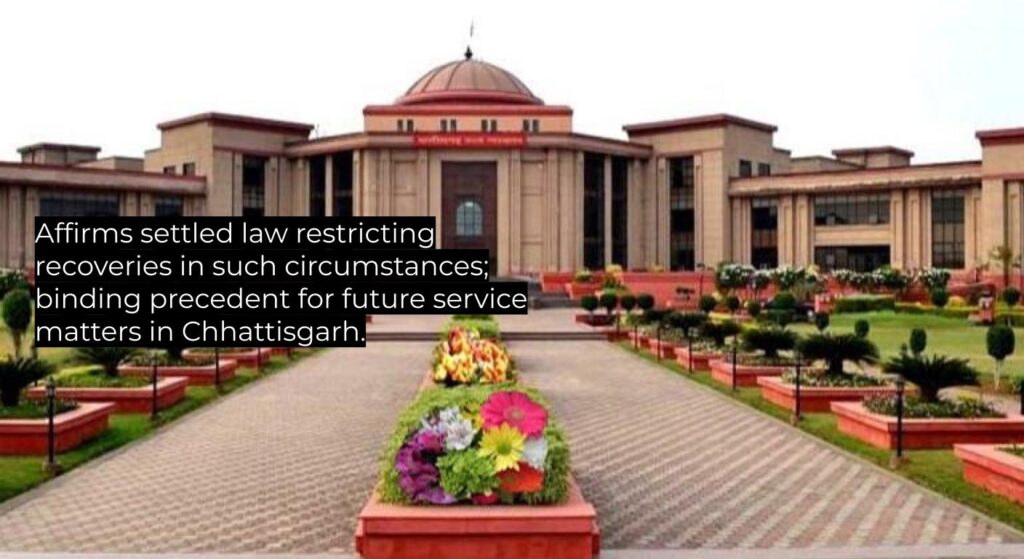
Recovery of excess payments, when not caused by an employee’s misrepresentation or fault and made long ago or at the verge of retirement, remains impermissible; the High Court of Chhattisgarh reaffirms Supreme Court precedent, ensuring robust protection for government employees against retrospective salary recoveries. This case upholds established law and serves as binding authority for similar future disputes in the public service sector.
Summary
| Category | Data |
|---|---|
| Case Name | WPS/8960/2023 of SMT. SUSHILA TEKAM Vs STATE OF CHHATTISGARH |
| CNR | CGHC010374822023 |
| Date of Registration | 08-11-2023 |
| Decision Date | 30-10-2025 |
| Disposal Nature | ALLOWED |
| Judgment Author | HON’BLE SHRI JUSTICE AMITENDRA KISHORE PRASAD |
| Court | High Court Of Chhattisgarh |
| Precedent Value | Binding Authority within Chhattisgarh; persuasive for other courts |
| Overrules / Affirms |
|
| Type of Law | Service Law / Administrative Law |
| Questions of Law | Whether recovery of salary paid in excess due to administrative error, without employee fault, is permissible—particularly at the verge of retirement or for payments made more than five years ago. |
| Ratio Decidendi |
It is impermissible to recover excess salary payments from government employees where such payments occurred due to administrative error and without any misrepresentation or fault of the employee. Such recovery is especially barred where the amount pertains to payments made more than five years ago or at the verge of retirement (within one year of retirement), as per Supreme Court guidance. The process used must adhere to principles of natural justice—meaningful notice and real consideration of any defense. Failure of authorities to genuinely consider the employee’s reply renders the recovery order unlawful. |
| Judgments Relied Upon |
|
| Logic / Jurisprudence / Authorities Relied Upon by the Court | Recovery of the excess amount is a civil consequence requiring observance of natural justice. Orders causing financial loss without genuine opportunity of hearing violate the law. Rafiq Masih restricts retrospective recoveries for long-past excess payments and those nearing retirement. |
| Facts as Summarised by the Court | The petitioner, a Deputy Superintendent of Police, was erroneously paid excess salary from 01.07.2010 due to administrative error in pay fixation (without her fault). After 13 years, near her date of retirement, a show cause notice and subsequent recovery order were issued. Petitioner submitted a reply citing no misrepresentation or fault, but her response was not adequately considered and recovery was directed on the same day. |
Practical Impact
| Category | Impact |
|---|---|
| Binding On | All subordinate courts in Chhattisgarh |
| Persuasive For | Other High Courts, Supreme Court |
| Follows |
|
What’s New / What Lawyers Should Note
- Reiterates that recoveries of excess salary, made due to no fault or misrepresentation by the employee, are impermissible under service law, especially when:
- The excess payment relates to a period beyond five years.
- The employee is due to retire within one year.
- Reinforces that issuing a show cause notice is not sufficient—authorities must give real consideration to the reply; a mechanical or same-day order violates natural justice.
- Directs refund of any amount already recovered, strengthening remedies available for affected employees.
- Cites specific application of Supreme Court precedents (Rafiq Masih, Thomas Daniel, Bhagwan Shukla) and aligns Chhattisgarh High Court practice accordingly.
- Lawyers may rely on this judgment to challenge similar recovery notices, particularly for long-past payments or pre-retirement recoveries.
Summary of Legal Reasoning
- The Court noted the relevant facts: administrative error led to excess payment, not due to employee’s fault or misrepresentation.
- After analyzing the procedural sequence, the Court determined that the mere issuance of a show cause notice is insufficient—meaningful consideration of a reply is required for compliance with natural justice, referencing Bhagwan Shukla (1994) 6 SCC 154.
- The Court relied on the binding Supreme Court judgments, especially Rafiq Masih (2015) 4 SCC 334 and Thomas Daniel (2022) SCC OnLine SC 536, which categorically bar such recoveries from government employees under certain conditions:
- When the excess payment is discovered long after (beyond five years).
- Or when the employee is on the verge of retirement (within one year).
- The order of recovery, being passed on the same day as the reply and without substantive consideration, was declared mechanical and thus unlawful.
- Concluded that the recovery was contrary to law and principles of fair play, mandating refund and quashing the order.
Arguments by the Parties
Petitioner:
- The excess payment was due solely to an error by administrative staff in pay fixation, with no misrepresentation or fault by the petitioner.
- Cited Supreme Court and High Court judgments clearly barring such recoveries when not attributable to employee fault.
- Highlighted the long delay (over thirteen years) and the retirement status, invoking the bar on such recoveries close to retirement and for remote payments.
- Contended that the process failed principles of natural justice, as her reply was not adequately considered before issuing the recovery order.
Respondent (State):
- Fairly conceded, not disputing the legal position advanced by the petitioner.
- Accepted that in view of the cited Supreme Court and High Court decisions, such recovery was impermissible in the present circumstances.
Factual Background
The petitioner served as Deputy Superintendent of Police under the control of the Superintendent of Police, Bilaspur. Due to a clerical/administrative error, her pay was wrongly fixed, leading to excess salary payment starting from 01.07.2010. More than thirteen years later, on 20.09.2023, a show cause notice was issued proposing recovery of Rs. 4,25,586/-. The petitioner promptly replied, asserting she was not at fault and citing established law. On the same day, the department rejected her reply and ordered recovery. The petitioner retired on 31.03.2024; the recovery process was initiated just before her retirement.
Statutory Analysis
- The Court discussed the principle of natural justice as it applies to orders of civil consequence (such as financial recovery).
- The binding interpretation of the Supreme Court’s ruling in Rafiq Masih (2015) regarding service law and salary recovery:
- Recovery cannot be made from employees due to retire within one year of the order.
- No recovery for excess payments made more than five years prior.
- Cited Section 4 of the Constitution regarding fair play in governmental actions (by implication through reference to “principle of natural justice”, explicit constitutional provision not quoted).
- Interpreted “civil consequences” broadly to cover not just disciplinary actions but also adverse financial orders.