


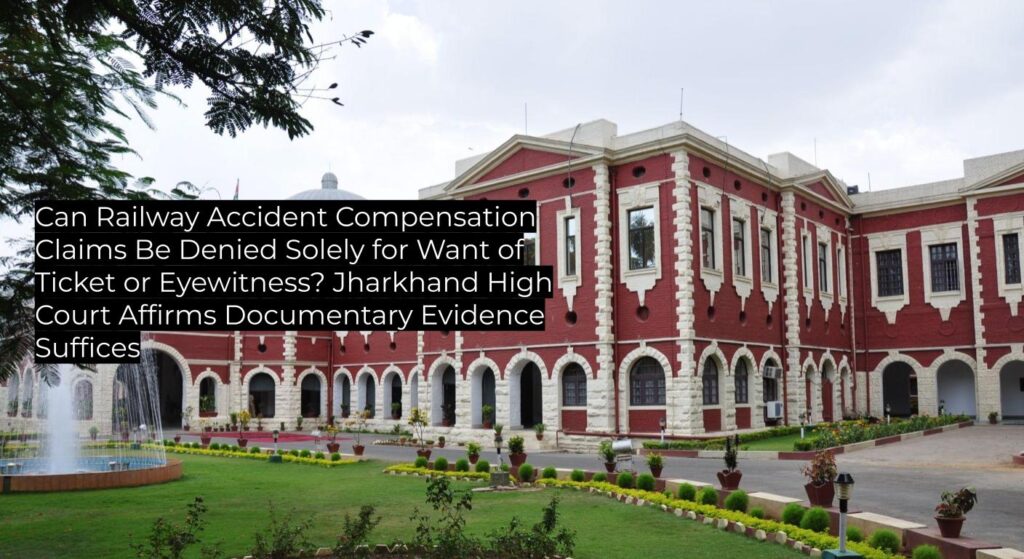
The High Court of Jharkhand held that documentary evidence such as inquest and postmortem reports indicating accidental death from a train suffices to prove a claim under the Railway Claims Tribunal Act, even if the claimant cannot produce a ticket or eyewitness. This judgment upholds and clarifies existing Supreme Court precedent, providing binding authority within the State and persuasive value elsewhere in railway claims cases.
Summary
| Category | Data |
|---|---|
| Case Name | MA/432/2024 of SRI SUDHIR SAH Vs UNION OF INDIA THROUGH THE GENERAL MANAGER, EASTERN RAILWAY |
| CNR | JHHC010328482024 |
| Date of Registration | 04-12-2024 |
| Decision Date | 15-10-2025 |
| Disposal Nature | Allowed |
| Judgment Author | HON’BLE MR. JUSTICE GAUTAM KUMAR CHOUDHARY |
| Court | High Court of Jharkhand |
| Precedent Value | Binding on subordinate courts in Jharkhand; persuasive elsewhere |
| Overrules / Affirms | Affirms Supreme Court precedent (Union of India v. Rina Devi (2019) 3 SCC 572) |
| Type of Law | Railway accident claims, compensation, evidentiary standards |
| Questions of Law | Whether absence of passenger ticket and eyewitness alone can justify dismissal of a railway accident compensation claim when documentary evidence supports accidental death from a train. |
| Ratio Decidendi | The High Court held that refusal to grant compensation under Section 16 of the Railway Claims Tribunal Act purely on the grounds of absence of a ticket or eyewitness is unsustainable if reliable documentary evidence exists. Documentary evidence, such as inquest and postmortem reports—especially when produced by the railways themselves and marked as exhibits—are sufficient to establish accidental death arising from a train accident. The tribunal’s contrary finding was set aside, and compensation awarded under the applicable rules. |
| Judgments Relied Upon | Union of India v. Rina Devi (2019) 3 SCC 572 |
| Logic / Jurisprudence / Authorities Relied Upon by the Court | Relied on documentary evidence (inquest report, postmortem report) and Supreme Court precedent recognizing their sufficiency in the absence of direct testimony or ticket production. |
| Facts as Summarised by the Court | Deceased Kanhaiya Kumar was returning from Howrah to Simultala by train no. 13019 Bagh Express. Father purchased the ticket. The deceased fell from a running train on 31.05.2019 resulting in death. No eyewitness and ticket not produced; however, inquest and postmortem records confirmed accidental fall. |
Practical Impact
| Category | Impact |
|---|---|
| Binding On | All subordinate courts in Jharkhand |
| Persuasive For | Other High Courts, Supreme Court |
| Follows | Union of India v. Rina Devi (2019) 3 SCC 572 |
What’s New / What Lawyers Should Note
- Clarifies that lack of an eyewitness or absence of a passenger ticket alone do not justify dismissal of railway accident compensation claims if reliable documentary evidence of accidental death is available.
- Reinforces that documentary evidence, including inquest and postmortem reports (even those produced by railways and marked as exhibits), can be determinative in establishing entitlement to compensation.
- Reiterates the Supreme Court’s approach (Rina Devi, 2019) and applies it to factually similar circumstances at the High Court level.
- Lawyers can rely on this precedent to argue compensation claims where circumstantial and documentary evidence substantiate the occurrence, even without strict ticket proof or direct witness testimony.
Summary of Legal Reasoning
- The High Court examined whether the absence of ticket and eyewitnesses can be the sole basis for denying compensation when other reliable evidence is present.
- It found that the claimant produced multiple forms of documentary evidence (inquest, postmortem, station memo) confirming an accidental fall from a train, which the tribunal had recorded as exhibits.
- The Court relied on the Supreme Court’s decision in Union of India v. Rina Devi (2019), which recognized that compensation cannot be denied merely due to lack of ticket or eyewitnesses if surrounding circumstances and official records indicate accidental death while traveling on a train.
- The tribunal’s reliance on the DRM inquiry report was found unconvincing as substantive evidence clearly pointed to accidental death from the train.
- The Court set aside the tribunal’s order and awarded statutory compensation with interest, emphasizing sufficiency of circumstantial and documentary proof over technical requirements like ticket retention.
Arguments by the Parties
Petitioner:
- Submitted that documentary evidence—including inquest, postmortem, final police, and DRM reports—collectively demonstrated the death was accidental and resulted from a fall from the running train.
- Argued dismissal based solely on non-production of ticket and lack of eyewitness was incorrect, relying specifically on Supreme Court ruling in Rina Devi (2019).
Respondent (Union of India / Railways):
- Contended that in genuine accidental train deaths, a report would be made by the train driver, guard, or attendant, which was absent here.
- Pointed to the DRM’s inquiry finding suggesting cause of death was not established as from a fall from the train, but possibly impact by an unknown train.
Factual Background
The deceased, Kanhaiya Kumar, was returning from Howrah to Simultala by train no. 13019 Bagh Express on 31.05.2019. He had been sent to Kolkata by his father, who purchased his travel ticket. Kanhaiya Kumar did not reach his destination. His body was found near the railway track between JSME and Tulsitar on 01.06.2019 and identified by his Voter Identity Card. Various official records (inquest, FIR, postmortem) were produced; however, the claimant could not produce the actual travel ticket and no eyewitness testified to the accident.
Statutory Analysis
The Court applied Section 16 of the Railway Claims Tribunal Act, 1987 and Rule 3 of the Railway Accidents and Untoward Incidents (Compensation) Rules, 1990. It enforced the statutory minimum compensation amount and interest rate as per Rule 3, awarding Rs. 8,00,000 with 7.5% interest from the date of accident. Interpretation was consistent with Supreme Court guidance that technical deficiencies (like absence of ticket) cannot override substantive documentary evidence proving accidental railway death.
Dissenting / Concurring Opinion Summary
No dissenting or concurring opinions were recorded in the judgment.
Procedural Innovations
No new procedural guidelines, directions, or innovations were issued in the judgment.
Alert Indicators
- ✔ Precedent Followed