


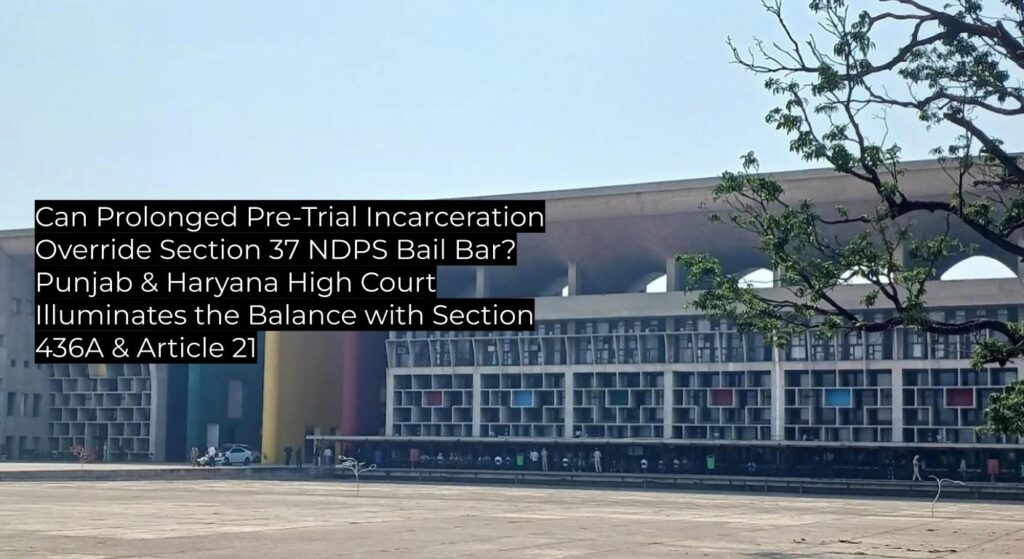
The High Court clarifies that, despite the rigours of Section 37 NDPS Act, long incarceration—especially when the trial is delayed and no prosecution witness has been examined—can weigh in favour of granting bail, aligning this principle with Section 436A CrPC and Article 21. The decision upholds existing precedent and is binding on subordinate courts within Punjab & Haryana, with persuasive value for other jurisdictions prosecuting NDPS offences.
Summary
| Category | Data |
|---|---|
| Case Name | CRM-M/3222/2025 of MOHD AARIF Vs STATE OF PUNJAB |
| CNR | PHHC010088442025 |
| Date of Registration | 18-01-2025 |
| Decision Date | 28-10-2025 |
| Disposal Nature | ALLOWED |
| Judgment Author | MRS. JUSTICE MANISHA BATRA |
| Court | High Court of Punjab and Haryana |
| Precedent Value | Binding on subordinate courts within its jurisdiction; persuasive for other High Courts |
| Type of Law |
|
| Questions of Law | Whether prolonged incarceration and delay in trial can enable grant of bail under NDPS Act, overriding Section 37 |
| Ratio Decidendi |
The Court held that even though Section 37 of the NDPS Act imposes stringent conditions for bail in commercial quantity NDPS cases, a prolonged period of incarceration—especially when the trial is delayed and no prosecution witness has been examined—justifies consideration for bail. The imperative of Section 436-A CrPC and Article 21’s guarantee of personal liberty militate against indefinite detention, overriding statutory embargo. The lack of further requirement for investigation and continued detention serving no “useful purpose” are material factors. |
| Facts as Summarised by the Court | The petitioner was arrested in May 2024 for possession of 315 grams of heroin (commercial quantity) and has been in custody for over a year; no prosecution witness has been examined and no further investigation is pending. |
Practical Impact
| Category | Impact |
|---|---|
| Binding On | All subordinate courts within Punjab & Haryana |
| Persuasive For | Other High Courts and Supreme Court, especially in cases with prolonged custody under NDPS Act |
What’s New / What Lawyers Should Note
- The Court reaffirms that the statutory embargo under Section 37 of NDPS Act is not absolute; Article 21 and Section 436-A CrPC can justify bail when incarceration is unduly prolonged.
- Even for commercial quantity NDPS cases, delayed prosecution and lack of progress (such as no prosecution witness examined) weigh for bail.
- Defence lawyers can cite this to argue for bail in NDPS cases where pre-trial custody is extended and no significant progress in trial has occurred.
- The Court specifically noted that mere seriousness of accusations does not eclipse constitutional rights if trial is delayed.
Summary of Legal Reasoning
- The Court acknowledged the stringent conditions of Section 37 of the NDPS Act in granting bail for commercial quantity offences.
- Nevertheless, it emphasized that pre-trial incarceration for a prolonged period, with no examination of prosecution witnesses and no requirement for further investigation, infringes Article 21.
- The Court explained that Section 436-A CrPC, which allows consideration of the time an accused has spent in custody during trial, applies to NDPS offences.
- The rationale is that continued detention serves no useful purpose and must not outweigh the fundamental right to liberty, especially when trial is expected to be delayed further.
- The Court balanced the gravity of the offence against the realities of delayed criminal proceedings and the non-absolute nature of statutory bail embargoes.
- No specific case law was cited as relied upon in the judgment text provided.
Arguments by the Parties
Petitioner:
- Contended false implication and that alleged recovery was planted.
- Argued that the trial progress was negligible, with no prosecution witnesses examined.
- Emphasized clean antecedents and no involvement in any other criminal case.
- Stated that further incarceration would serve no useful purpose.
Respondent (State):
- Argued that serious and specific allegations existed.
- Asserted that Section 37 NDPS Act rigours apply.
- Claimed petitioner had criminal antecedents and was involved in two other similar cases.
- Expressed apprehension of likelihood of recurrence of offences if released.
Factual Background
On the basis of a secret information, the petitioner and a co-accused were apprehended on 17.05.2024, allegedly in conscious possession of 315 grams of heroin. FIR No. 58 was registered under Sections 21 and 29 of the NDPS Act at Police Station City-I, Malerkotla. The petitioner has been in custody for over a year; the investigation is complete, and the trial has not progressed, with no prosecution witnesses examined at the time of decision.
Statutory Analysis
- Section 37 of the NDPS Act: Imposes stringent conditions against bail for commercial quantity offences, requiring satisfaction of certain prerequisites.
- Section 436-A CrPC: Allows consideration of the period undergone in custody during trial for purpose of bail.
- Article 21 of the Constitution: Protects the right to personal liberty, which the Court found to be threatened by indefinite incarceration.
- The Court interpreted these provisions collectively, holding that long pre-trial custody must override procedural embargo on bail in appropriate circumstances.
Alert Indicators
- ✔ Precedent Followed – The decision affirms the established approach that constitutional rights and prolonged custody justify bail even under NDPS Act’s strictures.