


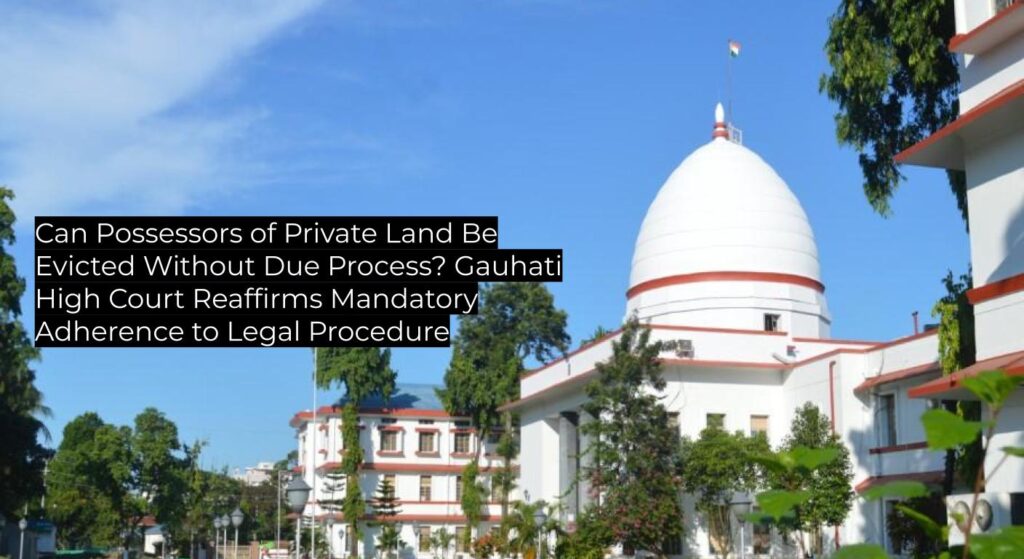
The Gauhati High Court has reaffirmed that eviction from private land—even if the possessors lack title—cannot be done without following the due process of law. The judgment clarifies that technical objections about association registration do not bar such petitions, and that preventive writ jurisdiction is available even on bona fide apprehension of rights violation. The judgment upholds and applies existing Supreme Court precedent, providing robust precedential value for all subordinate courts in Assam.
Summary
| Category | Data |
|---|---|
| Case Name | WP(C)/2391/2021 of TRINAYAN NAGAR UNNAYAN SAMITEE AND 4 ORS Vs THE STATE OF ASSAM AND 7 ORS |
| CNR | GAHC010062582021 |
| Date of Registration | 26-03-2021 |
| Decision Date | 15-10-2025 |
| Disposal Nature | Disposed Of |
| Judgment Author | HONOURABLE MR. JUSTICE SANJAY KUMAR MEDHI |
| Court | Gauhati High Court |
| Precedent Value | Binding on all subordinate courts in Assam; strong persuasive value for broader jurisdictions |
| Overrules / Affirms |
|
| Type of Law | Constitutional law, property law, procedural law |
| Questions of Law |
|
| Ratio Decidendi |
The Court held that eviction from private land—even where occupants are mere possessors and not title holders—requires strict adherence to the due process of law. Actions taken by authorities to remove occupants without legal authority or court orders are illegal. Technical objections like association registration status are not valid where fundamental rights are alleged to have been violated. Preventive writ jurisdiction under Article 226 is maintainable even on bona fide apprehension of right violation. The actual merits of title and possession disputes must be determined in properly instituted civil proceedings. |
| Judgments Relied Upon |
|
| Logic / Jurisprudence / Authorities Relied Upon by the Court |
Cited Supreme Court and Privy Council decisions emphasizing that rights (including possession) cannot be disturbed except through prescribed legal processes. Reaffirmed the principle that preventive relief via writ is available on bona fide apprehension. Dismissed technical objections where fundamental rights are at stake, especially where representative litigation by associations is involved. |
| Facts as Summarised by the Court |
Petitioners (an association and its members) were dispossessed/evicted from 2 bighas of private land on 02.02.2021 by authorities who handed over possession to a private company. Land was originally requisitioned in 1976, derequisitioned in 1999, and then purchased (with encumbrance in possession) by the private respondent in 2011. Previous eviction proceedings under the Public Premises Act were quashed in 2014. A title suit and land grabbing criminal case involving the same land are pending. Petitioners challenge the eviction as illegal and without legal backing, invoking the Court’s preventive writ jurisdiction. |
Practical Impact
| Category | Impact |
|---|---|
| Binding On | All subordinate courts in Assam |
| Persuasive For | Other High Courts, Supreme Court |
| Follows |
|
What’s New / What Lawyers Should Note
- Reaffirms that even possessors (without title) of private land cannot be evicted without adhering to the due process of law.
- Technical defects regarding the registration status of an association do not bar maintainability of writ petitions where rights are at stake.
- Preventive writs under Article 226 are maintainable even on apprehension of violation, not just after rights are infringed.
- The order specifically sets aside administrative eviction actions not backed by court or lawful authority.
- Provides clear authority that private law disputes (e.g., title/possession) must be resolved in civil courts, not by executive fiat.
- Lawyers can cite this decision to resist forced dispossession by authorities or private parties without court orders, especially where civil or criminal proceedings on title/possession are pending.
Summary of Legal Reasoning
- Undisputed Facts & Status of Land: The land in question, once requisitioned and then derequisitioned, reverted to private ownership. Petitioners are in possession; respondent’s title flows from a purchase made with notice of encumbrant possession.
- Precedent on Due Process: The Court relied on Supreme Court and Privy Council precedents (State of MP v. Bhailal Bhai; Nazir Ahmad v. King Emperor) to hold that removal/eviction from private land is permissible only after following the procedure established by law.
- Writ Jurisdiction & Bona Fide Apprehension: The Court relied on Bhailal Bhai and SMD Kiran Pasha to conclude that Article 226 provides not only for remedies after violation but pre-violation (preventive) relief on bona fide apprehension.
- Representative Actions/Technical Objections: Following Akhil Bharatiya Soshit Karamchari Sangh (Railway) v. Union of India, the Court dismissed technical objections about association registration, especially where fundamental rights are implicated.
- Efficacy of Possessor’s Rights: Even mere possession is protected in law; authorities cannot lawfully dispossess or handover land to others without court orders or following due legal process.
- Pending Civil and Criminal Proceedings: The ongoing title suit and land grabbing case are recognized as the appropriate forums for deciding substantive rights. The present writ is limited to setting aside illegal dispossession.
- Conclusion: The Court declared the eviction action illegal and set it aside, while clarifying that its order does not affect determination of title or criminal liability, which remain sub judice.
Arguments by the Parties
Petitioner
- Only possessors of private land but entitled to due process before eviction.
- Land reverted to private status after derequisition in 1999.
- Eviction on 02.02.2021 was without court order or legal process.
- Cited Supreme Court precedent allowing writs on bona fide apprehension (Bhailal Bhai).
- Argued that technical objection regarding registration lacks merit; registration renewal was pending and subsequently granted; judgment in Akhil Bharatiya Soshit Karamchari Sangh supports maintainability.
State/Respondent Authorities
- Preliminary objection: Association not validly registered at petition institution, bars maintainability.
- Title suit on same dispute already pending, making present writ infructuous.
- No affidavit-in-opposition filed by the State.
Respondent No. 4 (Administrative Authority)
- Defended action of 02.02.2021, claiming due process was followed (but could not produce documents due to suspension).
Respondent No. 8 (Private Purchaser)
- Supported State’s objections on registration and maintainability.
- Asserted petitioners have no individual cause, only as association members.
- Claimed land re-vested in owner in 1999.
- Asserted writ is counter-blast to FIR/Title Suit.
- Alleged petitioners misusing status quo order and altering property.
Factual Background
The petition concerned 2 bighas of land at Maidamgaon, Guwahati, part of a larger plot initially requisitioned by the State in 1976 and subsequently derequisitioned in 1999, reverting to private ownership. The land was purchased by respondent no. 8 in 2011, subject to existing possessory encumbrances. Petitioners, an association and its members, were in possession. On 02.02.2021, State authorities dispossessed the petitioners without any court order and handed possession to respondent no. 8. Previous public premises eviction proceedings were quashed in 2014. Title and land grabbing cases are pending between the parties. Petitioners challenged the dispossession as illegal and premature.
Statutory Analysis
- Section 8(1) of the Assam Land (Requisition & Acquisition) Act, 1964, was discussed regarding vesting of land back to its owner upon derequisition.
- The Assam Public Premises (Eviction of Unauthorized Occupation) Act, 1971, was referenced; prior proceedings under this Act were quashed as the land was not public premises.
- Article 226 of the Constitution was crucial, with the Court confirming its scope to grant preventive relief (injunction) on threat/apprehension of rights violation, not just after violation.
- Order 39 Rules 1 & 2 CPC discussed in passing, referencing the pending injunction application in the civil suit.
Dissenting / Concurring Opinion Summary
No dissenting or concurring opinions are recorded in this judgment.
Procedural Innovations
- The Court clarified that technical objections such as lack of registration will not defeat consideration of writ petitions involving breach of fundamental rights, referencing Supreme Court precedent.
- Affirmed the availability of preventive writ relief under Article 226 on bona fide apprehension of rights violation, before actual infringement.
- The order made clear its non-interference with the merits of pending civil or criminal proceedings, allowing those to continue independently.
Alert Indicators
- ✔ Precedent Followed – Judgment closely adheres to existing Supreme Court and Privy Council authority regarding due process, preventive relief in writ proceedings, and technical maintainability objections.