


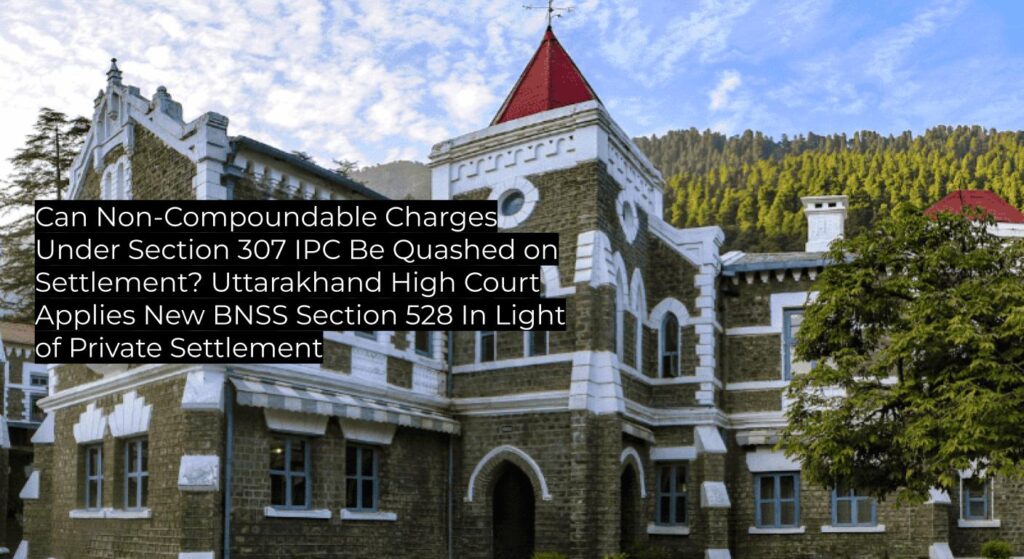
The Uttarakhand High Court, applying Section 528 of the Bharatiya Nagarik Suraksha Sanhita, 2023, clarified that proceedings under non-compoundable charges like Section 307 IPC can be quashed on the basis of genuine settlement between parties. This case reaffirms existing precedent and provides binding value for subordinate courts in Uttarakhand, offering important guidance on quashing in light of the new BNSS framework.
Summary
| Category | Data |
|---|---|
| Case Name | C528/1832/2025 of PRAKASH SINGH Vs STATE OF UTTARAKHAND |
| CNR | UKHC010162572025 |
| Date of Registration | 13-10-2025 |
| Decision Date | 31-10-2025 |
| Disposal Nature | ALLOWED |
| Judgment Author | Hon’ble Mr. Justice Alok Kumar Verma |
| Court | High Court of Uttarakhand |
| Precedent Value | Binding on subordinate courts in Uttarakhand |
| Type of Law | Criminal Law; Quashing of criminal proceedings based on settlement under BNSS |
| Questions of Law | Whether proceedings under Sections 307, 452, 504 IPC can be quashed via Section 528 BNSS on settlement, despite Section 307 IPC being non-compoundable? |
| Ratio Decidendi |
The Court held that, considering the facts—where the accused is the real nephew of the informant, both parties were present and affirmed a voluntary settlement, and the informant supported quashing—the ends of justice would be met by allowing quashing of proceedings, even though Section 307 IPC is non-compoundable. The compounding application was accepted after ensuring there was no coercion or pressure. The Court deemed that individual, familial settlements with no societal impact could form the basis for quashing under Section 528 BNSS, overruling State opposition rooted solely on non-compoundability. |
| Facts as Summarised |
FIR was lodged on 08.08.2023 under Sections 307, 452, and 504 IPC, alleging the applicant (nephew) entered the informant’s room and caused injuries. Both parties later settled voluntarily, filed a compounding application, and informed the Court that they were now living in harmony. |
Practical Impact
| Category | Impact |
|---|---|
| Binding On | All subordinate courts in Uttarakhand |
| Persuasive For | Other High Courts |
What’s New / What Lawyers Should Note
- First reported application of Section 528 of the Bharatiya Nagarik Suraksha Sanhita, 2023, for quashing criminal proceedings in Uttarakhand.
- Affirms that even non-compoundable offences (like Section 307 IPC) may be quashed if parties have genuinely settled and the matter is essentially private.
- State opposition on the ground of non-compoundability alone does not prevent quashing when settlement is bona fide and justice warrants it.
- Lawyers should document and present proof of voluntary, pressure-free settlements with affidavits and compounding applications.
Summary of Legal Reasoning
- The Court recorded that the applicant and informant (close relatives) were present and had voluntarily settled their dispute, submitting a compounding application and supporting affidavits.
- The informant expressly supported quashing of proceedings and confirmed there was no coercion.
- The State opposed the application citing Section 307 IPC as non-compoundable.
- The Court determined that, given the private nature of the dispute and the complete settlement between parties, justice would be served by quashing proceedings, using the power under Section 528 BNSS.
- Emphasized that the societal impact criterion was satisfied—no wider public interest would be harmed.
- The order was passed to advance the ends of justice despite statutory bar on compounding under Section 307 IPC.
Arguments by the Parties
Petitioner (Applicant):
- Parties are close relatives (nephew and uncle/informant).
- Dispute was settled amicably, voluntarily, and without any undue pressure.
- Both parties now wish to live in harmony, and settlement documents were formally filed.
- Requested quashing of trial proceedings to prevent further abuse of process.
Respondent No. 2 (Informant):
- Confirmed voluntary settlement.
- Supported the applicant’s request and did not wish to pursue the case.
- Affirmed that no coercion or pressure was involved.
Respondent No. 1 (State):
- Opposed the application on the sole ground that Section 307 IPC is non-compoundable.
- Argued that quashing proceedings may not be permissible in such cases.
Factual Background
The case arose from a personal dispute between close family members, where the applicant allegedly entered the informant’s room and physically assaulted him, causing injuries. FIR was filed on 08.08.2023 under Sections 307 (attempt to murder), 452 (house-trespass after preparation), and 504 (intentional insult with intent to provoke breach of the peace) IPC. Subsequently, both parties amicably resolved their differences and jointly moved the High Court for quashing of the criminal proceedings, submitting a compounding application and affidavits evidencing the voluntary settlement.
Statutory Analysis
- The primary provision invoked was Section 528 of the Bharatiya Nagarik Suraksha Sanhita, 2023, empowering High Courts to quash criminal proceedings when justice demands, even where compounding is otherwise barred.
- The Court noted the non-compoundable nature of Section 307 IPC but construed Section 528 BNSS to grant inherent power for quashing where private disputes are resolved and continuance of prosecution would not serve justice.
Procedural Innovations
- The case marks the precedent for using Section 528 BNSS (2023) for quashing criminal proceedings in Uttarakhand consequent to a voluntary settlement.
- Acceptance of compounding applications and affidavits as sufficient evidence of genuine compromise between parties.
Alert Indicators
- ✔ Precedent Followed – Existing principles regarding quashing on settlement applied to new BNSS framework.