


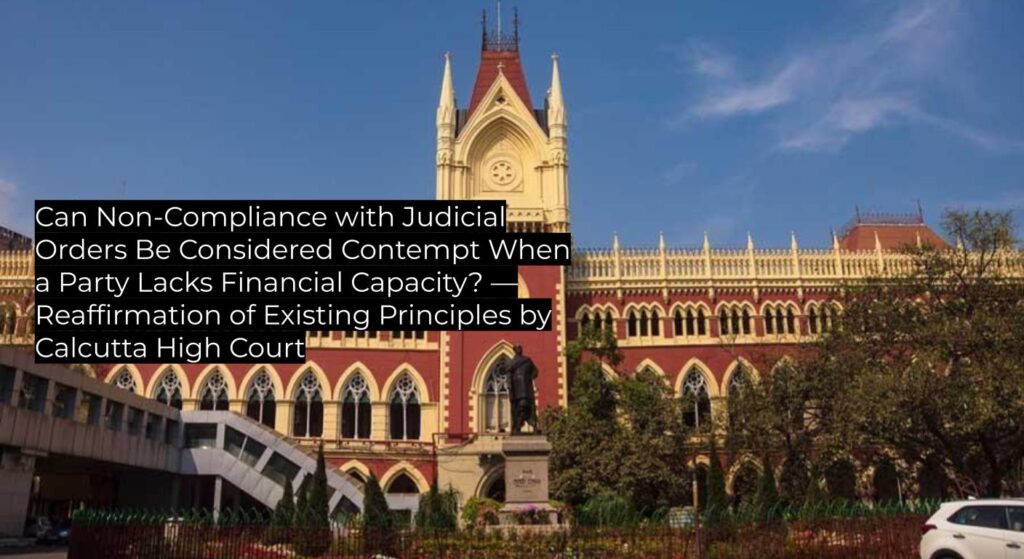
The Calcutta High Court reiterates that inability to comply with a court’s direction due to genuine financial incapacity does not amount to contempt; affirms precedent and preserves the petitioner’s right to seek modification. The decision serves as binding authority within the jurisdiction and provides instructive value on the interplay between contempt and enforceability.
Summary
| Category | Data |
|---|---|
| Case Name | CPAN/1485/2025 of SOBHA SINGH Vs NIMAI GHOSH CHAIRMAN MADHYAMGRAM MUNICIPALITY AND ANR |
| CNR | WBCHCA0408852025 |
| Date of Registration | 26-08-2025 |
| Decision Date | 31-10-2025 |
| Disposal Nature | DISMISSED |
| Judgment Author | HON’BLE JUSTICE KAUSIK CHANDA |
| Court | Calcutta High Court |
| Bench | Single Judge (Justice Kausik Chanda) |
| Precedent Value | Binding within Calcutta High Court and subordinate courts |
| Overrules / Affirms | Affirms existing principles on contempt and financial inability |
| Type of Law | Contempt of Court / Civil Procedure |
| Questions of Law | Whether failure to comply with a judicial order owing to lack of financial capacity amounts to contempt. |
| Ratio Decidendi |
The Court held that non-compliance with a previous order, requiring the petitioner to pay the estimated cost for construction, cannot be deemed contemptuous when the petitioner’s inability stems from genuine financial hardship. There was no willful or deliberate disobedience proved, and thus, no contempt was established. The order clarifies that such circumstances do not attract punitive measures under contempt jurisdiction and preserves the petitioner’s liberty to seek appropriate modification of earlier orders in accordance with law. |
| Facts as Summarised by the Court |
The Engineer, following court orders, prepared a drainage construction plan, but the work could not commence as the petitioner failed to deposit the estimated cost (Rs. 1,58,803/-). The petitioner admitted non-payment on account of poor financial condition. The Special Officer was accordingly discharged. |
Practical Impact
| Category | Impact |
|---|---|
| Binding On | All subordinate courts within jurisdiction of Calcutta High Court |
| Persuasive For | Other High Courts on issues relating to contempt and inability to comply due to poverty |
| Follows | Established principles regarding the necessity of willful disobedience for contempt |
What’s New / What Lawyers Should Note
- Clarifies that genuine financial incapacity to comply with court orders does not, by itself, constitute contempt of court.
- Affirms that dismissal of a contempt application does not bar the petitioner from seeking modification of the original order.
- Reinforces the necessity of proving willful and deliberate non-compliance for contempt actions to succeed.
- The judgment provides clear precedent for future cases where inability to pay or comply stems from poverty or hardship.
Summary of Legal Reasoning
- The Court recited that for contempt to be established, there must be willful or deliberate disobedience of a court order.
- Here, the applicant admitted non-payment, citing poor financial condition, and did not dispute the demand for estimated construction costs.
- The Court observed that, absent willful default and in the presence of financial incapacity, a finding of contempt is not justified.
- Accordingly, the contempt application was dismissed.
- The Court specifically noted that the petitioner remains at liberty to make a proper application for modification of the original order, preserving procedural fairness.
- Special thanks were recorded for the Special Officer, who was discharged.
Arguments by the Parties
Petitioner
- Admitted failure to deposit the required sum for drainage construction.
- Submitted that the non-compliance was due to his poor financial condition and inability to pay the estimated cost.
Respondent (Special Officer)
- Informed the Court that the construction could not commence solely because the petitioner did not deposit the estimated cost, as required by previous court order.
Factual Background
Pursuant to earlier directions, an Engineer appointed by the Madhyamgram Municipality inspected the petitioner’s premises and submitted a drainage construction plan. The petitioner was to deposit an estimated cost of Rs. 1,58,803/-, but admitted that due to his poor financial condition, he could not do so. As a result, the municipality could not commence the construction work, leading to the current contempt proceedings against the respondent, which the Court ultimately dismissed.
Statutory Analysis
The judgment applies the established legal standard for contempt: that only willful or deliberate disobedience of a court order constitutes contempt. The judgment does not reference or interpret any specific statutory provision in detail but reiterates that inability to comply (particularly for financial reasons) does not amount to contemptuous conduct.
Alert Indicators
- ✔ Precedent Followed – When existing law is affirmed.