


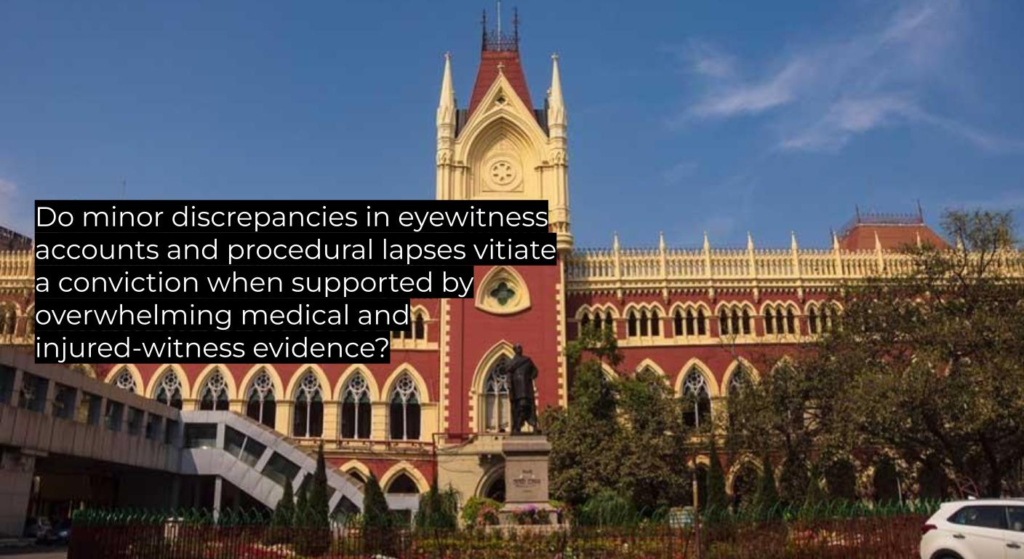
The Calcutta High Court answers “no,” reaffirming that normal contradictions and incomplete recovery of weapons do not defeat convictions when injured witnesses’ evidence and medical reports are overwhelming; this decision upholds existing Supreme Court precedents and serves as binding authority for criminal trials.
Summary
| Category | Data |
|---|---|
| Case Name | CRA/266/2015 of AFTAB SK @ ATAB SK & ORS Vs STATE OF WEST BENGAL |
| CNR | WBCHCA0249992015 |
| Date of Registration | 11-05-2015 |
| Decision Date | 18-08-2025 |
| Disposal Nature | DISMISSED |
| Judgment Author | Rajasekhar Mantha, J. |
| Concurring or Dissenting Judges | Ajay Kumar Gupta, J. (concurring) |
| Court | Calcutta High Court |
| Bench | Two-Judge Bench |
| Precedent Value | Upholds existing Supreme Court precedents; binding |
| Overrules / Affirms | Affirms |
| Type of Law | Criminal law (IPC) |
| Questions of Law | Are minor discrepancies in eyewitness accounts and investigative omissions fatal to conviction under Sections 302, 326 and 34 IPC? |
| Ratio Decidendi |
|
| Judgments Relied Upon |
|
| Logic / Jurisprudence / Authorities Relied Upon by the Court | The court applied the distinction between material and normal discrepancies; held that inquest reports supply mere leads; post-mortem meal-time opinion is not conclusive; followed high value of injured eyewitness testimony; held that faulty investigation or non-recovery of agricultural tools does not defeat clear-cut medical and eyewitness evidence. |
| Facts as Summarised by the Court | A boundary dispute in a paddy field escalated into a group attack by 20–30 persons armed with agricultural implements. One victim was killed and several family members suffered grievous injuries. Multiple related eyewitnesses (PWs 1–4, 8–10) testified, producing bed-head tickets and a post-mortem report. Two officers investigated; weapons were not seized; one accused lacked direct evidence and was acquitted. |
| Citations | (1983) 3 SCC 217; (1975) 4 SCC 153; 2023 SCC OnLine SC 35; (1981) 2 SCC 752; (1995) 4 SCC 511; (2011) 2 SCC 234; (2016) 16 SCC 192; (2023) 19 SCC 672; (1998) 9 SCC 49; (2010) 4 SCC Cri 67; (2016) 12 SCC 76; (2015) 6 SCC 282 |
Practical Impact
| Category | Impact |
|---|---|
| Binding On | All Sessions and subordinate courts in West Bengal |
| Persuasive For | Other High Courts, trial courts nationwide |
| Overrules | (None) |
| Distinguishes | Md. Jabbar Ali v. State of Assam ((2023) 19 SCC 672) on material discrepancies vs normal discrepancies |
| Follows | Bharwada Bhoginbhai v. State of Gujarat; Pedda Narayana v. State of AP; State of Rajasthan v. Kalki |
What’s New / What Lawyers Should Note
- Confirms that contradictory timings and meal-time opinions in PM reports do not vitiate eyewitness evidence.
- Reaffirms that inquest reports are preliminary leads and do not fetter police discretion in investigation.
- Emphasises that minor variations in large-group assaults among injured eyewitnesses are “normal discrepancies” and not fatal to prosecution.
- Clarifies that non-recovery of commonplace agricultural implements and even omission of a dying declaration do not automatically entitle accused to benefit of doubt.
- Demonstrates the court’s power to acquit specific co-accused when no direct evidence links them to the homicidal act, even in joint-venture cases.
Summary of Legal Reasoning
- Timing and Inquest Discrepancies: Held that variations in time estimates by lay witnesses and separate UD case registration at hospital do not undermine core evidence (Bharwada Bhoginbhai).
- Scope of Inquest Reports: Inquest under Section 174 CrPC provides preliminary leads; police may pursue or repudiate them based on relevance (Pedda Narayana).
- Post-Mortem Opinions: PM on last meal is advisory and not conclusive on incident timing.
- Normal vs. Material Discrepancies: Minor differences in identifying which accused held victim’s arms are natural in chaotic assaults; material discrepancies alone can vitiate (Kalki; Md. Jabbar Ali).
- Evidentiary Value of Injured Witnesses: Injured eyewitness testimony carries high weight, absent compelling reasons to discard it (Balu Sudam Khalde).
- Faulty Investigation: Non-recovery of weapons and delayed statements are irrelevant if medical and eyewitness evidence is otherwise unimpeachable (State of U.P. v. Wasif Haider).
- Common Intention (Section 34 IPC): Convictions affirmed for those who acted in furtherance of exhortations to kill; acquittal of co-accused against whom no direct evidence was led.
- Benefit of Doubt for Waser Sk.: No medical or eye-witness proof of his participation; acquitted accordingly.
Arguments by the Parties
Petitioners (Appellants):
- The incident timing is inconsistent with PM meal-time opinion and hospital inquest timing.
- Inquest report named a different assailant (“son of Tajer Bere”) not investigated.
- Witnesses gave varying accounts of who held the victim, indicating parrot-like or confused testimony.
- Weapons used were not recovered; FSL report not produced.
- No dying declaration produced despite request.
- Genesis of conflict differs in several testimonies (PW 6 vs. main witnesses).
Respondent (State):
- Multiple injured eyewitnesses uniformly identified the assailants and their roles.
- Medical evidence and bed-head tickets corroborate the nature and sequence of injuries.
- Minor contradictions are normal in large-scale violent incidents.
- Inquest and PM discrepancies relate only to preliminary details and do not affect substance.
- Faulty or incomplete investigation does not override overwhelming admissible evidence.
Factual Background
On 9 November 2005, a boundary dispute in a paddy field triggered a mass assault by 20–30 persons armed with ram dao, tangi, sticks, and a pistol. One victim, Lalchand Mallick, died of sharp-force injuries; his father and brothers suffered grievous cuts. The FIR under Sections 147, 148, 326 IPC was registered at Nakashipara PS. Two investigating officers recorded statements at intervals; no weapons were seized. Multiple family members of the deceased testified at trial.
Statutory Analysis
- Section 302 IPC (murder): ingredients satisfied by common intention and homicidal injuries.
- Section 326 IPC (voluntarily causing grievous hurt): grievous cut-deep injuries on multiple victims.
- Section 34 IPC (common intention): exhortation to kill (“cut their heads and take them home”) and joint action established.
- Section 174 CrPC (inquest): limited to preliminary cause of death, not exhaustive investigative mandate.
Dissenting / Concurring Opinion Summary
No separate dissent or concurrence; both judges unanimously affirmed convictions for those properly identified and acquitted one co-accused for lack of evidence.
Alert Indicators
- ✔ Precedent Followed
Citations
- Bharwada Bhoginbhai v. State of Gujarat, (1983) 3 SCC 217
- Pedda Narayana v. State of Andhra Pradesh, (1975) 4 SCC 153
- Balu Sudam Khalde v. State of Maharashtra, 2023 SCC OnLine SC 35
- Md. Jabbar Ali v. State of Assam, (2023) 19 SCC 672
- State of Rajasthan v. Kalki, (1981) 2 SCC 752
- Balaka Singh v. State of Punjab, (1995) 4 SCC 511
- Jagat Singh v. State of Himachal Pradesh, (2011) 2 SCC 234
- Pankaj v. State of Rajasthan, (2016) 16 SCC 192
- Munna Lal v. State of Uttar Pradesh, (2023) 18 SCC 661
- Abdul Razak v. State of Karnataka, (2015) 6 SCC 282