


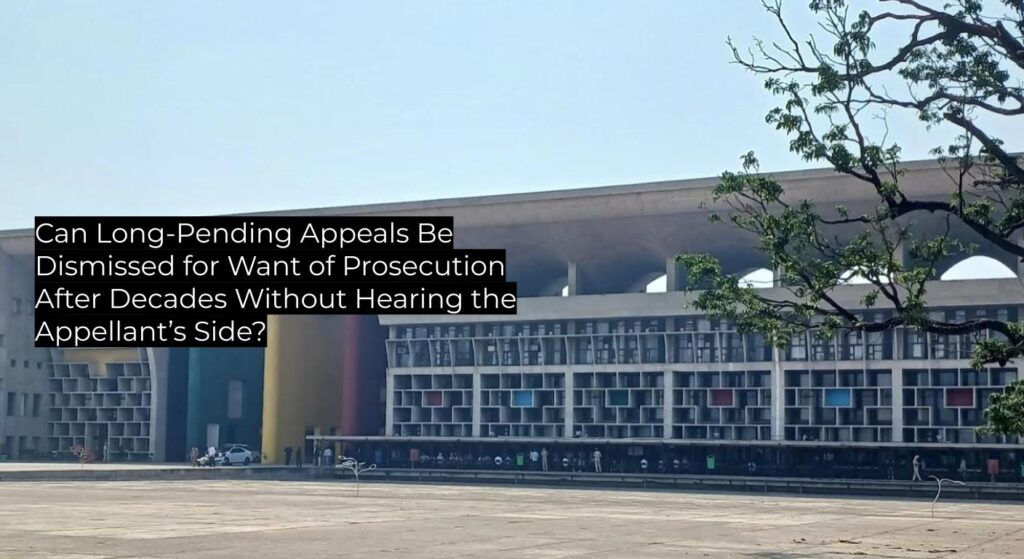
The court reaffirmed that when appellants fail to appear and prosecute an old appeal despite repeated calls, the court may dismiss the case for want of prosecution. This judgment upholds established procedural law and is binding precedent for all subordinate courts dealing with long-pending appeals. The ruling echoes judicial efficiency and the importance of parties diligently pursuing their cases.
Summary
| Category | Data |
|---|---|
| Case Name | FAO/1980/2003 of MEERA DEVI ETC. Vs ASHOK KUMAR ETC. |
| CNR | PHHC010554792003 |
| Date of Registration | 05-05-5500 |
| Decision Date | 30-10-2025 |
| Disposal Nature | DISMISSED |
| Judgment Author | MR. JUSTICE VIRINDER AGGARWAL |
| Court | High Court of Punjab and Haryana |
| Bench | Single Bench |
| Precedent Value | Binding on subordinate courts within jurisdiction |
| Overrules / Affirms | Affirms established law on dismissal for non-prosecution |
| Type of Law | Procedural—Civil Appellate Practice |
| Ratio Decidendi |
The court reasoned that, when appellants do not appear despite notice and time, it signifies lack of interest in pursuing the litigation. There is no justification to indefinitely retain such cases on the docket. Dismissal for want of prosecution, with liberty to restore within a stipulated period, is a proper use of judicial discretion in managing old and pending matters. |
| Facts as Summarised by the Court |
The appeal, filed in 2003, was called twice and the appellants did not appear, indicating disinterest. The matter had been pending for more than two decades. The court found no justification to retain the appeal indefinitely. |
Practical Impact
| Category | Impact |
|---|---|
| Binding On | All subordinate courts within the jurisdiction of the Punjab & Haryana High Court |
| Persuasive For | Other High Courts, particularly on procedural handling of dormant/long-pending appeals |
| Follows | Established principles regarding dismissal for want of prosecution in appellate proceedings |
What’s New / What Lawyers Should Note
- Reaffirms that appellate courts may dismiss old appeals for want of prosecution when appellants do not appear despite repeated calls.
- Indicates courts’ willingness to clear dockets of dormant cases, especially those pending for decades.
- Appellants retain the right to revive the appeal within a limited period (here, three months), providing a procedural safeguard.
- Lawyers should advise appellants on the importance of timely presence and representation, especially in old matters.
Summary of Legal Reasoning
- The court noted the appeal was very old (from 2003) and called twice on the same day.
- No one appeared for the appellants, and the non-appearance was taken as a sign of disinterest.
- Given the age of the case and absence of prosecution, the court found no reason to keep the appeal pending indefinitely.
- The court exercised its discretion to dismiss the appeal for want of prosecution.
- The appellants were given liberty to revive the appeal within three months should they have any grievance with the dismissal.
Arguments by the Parties
Petitioner (Appellants)
No arguments recorded (no appearance).
Respondent
Represented by counsel; no arguments recorded in the text.
Factual Background
The appeal had been pending since 2003 and related to a fully burnt case. When called, appellants failed to appear on two occasions. The long delay and absence led the court to infer lack of interest from the appellants, prompting dismissal for non-prosecution.
Statutory Analysis
- The judgment does not expressly set out or interpret any statutory provision, but implicitly applies established principles permitting dismissal of appeals for non-prosecution, common in civil appellate procedure.
Dissenting / Concurring Opinion Summary
No dissenting or concurring opinions are recorded in the judgment.
Procedural Innovations
No new procedural innovations set out; judgment follows settled procedure for dismissal for non-prosecution while granting liberty for restoration within a specific period.
Alert Indicators
- Precedent Followed – Existing law on dismissal for non-prosecution in appellate procedure is reaffirmed.