


Summary
| Category | Data |
|---|---|
| Court | Supreme Court of India |
| Case Number | Crl.A. No.-004213-004213 – 2025 |
| Diary Number | 8809/2025 |
| Judge Name | HON’BLE MR. JUSTICE SANJAY KAROL |
| Bench | HON’BLE MR. JUSTICE SANJAY KAROL; HON’BLE MR. JUSTICE VIPUL M. PANCHOLI |
| Precedent Value | Binding |
| Overrules / Affirms |
|
| Type of Law | Criminal law – inherent jurisdiction under Section 482 CrPC and Section 528 BNSS |
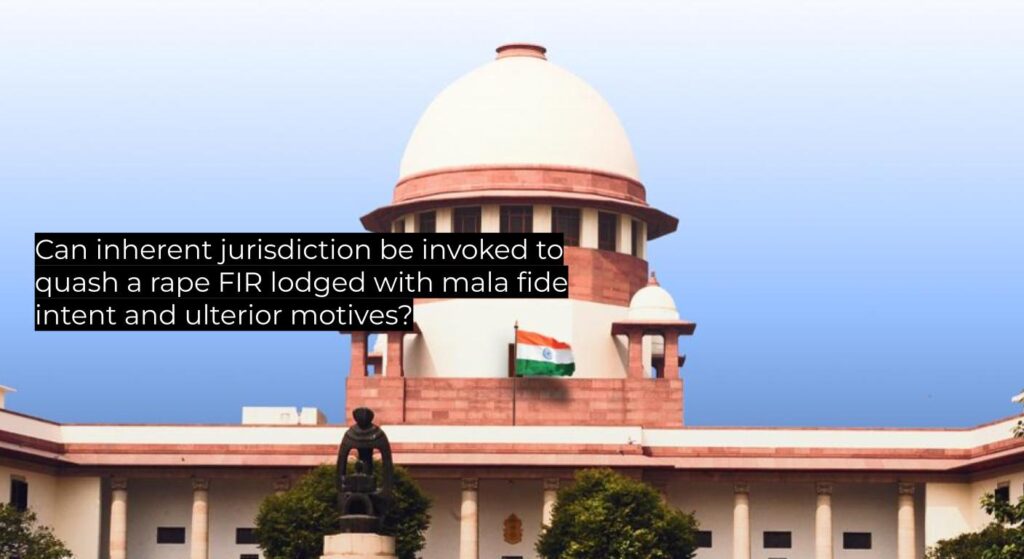
| Questions of Law | Whether a FIR and chargesheet alleging rape on promise of marriage can be quashed under inherent powers when instituted with mala fide and ulterior motives |
| Ratio Decidendi | The Court held that exercise of inherent powers under Section 528 BNSS (akin to Section 482 CrPC) permits quashing criminal proceedings where they are manifestly vexatious or instituted out of ulterior motive. Delay in lodging the FIR and preceding administrative actions against the complainant supported an inference of malice. Applying Bhajan Lal and Mohd. Wajid, the Court must look beyond pleadings to overall circumstances indicating abuse of process. |
| Judgments Relied Upon |
|
| Logic / Jurisprudence / Authorities Relied Upon | Bhajan Lal factors for quashing criminal proceedings initiated maliciously; Mohd. Wajid duty to examine overall circumstances to prevent abuse of process; inherent power under Section 528 BNSS not limited by statute |
| Facts as Summarised by the Court | The parties, colleagues for five years, entered into an intimate relationship on promise of future marriage. The Accused initiated administrative actions (show-cause notice threatening removal) against the Complainant before the FIR was lodged. The FIR for rape (Sections 376, 376(2)(n) IPC) was filed four months after the alleged incident. The timing and sequence of events suggested an ulterior motive and abuse of process. |
Practical Impact
| Category | Impact |
|---|---|
| Binding On | All subordinate courts |
| Persuasive For | Other High Courts |
| Overrules | High Court of Madhya Pradesh’s refusal to quash FIR |
| Follows |
|
What’s New / What Lawyers Should Note
- Confirms that Section 528 BNSS, like Section 482 CrPC, empowers courts to quash FIRs instituted with mala fide or ulterior motives.
- Emphasises that delay in lodging an FIR and prior administrative actions against the complainant are relevant indicia of malice.
- Reinforces that courts must look beyond the face of the FIR—examining overall circumstances—to prevent abuse of process.
- Clarifies that criminal proceedings used as a vehicle for vengeance can and should be quashed at the threshold.
- Provides a binding authority for quashing rape cases where factual determination is not required to expose ulterior motive.
Summary of Legal Reasoning
- Statutory Powers: Section 528 BNSS preserves inherent High Court powers analogous to Section 482 CrPC to prevent abuse of process and secure justice.
- Precedents: Reliance on State of Haryana v. Bhajan Lal and its reiterations in M. Srikanth and Balaji Traders to frame factors for quashing.
- Factual Matrix: Noted the five-year work relationship, sequence of administrative proceedings (show-cause notice) and four-month delay before FIR registration.
- Ulterior Motive: Held that filing FIR after employment threats and delay supported an inference of mala fide and vengeance.
- Duty to Examine: Citing Mohd. Wajid, courts must examine overall circumstances “with care and circumspection,” not restrict to FIR averments.
- Conclusion: FIR and chargesheet quashed to prevent abuse of criminal process.
Arguments by the Parties
Petitioner (Appellant-Accused)
- The FIR was lodged four months after the incident and only after administrative show-cause action, indicating a vendetta.
- The complaint was malicious and constituted an abuse of the court’s process under Section 482 CrPC / 528 BNSS.
Respondent (State of Madhya Pradesh)
- The allegation of rape on pretext of marriage raises serious questions of fact requiring trial.
- It is premature to quash the FIR at the threshold; factual disputes cannot be resolved on a quashing petition.
Factual Background
The complainant, a municipal computer operator, and the appellant-accused, an assistant revenue inspector, developed a personal relationship at work. The accused allegedly promised marriage, secured non-consensual intimacy on that basis, and later refused to marry her. After four months and following show-cause notices and administrative complaints by the accused, the complainant lodged an FIR on 7 August 2023 under Sections 376 and 376(2)(n) IPC. A chargesheet followed after investigation.
Statutory Analysis
- Section 528 BNSS, 2023: Preserves inherent High Court powers to prevent abuse of process or secure justice, mirroring Section 482 CrPC.
- Section 482 CrPC: Recognised and elaborated in Supreme Court judgments to quash FIRs that are frivolous, vexatious, or maliciously instituted.
Alert Indicators
- ✔ Precedent Followed – Reaffirms Bhajan Lal framework for quashing malicious proceedings.
- 🔄 Conflicting Decisions – Departs from High Court of Madhya Pradesh’s refusal to quash the FIR.