


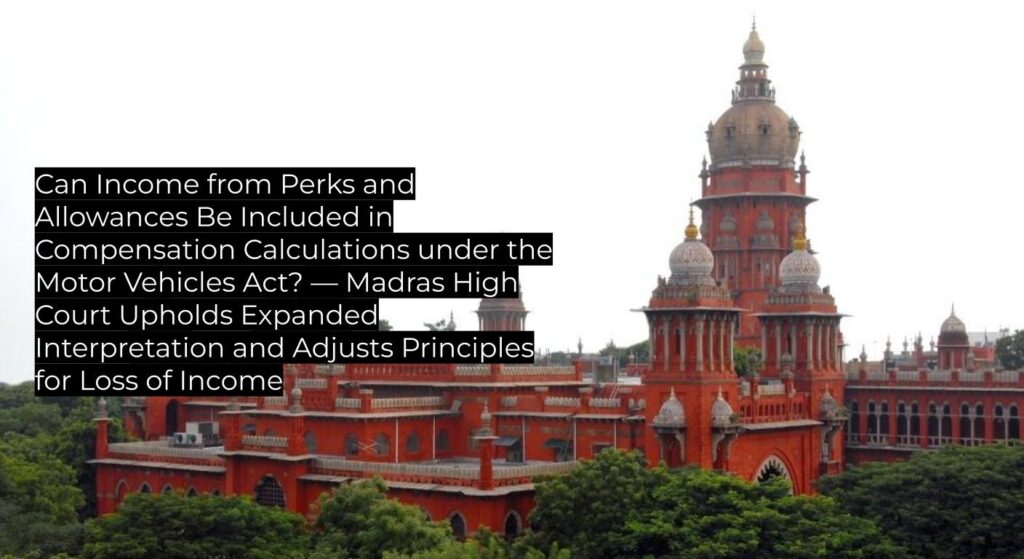
Madras High Court clarifies that for loss of income computation in fatal motor accident claims, allowances such as House Rent Allowance, Leave Travel Allowance, Medical Allowance, and Car Lease Allowance must be included, while Special/Conveyance Allowances are to be excluded. The Court modifies prior compensation principles, aligning with recent Supreme Court dicta, and partially allows enhancement of compensation. This judgment sets binding precedent for all subordinate courts in Tamil Nadu handling motor accident claim cases.
Summary
| Category | Data |
|---|---|
| Case Name | CMA/132/2018 of THE DIVISIONAL MANAGER Vs S.VIJAYA MARY |
| CNR | HCMA010330422018 |
| Date of Registration | 25-01-2018 |
| Decision Date | 28-10-2025 |
| Disposal Nature | DISMISSED (for CMA/132/2018); C.M.A.No.3835 of 2019 PARTLY ALLOWED |
| Judgment Author | Dr. Justice G. Jayachandran, Mr. Justice Mummineni Sudheer Kumar |
| Court | Madras High Court |
| Bench | Dr. Justice G. Jayachandran and Mr. Justice Mummineni Sudheer Kumar |
| Precedent Value | Binding on all subordinate courts in Tamil Nadu (motor accident claim cases) |
| Overrules / Affirms | Upholds Tribunal’s liability finding, modifies compensation methodology |
| Type of Law | Motor Accidents Claims / Compensation Law |
| Questions of Law |
|
| Ratio Decidendi |
For computation of loss of income in motor accident fatal claims, the last drawn salary slip is determinative; allowances such as House Rent, Leave Travel, Medical, and Car Lease must be included, while Special/Conveyance Allowance is to be excluded as it is a reimbursement. Deductions for income tax and professional tax must be made. Tribunal rightly excluded medical expenses already reimbursed under the employer-mediated medi-claim policy, save for premium deductions from salary. The motor accident and death—though affected by pre-existing health issues—remained the proximate cause for compensation liability. The Court applied a “15” multiplier, added 50% future prospects, deducted 1/4th for personal expenses, and apportioned the award accordingly. The liability of insurer affirmed where owner/driver involvement found reliable based on all available evidence, despite delay in FIR and hostile witnesses. |
| Judgments Relied Upon |
|
| Logic / Jurisprudence / Authorities Relied Upon by the Court |
The Court reasoned that just compensation requires a realistic assessment of the deceased’s real income, per Supreme Court authority. Allowances benefiting dependents are integral income, not just basic salary. Medical compensation precluded where claimants reimbursed by employer’s medi-claim except for premium deducted from salary. Liability not defeated by late FIR/hostile witnesses if other contemporaneous and direct evidence is present. |
| Facts as Summarised by the Court |
Deceased (37) riding pillion, suffered fatal injury when hit by an auto, died after 28 days’ hospitalization. Claimants: wife, children, parents. Claim for over Rs.9 crore based on high earnings as Senior Manager, landlord, and business owner. Insurer denied accident involvement, alleged collusion, highlighted delayed FIR and hostile owner/driver witnesses. Tribunal and Court found autopsy, hospital documents, and direct witness reliable. Tribunal awarded ~Rs.3 crore; High Court modified upwards using latest pay-slip info, adjusting computation as per law. |
Practical Impact
| Category | Impact |
|---|---|
| Binding On | All subordinate courts in Tamil Nadu in motor accident claims |
| Persuasive For | Other High Courts and Supreme Court |
| Distinguishes | Distinguishes reliance on old compensation computation methodology and on mere basic pay for loss of income |
| Follows |
|
What’s New / What Lawyers Should Note
- Clear judicial affirmation that House Rent Allowance, Leave Travel Allowance, Medical Allowance, and Car Lease Allowance are to be included in loss of income computation for motor accident death claims; Special/Conveyance Allowance excluded.
- Loss of income should be calculated using the last drawn monthly salary/slip, not appointment order or average of past years.
- Income tax and professional tax deductions must be factored in before netting the loss of income.
- Where medical expenses are reimbursed under an employer’s medi-claim policy, only the premium amount paid by the employee (i.e., deducted from salary) may be included in compensation; double recovery for medical expenses is not allowed.
- The judgment demonstrates the Court’s willingness to look beyond formal defects like delay in FIR or hostile witnesses, focusing on substantive and contemporaneous evidence.
- Explains the interplay of contributory health issues with causation in awarding compensation—injuries need not be the sole cause of death for compensation to be payable if the accident remained the proximate cause.
Summary of Legal Reasoning
- The Court began with a factual assessment, confirming that despite the delayed FIR and the insurer’s contentions of collusion/false claim, hospital records and eye-witness evidence established occurrence, cause, and timeline of the accident.
- Drawing from Supreme Court authority (National Insurance v. Indira Srivastava; Meenakshi v. Oriental Insurance Co. Ltd.), the Court held that all salary components that benefit dependents should be considered for loss of income calculation, excluding only reimbursements for specific personal expenditure (i.e., Special/Conveyance Allowance).
- Salary slips and income tax returns were scrutinised to ensure that only net income after tax was used for the compensation calculation, with appropriate addition for future prospects (+50%) per law, and 1/4th deduction for personal expenses.
- On medical expenses, the Court followed Bajaj Allianz v. Ganpal Rai Sehgal and Deepmala Goel to preclude double recovery, allowing only the actual medi-claim premium (deducted from salary) and excluding any claim already reimbursed.
- The issue of causation (whether pre-existing health conditions absolved the tortfeasor) was addressed by holding that as long as the accident was the proximate cause, and other factors only accelerated but did not independently cause death, the liability remained.
- The Court emphasised the principle of “just compensation”, balancing claims with available reliable evidence, and making upward adjustments where prior computation fell short.
Arguments by the Parties
Petitioner (Insurance Company):
- Asserted non-involvement of the auto in the accident; alleged collusion and fabrication as evidenced by late FIR and lack of vehicle damage.
- Pointed to exculpatory letters (Ex.R-1, Ex.R-2) and acquittal of the auto driver in criminal trial.
- Contended that compensation computation improperly included various allowances; asserted that allowances for personal comfort (travel, medical, car lease) cannot be included as loss of income.
- Criticised discrepancies in income tax returns and pay slips, called Tribunal’s award unreliable.
Respondent (Claimants):
- Sought enhancement, arguing Tribunal ignored Form-16, latest pay slips, and income from other sources (land, transport business).
- Argued that all employment allowances/perks should form part of salary for loss-of-income calculation.
- Challenged exclusion of medical expenses merely because medi-claim reimbursed them, arguing the policy was from employee’s own paid premiums.
- Sought application of appropriate multiplier and deduction formula, as per SC law, for just compensation.
Factual Background
A 37-year-old Senior Manager (Sabu James) died after sustaining head injuries in a road accident on 11 August 2010, while riding pillion on a motorcycle struck by an auto. Hospital records confirmed immediate medical attention; death occurred after 28 days’ hospitalization. The FIR was registered with police after a delay of seven days. Claimants included the widow, minor children, and parents, who alleged large scale dependency based on the deceased’s substantial income from employment, business, and land. The insurer denied liability, questioning accident involvement and quantum. The Motor Accidents Claims Tribunal held the insurer liable and awarded compensation, leading to cross-appeals on both liability and quantum.
Statutory Analysis
- Court interpreted Section 173 of the Motor Vehicles Act, 1988, which enables appeal against awards of Motor Accidents Claims Tribunal.
- Applied precedent on the scope of “just compensation” under the Act, including judicially evolved principles on inclusion/exclusion of salary components for loss of income.
- Analyzed statutory and judicial guidelines for multiplier selection, future prospects addition, personal expense deduction.
- Considered legal treatment of medical expense claims when employer-mediated, premium-paid (rather than self-paid) group insurance covers are present.
Dissenting / Concurring Opinion Summary
No dissenting or separate concurring opinions were delivered; the bench issued a common, unanimous judgment.
Procedural Innovations
- No new procedural rules or innovations were introduced; judgment followed established appeals procedure and evidentiary assessment under the Motor Vehicles Act claims regime.
- Exclusion of medical bills already reimbursed by employer medi-claim policy, save for actual premium deducted from salary, illustrates practical application of recent Supreme Court guidelines.
Alert Indicators
- ✔ Precedent Followed – Affirms, clarifies, and applies Supreme Court precedent on compensation calculation under the Motor Vehicles Act; no existing precedent is overturned.