


Summary
| Category | Data |
|---|---|
| Court | Supreme Court of India |
| Case Number | C.A. No.-015037-015037 – 2025 |
| Diary Number | 24603/2023 |
| Judge Name | HON’BLE MR. JUSTICE ARAVIND KUMAR |
| Bench |
HON’BLE MR. JUSTICE ARAVIND KUMAR HON’BLE MR. JUSTICE N.V. ANJARIA |
| Precedent Value |
Clarifies that Section 37 appellate jurisdiction is co-extensive with Section 34 and confined to grounds under Section 34—including “patent illegality”—and that courts cannot re-appreciate evidence or re-interpret contracts beyond express prohibitions. |
| Overrules / Affirms | Sets aside High Court’s order in ARBA No. 05 of 2017 (03.05.2023) and restores the arbitral award dated 15.07.2012 |
| Type of Law | Arbitration and Conciliation Act, 1996 |
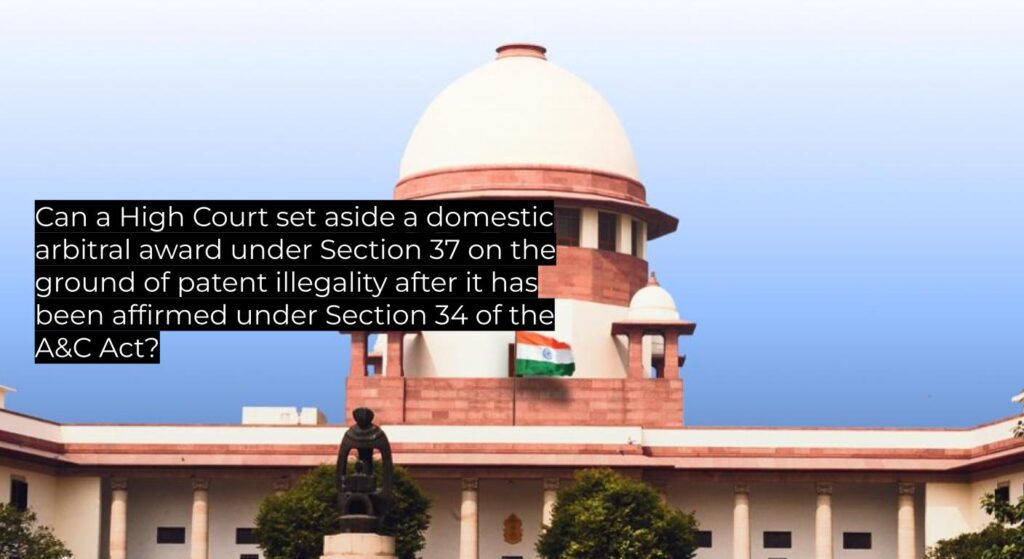
| Questions of Law | Whether interference with an arbitral award by a High Court under Section 37 on the ground of patent illegality is sustainable once the award has been affirmed under Section 34. |
| Ratio Decidendi |
The scope of judicial interference under Sections 34 and 37 of the A&C Act is narrowly confined to the specific grounds enumerated in Section 34. Section 37 appeals cannot re-appraise factual or contractual issues afresh but must remain within the Section 34 parameters, including patent illegality. An arbitrator may award restitutionary relief (quantum meruit) under Section 70 of the Contract Act to fill gaps where no rate was agreed, and such awards are not “rewriting the contract” but enforcing an implied obligation. |
| Judgments Relied Upon |
|
| Logic / Jurisprudence / Authorities Relied Upon by the Court |
|
| Facts as Summarised by the Court |
BALCO invited bids for mining and transporting bauxite; appellant awarded 2,22,000 MT at Rs. 634.20/MT; extra work of 1,95,000 MT performed (June 2001–March 2002) with rate left open; dispute referred to arbitration; award dated 15.07.2012 for Rs. 3.71 crore plus interest; Commercial Court dismissed Section 34 challenge on 02.01.2017; High Court under Section 37 set aside award on 03.05.2023. |
Practical Impact
| Category | Impact |
|---|---|
| Binding On | All courts exercising jurisdiction under Sections 34 and 37 of the A&C Act |
| Persuasive For | High Courts dealing with appeals under Section 37 |
| Overrules | High Court judgment in ARBA No. 05 of 2017 dated 03.05.2023 |
| Follows |
|
What’s New / What Lawyers Should Note
- Reaffirms that judicial review under Section 37 cannot go beyond Section 34 grounds, even if the award has been affirmed under Section 34.
- Clarifies that “patent illegality” must be a glaring, evident violation (e.g., award on no evidence or in direct breach of an express contractual prohibition).
- Confirms arbitrators may award quantum meruit compensation under Section 70 of the Contract Act when extra work is performed at the behest of the other party and no rate is agreed.
- Emphasises arbitrators as masters of evidence; courts must not re-appraise or substitute their view on factual findings.
- High Courts must resist treating Section 37 appeals as de facto re-hearings of evidence or contract-interpretation disputes.
Summary of Legal Reasoning
- Minimal Intervention (Section 5): Judicial intervention in arbitral proceedings is an exception, confined to Part I remedies.
- Section 34 Scope: Sub-section (2)&(3) permit setting aside awards only for contravention of public policy, fundamental policy of Indian law, interest of India, justice or morality, or patent illegality.
- Section 37 Scope: The appellate remedy under Section 37 is co-extensive with Section 34 and does not enlarge judicial authority to re-appraise evidence or contract.
- Patent Illegality: Post-2015 amendment, a standalone ground requiring a patent (evident) violation, such as award beyond reference scope, direct breach of statutory or contractual terms, or decisions on no evidence.
- Quantum Meruit (Section 70): Where extra work is performed without a fixed rate, arbitrators fill contractual gaps and award reasonable compensation, not rewriting contracts.
- Arbitrator as Master of Evidence: Awards based on some evidence, even if approximate or based on oral testimony, cannot be branded patently illegal.
- Application to Facts: The tribunal’s findings on extra work, transportation loss, idle machinery and manpower were grounded in evidence and logical rationale; High Court impermissibly re-appreciated evidence.
Arguments by the Parties
Petitioner (Appellant)
- High Court exceeded narrow Section 37 jurisdiction by re-appreciating facts and evidence.
- Section 37 does not permit merits re-view; relied on Delhi Airport Metro Express & MMTC Ltd. decisions.
- Arbitrator provided detailed reasons; errors in interpretation of contract are not a basis for interference.
- Quantum meruit award under Section 70 was appropriate as rate for extra work was never fixed.
- Arbitrator properly exercised discretion with honest guesswork where full documentary proof was lacking.
Respondent
- No contractual clause permitted rate revision except diesel variation; extra work executed at existing rate.
- Claimant knew existing rate and accepted payments; no fresh agreement on Rs. 10/MT increment.
- No documentary evidence on transportation route, weight restrictions, or idle machinery costs.
- Arbitrator rewrote the contract and granted damages based on self-serving tables and guesswork.
- Award violated express terms of the contract and basic fairness.
Factual Background
Bharat Aluminium Company Ltd. (BALCO) invited tenders for mining and transporting bauxite; Ramesh Kumar Jain’s bid at Rs. 697/MT was accepted after negotiation at Rs. 634.20/MT for 2,22,000 MT (contract dated 11.12.1999). Extended to September 2001, he completed supply and was asked by letter dated 05.01.2002 to continue at an open rate. He transported 1,95,000 MT (16.06.2001–31.03.2002), dispute arose over compensation, and arbitration was invoked under Section 11(6). The arbitral award dated 15.07.2012 granted Rs. 3.71 crore plus interest. The Commercial Court dismissed a Section 34 challenge on 02.01.2017; the High Court under Section 37 set aside the award on 03.05.2023; Supreme Court granted leave and heard the appeal.
Statutory Analysis
- Section 5 A&C Act: Embargo on judicial intervention except as provided by Part I.
- Section 11(6): Reference of disputes to arbitration by court.
- Section 31(7)(b): Statutory interest from award date until payment.
- Section 34(2)&(3): Narrow grounds for setting aside awards, including public policy and patent illegality.
- Section 34(2A) (post-2015): Independent ground of patent illegality; proviso bars setting aside for erroneous law application or re-appreciation of evidence.
- Section 37: Limited appellate remedy against orders under Section 34, co-extensive with Section 34 grounds.
- Section 70, Contract Act: Restitutionary obligation where one party lawfully performs services for another without intending a gift, entitling compensation.
Alert Indicators
- ✔ Precedent Followed – Existing law on Section 34/37 and patent illegality reaffirmed.