


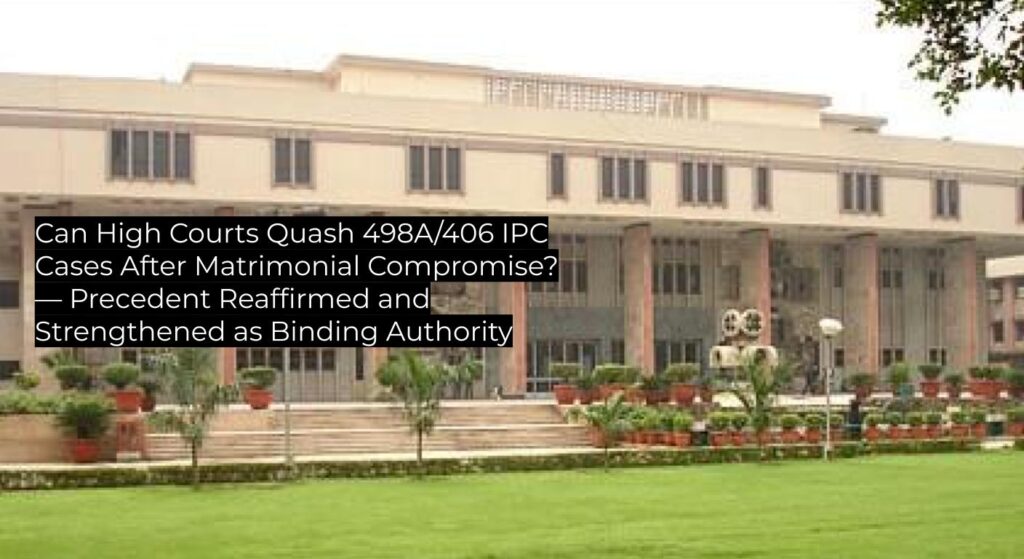
Delhi High Court confirms that criminal proceedings under Sections 498A/406/34 IPC can be quashed when matrimonial disputes have been amicably settled between the parties. This judgment reaffirms settled precedent, carries binding authority for subordinate courts in Delhi, and guides matrimonial practitioners across the jurisdiction.
Summary
| Category | Data |
|---|---|
| Case Name | CRL.M.C./6188/2025 of AJAY & ORS. Vs STATE (GOVT. OF NCT OF DELHI) & ANR. |
| CNR | DLHC010640082025 |
| Date of Registration | 01-09-2025 |
| Decision Date | 02-09-2025 |
| Disposal Nature | FIR quashed; proceedings arising therefrom also quashed |
| Judgment Author | HON’BLE MR. JUSTICE GIRISH KATHPALIA |
| Court | High Court of Delhi |
| Precedent Value | Binding within Delhi jurisdiction |
| Type of Law | Criminal Law (quashing of proceedings under Section 482 CrPC in matrimonial offences) |
| Questions of Law | Whether FIR under Sections 498A/406/34 IPC can be quashed when the complainant and accused settle? |
| Ratio Decidendi |
|
| Facts as Summarised by the Court | Petitioners and complainant entered an amicable settlement in a matrimonial dispute; parties are now cohabiting as a family; complainant has no objection to quashing and does not wish to proceed. |
Practical Impact
| Category | Impact |
|---|---|
| Binding On | All subordinate courts and criminal proceedings within the Delhi High Court’s jurisdiction |
| Persuasive For | Other High Courts and forums in India dealing with quashing of matrimonial and compoundable criminal cases |
What’s New / What Lawyers Should Note
- Reaffirms that FIRs under Sections 498A/406/34 IPC arising from matrimonial disputes are liable to be quashed when parties have amicably settled and now cohabit harmoniously.
- The court’s satisfaction regarding the voluntary nature of settlement and the complainant’s wish is crucial.
- Lack of opposition by the State strengthens, but does not solely determine, the basis for quashing.
- Lawyers may confidently rely on this precedent for quashing in similar facts, especially where matrimonial harmony is restored.
Summary of Legal Reasoning
- The court articulated that when matrimonial disputes are settled amicably and there is no further grievance, it serves the interest of justice to avoid prolonging criminal litigation.
- Direct interaction with the parties (in Hindi) confirmed the genuine and voluntary nature of the settlement.
- The complainant explicitly stated there was no interest in prosecution and that the family was living harmoniously.
- State’s lack of objection supported the application.
- Inherent powers under Section 482 CrPC were exercised to end unnecessary criminal proceedings, as continuing the prosecution would be counterproductive after true settlement.
Arguments by the Parties
Petitioner
- Disputes have been amicably settled in a matrimonial context.
- All parties, including the complainant, now cohabit happily.
- The complainant has no desire to proceed with prosecution.
Respondent No. 2 (Complainant)
- Acknowledged and confirmed the compromise.
- Affirmed absence of any current grievance against the petitioners.
- Expressed clear intent to not pursue prosecution.
State
- Represented by the Assistant Public Prosecutor.
- No serious objection to the petition for quashing.
Factual Background
The petitioners faced prosecution for offences under Sections 498A/406/34 IPC as per FIR No. 278/2023 at PS Maidan Garhi, stemming from a matrimonial dispute. During the pendency of proceedings, the parties amicably resolved their differences, resumed cohabitation, and are living as a happy family. Respondent No. 2, the complainant, confirmed having no grievance and no interest in pursuing further action against the petitioners.
Statutory Analysis
- The High Court acted under its inherent powers as per Section 482, CrPC, to prevent abuse of process and secure the ends of justice.
- The offence sections concerned were 498A (cruelty by husband or relatives of husband), 406 (criminal breach of trust), and 34 (common intention) of the IPC.
- Application of Section 482 CrPC was premised on the consensual and voluntary compromise between the parties, rendering the continuation of criminal proceedings unnecessary and unjust.
Dissenting / Concurring Opinion Summary
No dissenting or concurring opinions are recorded in the judgment.
Procedural Innovations
No new procedural precedents, changes to evidence requirements, or suo motu directions are noted in the judgment.
Alert Indicators
- ✔ Precedent Followed – Existing law regarding quashing of matrimonial criminal cases post-compromise is affirmed and applied.
Citations
No formal SCC, AIR, MANU, or neutral citations are specified in the judgment text provided.