


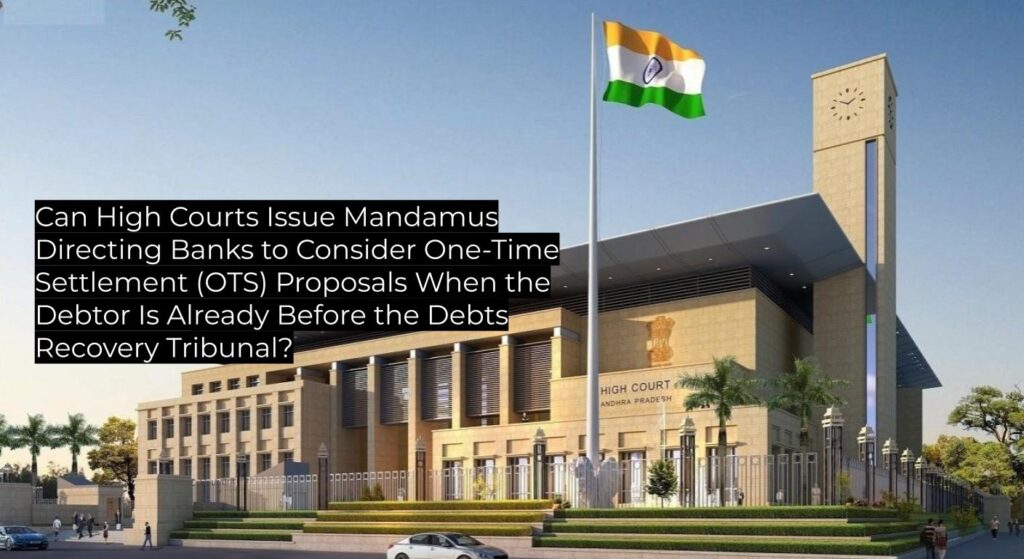
The Andhra Pradesh High Court held that no writ of mandamus can be issued to direct a bank to consider an OTS (One-Time Settlement) proposal when the matter is already before the Debts Recovery Tribunal (DRT) and relevant interim protections exist. This judgment upholds Supreme Court precedent (Bijnor Urban Cooperative Bank Limited v. Meenal Agarwal), reinforcing a hands-off approach by High Courts in such circumstances. The ruling serves as binding authority for subordinate courts and has strong persuasive value elsewhere.
Summary
| Category | Data |
|---|---|
| Case Name | WP/28543/2025 of OPTIONS MOBILES PVT LTD Vs THE AUTHORIZED OFFICER |
| CNR | APHC010517142025 |
| Date of Registration | 14-10-2025 |
| Decision Date | 16-10-2025 |
| Disposal Nature | DISMISSED NO COSTS |
| Judgment Author | DHIRAJ SINGH THAKUR, CJ; RAVI CHEEMALAPATI, J |
| Court | High Court of Andhra Pradesh |
| Bench | DHIRAJ SINGH THAKUR, CJ; RAVI CHEEMALAPATI, J |
| Precedent Value | Binding on subordinate courts in Andhra Pradesh; persuasive elsewhere |
| Overrules / Affirms | Affirms the ratio in The Bijnor Urban Cooperative Bank Limited v. Meenal Agarwal [(2023) 2 SCC 805] |
| Type of Law | Banking Law; Constitutional Law (writ jurisdiction under Article 226) |
| Questions of Law | Whether a High Court, under Article 226, can direct a bank to consider an OTS proposal when DRT proceedings are pending and protective interim orders exist. |
| Ratio Decidendi |
The High Court held that there is no legal basis to issue a mandamus to a respondent bank to consider an OTS proposal when recovery proceedings are pending before the Debts Recovery Tribunal and the petitioners have already been granted interim protection. The Court expressly affirmed the Supreme Court’s decision in Bijnor Urban Cooperative Bank Limited v. Meenal Agarwal, which prohibits High Courts from issuing such directions. Accordingly, the writ petition was dismissed for lack of merit. |
| Judgments Relied Upon | The Bijnor Urban Cooperative Bank Limited v. Meenal Agarwal [(2023) 2 SCC 805] |
| Logic / Jurisprudence / Authorities Relied Upon by the Court |
|
| Facts as Summarised by the Court | Petitioners were already before the Debts Recovery Tribunal at Visakhapatnam and had secured interim protection; they sought a writ of mandamus directing the bank to consider their One-Time Settlement proposal. |
Practical Impact
| Category | Impact |
|---|---|
| Binding On | All subordinate courts in Andhra Pradesh |
| Persuasive For | Other High Courts, Supreme Court |
| Follows | The Bijnor Urban Cooperative Bank Limited v. Meenal Agarwal [(2023) 2 SCC 805] |
What’s New / What Lawyers Should Note
- Reaffirms that High Courts will not entertain writs seeking directions to banks for considering OTS proposals where DRT proceedings are underway and interim protection exists.
- Cites and follows the Supreme Court decision in The Bijnor Urban Cooperative Bank Limited v. Meenal Agarwal as binding precedent.
- Makes clear that mere pendency of OTS proposals cannot be used to invoke writ jurisdiction under Article 226 when statutory remedies are available and availed.
Summary of Legal Reasoning
- The petitioners sought a writ of mandamus against the respondent bank, requesting it to consider their One-Time Settlement (OTS) proposal, even though proceedings were already pending before the Debts Recovery Tribunal (DRT) and interim protection was already granted.
- The petitioners failed to establish any statutory or legal foundation for the issuance of such a writ.
- The respondent bank relied on the Supreme Court judgment in The Bijnor Urban Cooperative Bank Limited v. Meenal Agarwal [(2023) 2 SCC 805], which explicitly barred High Courts from issuing such directions.
- The High Court examined the Apex Court’s decision and held that no such direction can be issued under Article 226 in the facts of the case, especially when DRT proceedings are ongoing and relevant protections have been granted.
- On this legal basis, the Court found no merit in the petition and dismissed it without costs.
Arguments by the Parties
Petitioner:
- Sought a mandamus directing the respondent bank to consider the OTS proposal.
- Argued that such a direction was justified, notwithstanding the ongoing proceedings and interim orders before the DRT.
Respondent:
- Argued that, as per the Supreme Court’s judgment in The Bijnor Urban Cooperative Bank Limited v. Meenal Agarwal, no such mandamus could be issued by the High Court.
Factual Background
The petitioners were engaged in proceedings before the Debts Recovery Tribunal in Visakhapatnam, having obtained interim orders safeguarding their interests. Notwithstanding these ongoing proceedings and protections, they approached the High Court by way of a writ petition, seeking a direction (mandamus) to the respondent bank to consider their One-Time Settlement (OTS) proposal.
Statutory Analysis
- The judgment involved the High Court’s powers under Article 226 of the Constitution of India.
- Reaffirmed that Article 226 relief is not available to bypass, or run parallel to, specialized statutory remedies under statutes like the Recovery of Debts and Bankruptcy Act (DRT Act), particularly when DRT proceedings exist and interim orders protect the petitioners.
- Relied on the interpretation and application of Supreme Court precedent regarding writ jurisdiction vis-à-vis specialized tribunals.
Dissenting / Concurring Opinion Summary
No dissenting or separate concurring opinions were recorded; judgment delivered jointly by the Bench.
Procedural Innovations
No new procedural innovations or directions issued by the Court in this judgment.
Alert Indicators
- Precedent Followed – The High Court expressly follows the Supreme Court’s decision in The Bijnor Urban Cooperative Bank Limited v. Meenal Agarwal, applying binding precedent to dismiss the writ petition.