


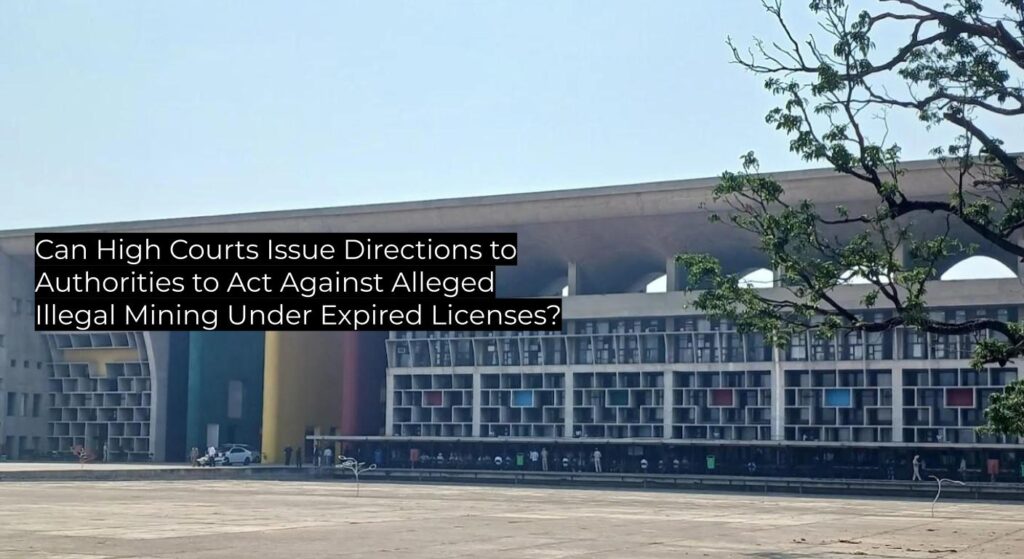
The High Court reaffirmed its authority under Article 226 of the Constitution to direct government respondents to address allegations of illegal mining—especially where mining licenses have already expired—by requiring statutory action against concerned parties after due process. The decision upholds the existing scope of judicial power and serves as binding precedent on subordinate courts in Punjab and Haryana pertaining to environmental and land regulation disputes.
Summary
| Category | Data |
|---|---|
| Case Name | CWP/32737/2024 of SUKHWINDER KAUR Vs STATE OF PUNJAB AND ORS |
| CNR | PHHC011688082024 |
| Date of Registration | 03-12-2024 |
| Decision Date | 10-09-2025 |
| Disposal Nature | DISPOSED OF |
| Judgment Author | ASHWANI KUMAR MISHRA, J. (oral); concurring: ROHIT KAPOOR, J. |
| Court | High Court of Punjab and Haryana |
| Bench | Hon’ble Mr. Justice Ashwani Kumar Mishra; Hon’ble Mr. Justice Rohit Kapoor |
| Precedent Value | Binding on subordinate courts within Punjab and Haryana |
| Overrules / Affirms | Affirms and applies existing judicial power under Article 226 |
| Type of Law | Constitutional/Writ; Environmental and Land Regulation |
| Questions of Law | Whether the High Court can direct authorities to take legal action regarding alleged illegal mining, especially after license expiry, based on a writ petition. |
| Ratio Decidendi | The court held that, where allegations of illegal mining under an expired license have been raised, and where proceedings have already been initiated by authorities, it is appropriate to direct those authorities to proceed in accordance with law after ensuring due process to concerned persons. This approach ensures both statutory enforcement and procedural fairness. The court clarified that once grievance has been addressed in substance, the writ petition may be disposed of with such directions, confirming the High Court’s supervisory jurisdiction. |
| Logic / Jurisprudence / Authorities Relied Upon by the Court | The judgment proceeds on established principles of judicial review and the power of writ to direct statutory compliance and procedural propriety. |
| Facts as Summarised by the Court | The petitioner alleged illegal mining on agricultural land by respondent No.4 after expiry of a clay excavation license. Respondents 1 to 3 stated that proceedings were already underway and the license had expired on 31.03.2025. |
Practical Impact
| Category | Impact |
|---|---|
| Binding On | All subordinate courts in Punjab and Haryana |
| Persuasive For | Other High Courts considering similar illegal mining or environmental writ petitions |
| Follows | Judicial precedents on supervisory directions under Article 226 to ensure enforcement of statutory obligations |
What’s New / What Lawyers Should Note
- Reiterates that courts can dispose of writ petitions where authorities have already initiated action, ensuring legal process continues.
- Mandates that authorities must issue notice and ensure due process before proceeding against alleged offenders, even post license expiry.
- Lawyers may cite this judgment to seek or oppose writ relief where parallel statutory proceedings are ongoing.
Summary of Legal Reasoning
- Examination of Allegations: The petitioner sought a direction to halt illegal mining in agricultural land, claiming misuse of licensing.
- Status of Statutory Action: Respondent authorities reported that not only were proceedings against the private respondent already initiated, but the mining license in question had expired.
- Scope of Writ Relief: The court noted that, since the authorities were already addressing the grievance through statutory means, it was appropriate to formally direct them to proceed as per law.
- Procedural Fairness: The court insisted that action should follow proper notice to the persons concerned, ensuring due process.
- Disposal of Petition: The petition was disposed of with a direction to continue statutory action, reiterating the writ court’s function as a supervisory authority rather than as an adjudicator of disputed facts.
Arguments by the Parties
Petitioner:
- Alleged illegal mining being conducted on agricultural land after the expiry of a clay excavation license.
- Prayed for a writ of mandamus to halt such mining activities.
Respondents (State Authorities):
- Informed the court that actions and proceedings had already been initiated concerning the illegal mining complaint.
- Confirmed that the mining license had expired on 31.03.2025, and was not renewed or reissued.
Factual Background
The petitioner approached the High Court, alleging that respondent no. 4 was carrying out illegal mining activities on specified agricultural lands under the guise of a clay excavation license, which had already expired. The authorities responded by stating that they had started legal proceedings in relation to the allegations and confirmed that the said mining license expired on 31.03.2025.
Statutory Analysis
- The judgment applies the constitutional jurisdiction under Article 226, reaffirming the High Court’s authority to direct statutory authorities to comply with legal obligations.
- No detailed interpretation of environmental or mining statutes was undertaken, as the dispute was resolved by directing statutory authorities to proceed in accordance with law after notice.
Dissenting / Concurring Opinion Summary
Both judges concurred; no dissent or separate opinion was recorded.
Procedural Innovations
- The judgment formalized a practice of disposing writ petitions with directions to authorities for further action, where statutory proceedings are already underway.
- Emphasizes issuing notice and following due process even when complaints relate to activities after license expiry.
Alert Indicators
- ✔ Precedent Followed – The decision affirms and applies existing principles regarding the supervisory role of the High Court under Article 226.