


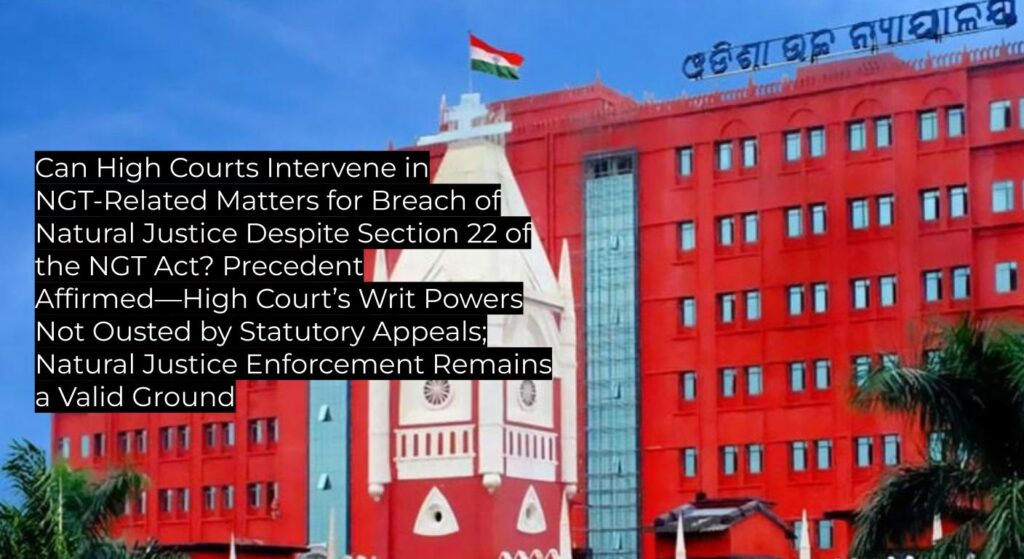
The Orissa High Court reaffirmed that alternative remedies under Section 22 of the National Green Tribunal Act, 2010, do not bar writ jurisdiction under Article 226 where there is a violation of natural justice, following established Supreme Court precedents. This ruling upholds the maintainability of writ petitions in such scenarios and serves as binding authority for cases involving environmental compensation and penalty actions by authorities in the absence of fair hearing.
Summary
| Category | Data |
|---|---|
| Case Name | WP(C)/29310/2022 of M/S.GAMMON INFRASTRUCTURE PROJECTS LTD. GECPL(JV), MUMBAI Vs STATE OF ODISHA |
| CNR | ODHC010751322022 |
| Date of Registration | 03-11-2022 |
| Decision Date | 17-10-2025 |
| Disposal Nature | Disposed Off |
| Judgment Author | Dr. Justice S.K. Panigrahi |
| Court | Orissa High Court |
| Bench | Single Bench: Dr. Justice S.K. Panigrahi |
| Precedent Value | Binding on subordinate courts within the jurisdiction; persuasive for other High Courts and tribunals |
| Overrules / Affirms |
|
| Type of Law |
|
| Questions of Law | Whether the High Court can exercise writ jurisdiction under Article 226 despite the existence of an appellate remedy under Section 22 of the NGT Act, particularly in cases of breach of principles of natural justice. |
| Ratio Decidendi |
The High Court’s writ jurisdiction under Article 226 is not ousted by Section 22 of the NGT Act, 2010. The Court may intervene even when statutory appeal exists, especially where there is a breach of natural justice. The rule of statutory remedy is one of discretion and not compulsion—violations of natural justice are an established exception. The Collector’s imposition of penalty and compensation, without notice or hearing to the petitioner, was held void and set aside solely on that ground. The petitioner’s case is remitted to the NGT to be decided after affording a fair hearing and opportunity to present a defence. |
| Judgments Relied Upon |
|
| Logic / Jurisprudence / Authorities Relied Upon by the Court | The principle that the existence of an alternative statutory remedy does not oust the writ jurisdiction of the High Court in exceptional cases—especially breach of natural justice, lack of jurisdiction, or where fundamental rights are involved. The principles of natural justice are fundamental to fair adjudication and are protected as part of constitutional guarantees. |
| Facts as Summarised by the Court | The petitioner, a JV company, was awarded a highway upgradation contract. Due to lack of government-allotted quarries, it procured minerals from local sources citing central government guidelines and paid royalties. The Collector imposed royalty, penalty, and environmental compensation following NGT directions, without making the petitioner a party or giving a hearing. The petitioner, not party to NGT proceedings, challenged the penalty as arbitrary, without opportunity of hearing, and lacking statutory basis. |
Practical Impact
| Category | Impact |
|---|---|
| Binding On | All subordinate courts within the territorial jurisdiction of the Orissa High Court; relevant to administrative authorities in Odisha |
| Persuasive For | Other High Courts, National Green Tribunal, and legal forums across India |
| Follows |
|
What’s New / What Lawyers Should Note
- Reaffirms that breach of principles of natural justice is a valid and sufficient ground for High Courts to exercise writ jurisdiction under Article 226, even where statutory remedy exists under Section 22 of the NGT Act.
- High Courts’ powers of judicial review under Articles 226 and 227 are not ousted by the NGT Act, following binding Supreme Court precedent.
- Any administrative or environmental penalty impacting parties not heard in prior NGT proceedings is vulnerable to challenge and likely to be set aside.
- The judgment mandates that authorities must provide proper notice and opportunity of hearing before imposing liability or penalty as a result of NGT directions.
- Lawyers may cite this decision to challenge ex parte orders for environmental compensation or penalties arising from NGT-initiated actions where their clients were not impleaded or afforded a hearing.
Summary of Legal Reasoning
- The Orissa High Court identified the main issue as whether it could exercise writ jurisdiction despite availability of an appeal before the Supreme Court under Section 22 of the NGT Act where there was a breach of natural justice.
- The Court relied extensively on Supreme Court precedent, notably Whirlpool Corpn. v. Registrar of Trade Marks, Harbanslal Sahnia v. Indian Oil Corporation, and Radhakishan Industries v. State of H.P., establishing that the rule against entertaining writ petitions when a statutory remedy exists is discretionary, not mandatory, and exceptions include breach of natural justice and orders without jurisdiction.
- The Court affirmed that Section 22 of the NGT Act does not oust the High Court’s jurisdiction under Articles 226 and 227, as reiterated in L. Chandra Kumar v. Union of India and Madhya Pradesh High Court Advocates Bar Association v. Union of India.
- The Court found that natural justice—specifically the right to notice and a hearing—is a minimum standard applicable even when not explicitly set out in statute, including the functioning of the NGT and administrative authorities acting under its direction.
- The imposition of liability by the Collector, based on NGT directions, without notice or opportunity to the petitioner (who was not a party to those proceedings), was in clear violation of the audi alteram partem rule and thus invalid.
- The Collector’s actions were also found to be arbitrary and lacking statutory basis, infringing Articles 14, 19, and 300A of the Constitution.
- Consequently, the impugned orders were quashed and the matter remitted to the NGT for fresh decision after hearing the petitioner.
Arguments by the Parties
Petitioner
- The Collector’s imposition of penalty and compensation was arbitrary, illegal, and violated Articles 14, 19, and 300A.
- The Petitioner was not made a party before the NGT and had no opportunity to be heard; thus, application of that order was in breach of natural justice.
- The order lacked legal reasoning, calculation, and statutory basis.
- Petitioner lawfully acted under Central government notifications/circulars and paid all royalties due.
- The Collector acted without jurisdiction and in an arbitrary manner.
- Sought quashing of the impugned orders and refund of recovered amounts.
Respondent (Opposite Parties)
- The petitioners could have availed the statutory appellate remedy under Section 22 of the NGT Act.
- Writ petition is not maintainable in light of available statutory remedy.
- Challenge to such orders should be addressed via appeal to Supreme Court under NGT Act.
Factual Background
The petitioner, a joint venture, was awarded a contract for upgradation of a section of National Highway-53 (Duburi–Chandikhole). Facing non-allotment of minor mineral quarries by authorities, it sourced material from local villagers and paid royalties in line with existing central government notifications. The Collector imposed additional royalty, penalty, and environmental compensation for alleged unauthorized extraction, based on NGT directions in a matter where the petitioner was not a party and without granting notice or hearing. The petitioner challenged the demand as arbitrary, lacking legal basis, and amounting to a violation of natural justice.
Statutory Analysis
- Section 22, NGT Act, 2010: Provides an appellate remedy to the Supreme Court from orders of the NGT.
- Section 14, NGT Act, 2010: Deals with settlement of environmental disputes by the Tribunal.
- Article 226, Constitution: Empowers High Courts to issue writs for enforcement of rights or “for any other purpose.”
- The Court observed that neither Section 14 nor Section 22 ousts High Courts’ writ jurisdiction, especially in cases involving breach of natural justice.
- The Court referred to Section 19(1) of the NGT Act to highlight the Tribunal’s obligation to follow principles of natural justice and not be strictly bound by the Civil Procedure Code.
Dissenting / Concurring Opinion Summary
No concurring or dissenting opinions were recorded in the judgment.
Procedural Innovations
No new procedural rules, innovations, or guidelines were issued in this judgment.
Alert Indicators
- ✔ Precedent Followed – When existing law is affirmed.