


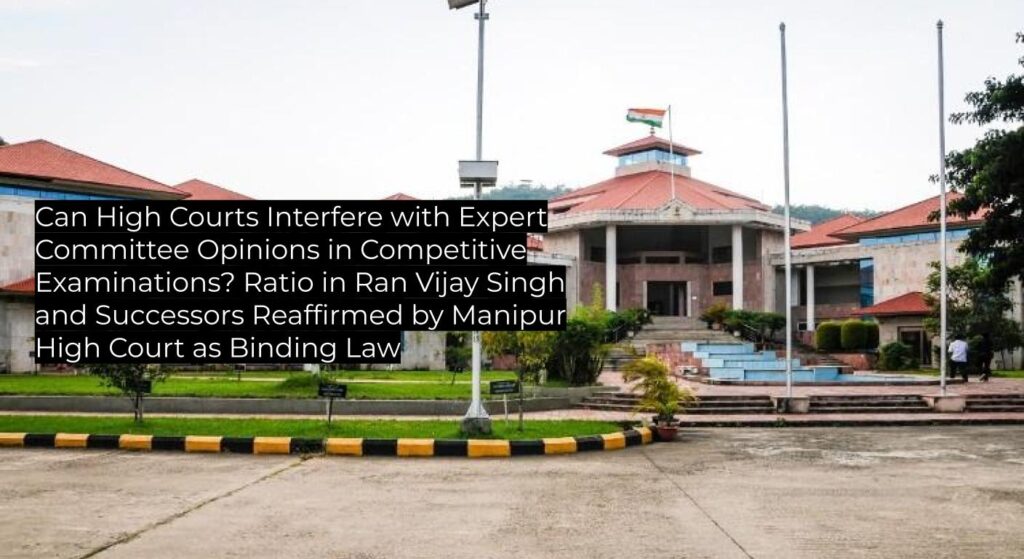
The Manipur High Court reiterates that judicial assessment of questions and answers in public recruitment exams is generally impermissible, and courts must be extremely slow to interfere with the findings of neutral, domain-specific expert committees—reaffirming Supreme Court precedent and clarifying that such judicial restraint applies even where candidates raise specific objections. This decision affirms prior Supreme Court authority and is binding on all subordinate courts in Manipur; it also carries persuasive value for other courts facing challenges to examinations conducted by expert bodies.
Summary
| Category | Data |
|---|---|
| Case Name | WA/56/2025 of Ringo Pebam Vs State of Manipur and Another |
| CNR | MNHC010029872025 |
| Date of Registration | 29-10-2025 |
| Decision Date | 03-11-2025 |
| Disposal Nature | Dismissed |
| Judgment Author | Hon’ble The Chief Justice M. Sundar |
| Concurring or Dissenting Judges | Hon’ble Mr Justice A. Guneswhar Sharma (concurring) |
| Court | High Court of Manipur at Imphal |
| Bench | Division Bench: Hon’ble The Chief Justice M. Sundar & Hon’ble Mr Justice A. Guneswhar Sharma |
| Precedent Value | Binding on all subordinate courts in Manipur, persuasive for other High Courts |
| Overrules / Affirms |
|
| Type of Law | Public Service/Administrative Law (Recruitment Examinations/Academic Litigation) |
| Questions of Law |
|
| Ratio Decidendi |
The High Court held that assessment of questions and answers by courts in public examination disputes is not permissible; judicial review is limited to cases where key answers are shown to be patently wrong such that no reasonable expert would endorse them (Kanpur University test). The Court reaffirmed that when a neutral, domain-specific expert committee has reviewed candidate objections and given detailed, reasoned unanimous opinions, courts must be extremely reluctant to interfere. Pan-India committees of unrelated experts, as in this case, reinforce neutrality. Propositions advanced from contrary High Court precedent were distinguished on facts or not followed, given binding Supreme Court authority. |
| Judgments Relied Upon |
|
| Logic / Jurisprudence / Authorities Relied Upon by the Court |
Supreme Court principles (Ran Vijay Singh, Vikesh Kumar Gupta):
Adopted Padma Sundara Rao’s warning against over-broad case law analogy; explained expert committee neutrality (members not from Manipur, domain experts); reasoned that the process, as adopted, fulfilled both substantive and procedural fairness. |
| Facts as Summarised by the Court |
The Manipur Public Service Commission conducted a preliminary screening examination (100 posts, ~10,333 candidates) for five government services. Objections were invited after answer keys were published; extensions to file objections were granted due to internet bans. An eight-member external expert committee (from outside Manipur) considered all objections, revised/dropped some questions, granted grace marks, and finalized results. Nine unsuccessful candidates (appellants), having failed to clear qualifying marks or secure ranking, challenged the correctness of answer keys and sought reconstitution of the expert committee. Their writ petitions were dismissed by the single judge; on appeal, the Division Bench affirmed the process and dismissed the claims. |
Practical Impact
| Category | Impact |
|---|---|
| Binding On | All subordinate courts in Manipur |
| Persuasive For | Other High Courts and courts considering academic disputes involving competitive exams and expert committees |
| Overrules | None specified; distinguishes Sapam Jiten Singh (Gauhati HC), Anoop v. Mohta (Bom HC) on facts and legal principles |
| Distinguishes |
|
| Follows |
|
What’s New / What Lawyers Should Note
- Affirms that courts cannot reassess questions/answers in public service exams once a neutral domain expert committee has given a detailed, reasoned unanimous opinion.
- Clarifies that mere disagreement or plausible alternative answer is insufficient to vitiate answer keys; key must be shown to be patently, demonstrably wrong (Kanpur University standard).
- Establishes that pan-India expert committees, not comprising persons from the local/state body, satisfy neutrality and preclude further judicial expert inquiry.
- Distinguishes High Court precedents where expert committees lacked reasoned findings or neutrality—these will not justify a fresh expert body where current process is robust.
- Leave open the issue of delay and laches for future cases—no finding returned where matter is decided on substantive merits.
- Practical tip: For writs against examination results, evidence of process failure or patent key error is essential.
Summary of Legal Reasoning
- Scope of Judicial Review in Exam-Related Disputes: The Court reiterated Supreme Court dicta (Ran Vijay Singh, Rishal, Vikesh Kumar Gupta) holding that courts should not themselves analyze academic questions or answers to determine correctness. Judicial review is confined to instances where answer keys are manifestly wrong (“no reasonable expert would say otherwise”; Kanpur University).
- Expert Committee’s Role: The Manipur PSC referred all objected questions to a neutral, eight-member external expert committee; the Court received evidence that all experts were senior academicians, not from Manipur, ensuring neutrality and expertise.
- Objection Handling and Grace Marks: Where expert opinion found questions invalid or ambiguous, the PSC dropped or revised such questions and granted grace marks (full marks, including notional negative marking where necessary) to all candidates—aligning with guidelines from Prabha Devi (Del HC).
- Precedent Handling: Cited and distinguished contrary High Court decisions (Sapam, Anoop) on the basis that in those cases either no expert committee had been appointed or the committee had not provided a reasoned opinion. Supreme Court authorities remain binding.
- Multiple Answers and Neutrality Claims: The possibility of “two equally valid answers” or alleged lack of neutrality was comprehensively addressed—no evidence of such findings in the instant case, and the external composition of the committee precluded bias.
- No Patent Error, No Relief: Applying the Kanpur University test, the Court found that candidates’ objections did not demonstrate manifest error; thus judicial interference was unwarranted.
- Unresolved Issues: The Court expressly left open the questions of laches/delay as the matter failed on substantive grounds.
Arguments by the Parties
Petitioners:
- Contended that certain answer keys (notably Question 31 of GS Paper-II) were incorrect and that previous competitive exams (CAT 1996, CLAT 2013) reflected a different ‘correct’ answer.
- Sought constitution of a fresh, neutral expert committee to reconsider the disputed questions.
- Argued, citing academic sources, that multiple plausible answers existed for some questions, or that all provided choices could be wrong.
- Asserted that minor wording changes in questions made the correct answer ambiguous relative to other national exam precedents.
- Relied on Gauhati and Bombay High Court decisions supporting court-constituted expert committees where initial process was inadequate.
Respondents (State of Manipur & MPSC):
- Argued that all objections were considered by a neutral, pan-India expert committee comprising domain experts, and their unanimous, reasoned opinions were binding.
- Emphasized that one question was revised and seven were dropped by accepting negative expert findings, granting grace marks to all.
- Maintained that questions and answer keys were not demonstrably wrong per the Supreme Court standard.
- Asserted no evidence of bias or irregularity; process was transparent and fulfilled legal and procedural requirements.
- Distinguished cited High Court precedents as factually inapplicable given the robust process followed in this case.
Factual Background
The Manipur Public Service Commission held a preliminary combined competitive examination for recruitment to five state services. Following the publication of answer keys, candidates were permitted to submit objections, with deadlines repeatedly extended due to internet service bans. An external, eight-member expert committee—comprising senior academicians from outside Manipur—considered all submitted objections. The expert committee advised MPSC to revise or drop some questions, with grace marks granted accordingly. Several unsuccessful candidates, whose marks remained insufficient for qualification or ranking even after grace marking, challenged the result and answer keys in the High Court. Their initial writ petitions were dismissed by a single judge; appeals were heard by the Division Bench.
Statutory Analysis
The Court interpreted the legal boundaries of judicial review in academic matters under the constitutional jurisdiction exercised over public service commission actions.
Supreme Court precedents (primarily Ran Vijay Singh, Vikesh Kumar Gupta, Kanpur University) were cited extensively for standards governing review of examination answers and the role of expert committees.
No specific statutory provisions (e.g., Constitution of India Articles, specific rules of Civil Procedure) were interpreted beyond applying the established precedent limiting the court’s scope.
Dissenting / Concurring Opinion Summary
No dissenting opinions were recorded; both judges were in agreement.
Both judges concurred that the reasoning and process followed were robust and immune from judicial interference under settled law.
Procedural Innovations
- The panel accepted the sealed envelope procedure for submitting expert committee details but, with consent of both parties, declined to publicize identities to protect ongoing neutrality and future utility of expert bodies, referencing Sodhi Sukhdev Singh (1961 SC).
- The Court explicitly recorded and appreciated the fair procedural cooperation and clarity among the senior advocates representing all parties.
Alert Indicators
- ✔ Precedent Followed – Supreme Court precedent reaffirmed regarding limited judicial review of expert committee findings and answer keys in public examinations.