


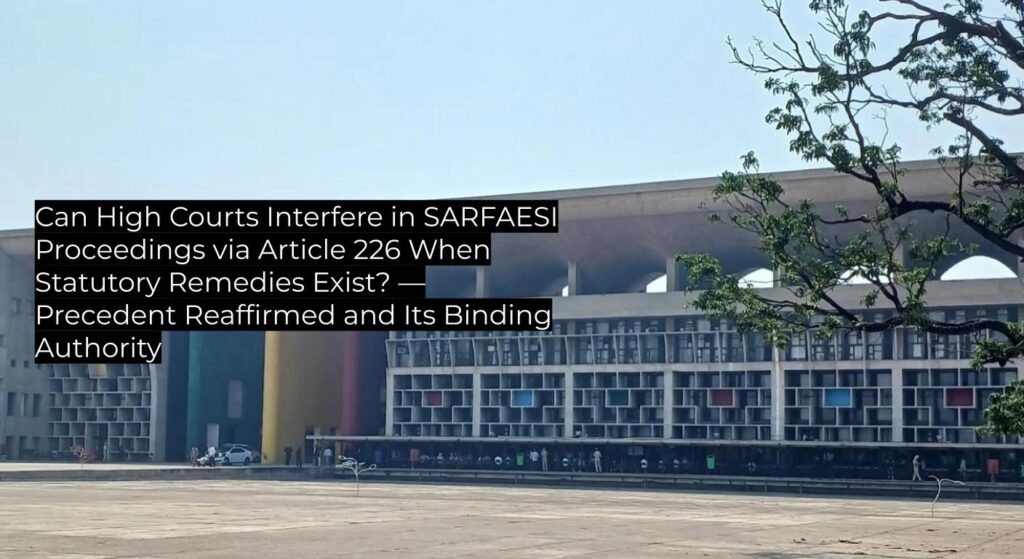
The Punjab and Haryana High Court, reiterating Supreme Court precedent, held that High Courts must refrain from exercising their writ jurisdiction under Article 226 in cases governed by the SARFAESI Act where effective statutory remedies before DRT/DRAT exist; this position upholds existing law and is binding for subordinate courts in SARFAESI matters.
Summary
| Category | Data |
|---|---|
| Case Name | CWP/13602/2023 of JEET RAM AND ORS. Vs STATE OF HARYANA AND OTHERS |
| CNR | PHHC010792502023 |
| Date of Registration | 17-06-2023 |
| Decision Date | 30-10-2025 |
| Disposal Nature | DISPOSED OF |
| Judgment Author | HON’BLE MR. JUSTICE SHEEL NAGU, CHIEF JUSTICE |
| Concurring or Dissenting Judges | HON’BLE MR. JUSTICE SANJIV BERRY |
| Court | High Court of Punjab and Haryana |
| Bench | Division Bench: THE CHIEF JUSTICE, MR. JUSTICE SANJIV BERRY |
| Precedent Value | Binding on subordinate courts within Punjab & Haryana |
| Overrules / Affirms | Affirms Supreme Court precedents |
| Type of Law | Banking, Recovery Proceedings, Constitutional Law |
| Questions of Law | Scope of High Court’s jurisdiction under Article 226 in SARFAESI matters where alternative statutory remedies exist |
| Ratio Decidendi |
The High Court reaffirmed the principle that it should refrain from exercising writ jurisdiction under Article 226 of the Constitution in matters arising under the SARFAESI Act, given the Act’s status as a self-contained code with detailed remedies before DRT and DRAT. The Court expressly relied on Supreme Court decisions in United Bank of India v. Satyawati Tondon, Phoenix ARC Pvt. Ltd. v. Vishwa Bharati Vidya Mandir, and PHR Invent Educational Society v. UCO Bank to hold that petitioners must ordinarily first exhaust available statutory remedies. Only in exceptional circumstances should the writ jurisdiction be exercised. |
| Judgments Relied Upon |
|
| Logic / Jurisprudence / Authorities Relied Upon by the Court | The SARFAESI Act provides a comprehensive remedy mechanism; writ jurisdiction is not warranted unless exceptional grounds are made out, as per binding Supreme Court precedent. |
| Facts as Summarised by the Court |
Petitioners challenged demand and possession notices and an order under the SARFAESI Act. The court noted that petitioners had not availed the remedy before DRT/DRAT as provided by the SARFAESI Act. The Court, therefore, refused to entertain the writ and relegated the petitioners to pursue statutory remedies, extending interim protection contingent on approaching the DRT within 30 days. |
Practical Impact
| Category | Impact |
|---|---|
| Binding On | All subordinate courts within the jurisdiction of the Punjab & Haryana High Court |
| Persuasive For | Other High Courts and potentially the Supreme Court |
| Follows |
|
What’s New / What Lawyers Should Note
- Reiterates that High Court’s writ jurisdiction under Article 226 will not ordinarily be exercised where statutory remedies under the SARFAESI Act are available and unexhausted.
- Express reliance on Supreme Court authority clarifies minimal scope for Article 226 interventions in SARFAESI matters.
- Petitioners aggrieved by SARFAESI actions must first pursue remedies before DRT/DRAT.
- Interim relief granted by the High Court may continue only if petitioners timely approach DRT as directed; DRT to decide interim relief independently and uninfluenced by the High Court’s order.
Summary of Legal Reasoning
- The Court recognized its limited jurisdiction under Article 226 when an efficacious statutory remedy exists under the SARFAESI Act.
- Cited Supreme Court judgments (United Bank of India v. Satyawati Tondon; Phoenix ARC v. Vishwa Bharati Vidya Mandir; PHR Invent Educational Society v. UCO Bank) confirming that SARFAESI is a complete code with a recovery mechanism and appellate remedies.
- Determined petitioners had not availed such statutory remedies (appeal to DRT/DRAT).
- Declined to entertain the writ, in accordance with binding precedent, and relegated petitioners to statutory forums.
- Provided transitional interim protection subject to petitioners’ timely application to DRT, ensuring non-prejudice to DRT’s independent discretion.
Arguments by the Parties
Petitioner
- Challenged the legality of the demand notice, possession notice, and the order under SARFAESI Act.
- Sought intervention of the High Court under Article 226.
Respondent (State/Bank/Others)
- Arguments not detailed beyond acknowledgment of counsel’s presence.
Factual Background
The petitioners filed a writ petition challenging a demand notice, a possession notice under Sections 13(2) and 13(4) of the SARFAESI Act, and a subsequent order under Section 14 of the SARFAESI Act. The Court observed that the petitioners had not availed the alternative statutory remedy provided under the SARFAESI Act (appeal before the DRT/DRAT).
Statutory Analysis
- The SARFAESI Act, 2002, especially Sections 13(2), 13(4), and 14, was central to the dispute.
- The Court interpreted the Act as a complete code providing for recovery of secured assets and setting out a statutory appeal mechanism (Section 17: appeal to DRT).
- The writ jurisdiction under Article 226 is not to be exercised where such statutory remedies have not been first exhausted, as per Supreme Court precedent.
Dissenting / Concurring Opinion Summary
No dissenting or separate concurring opinion is recorded; both judges concurred in the judgment.
Procedural Innovations
- The Court provided interim relief to continue only if petitioners approached the DRT within a set timeframe (30 days), with explicit directions that the DRT should consider interim relief independent of the High Court’s order and without being influenced by the petitioners’ earlier writ petition.
Alert Indicators
- ✔ Precedent Followed – Existing Supreme Court precedent on SARFAESI and Article 226 was strictly affirmed.