


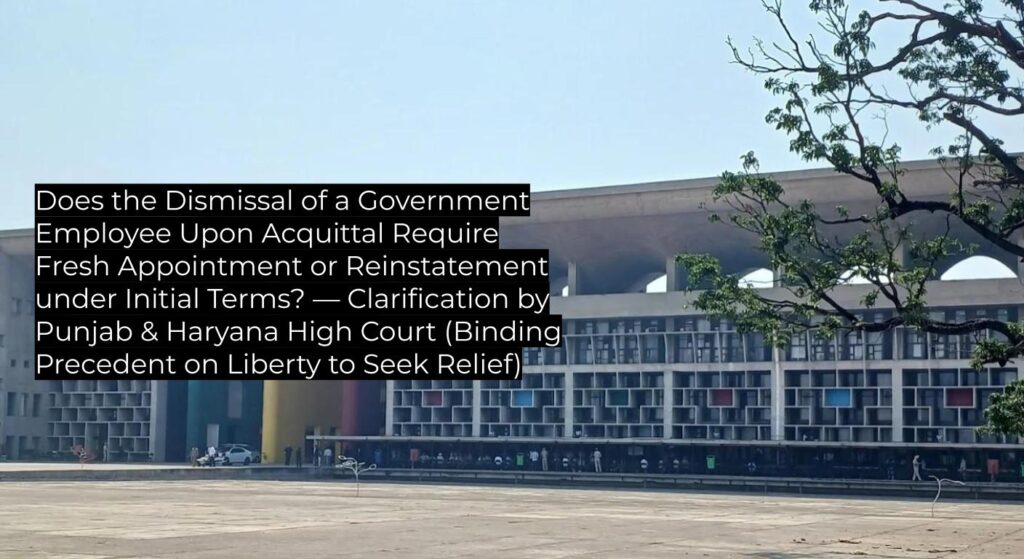
The Court affirmed that when a writ petition does not warrant substantive orders due to developments after filing (here, acquittal and service reinstatement issues), the petitioner may be granted liberty to seek appropriate remedies through a fresh application. This position upholds existing precedent regarding writ discretion in service matters, and provides binding guidance within the Punjab and Haryana High Court’s territorial jurisdiction.
Summary
| Category | Data |
|---|---|
| Case Name | CWP/9098/2017 of ASHWANI KUMAR Vs STATE OF HARYANA AND ANR |
| CNR | PHHC011069472017 |
| Date of Registration | 28-04-2017 |
| Decision Date | 01-09-2025 |
| Disposal Nature | DISPOSED OF |
| Judgment Author | MR. JUSTICE JAGMOHAN BANSAL |
| Court | High Court of Punjab and Haryana |
| Precedent Value | Binding within the territorial jurisdiction of Punjab and Haryana High Court |
| Type of Law | Service law / Writ jurisdiction |
| Questions of Law | Whether a petitioner whose service issues are unresolved post-acquittal can be granted liberty by the High Court to seek further remedies via a fresh application. |
| Ratio Decidendi |
The Court observed that when circumstances change during the pendency of a writ (such as acquittal and employment reinstatement inquiries pending), the proper course is to dispose of the writ while granting liberty to the petitioner to approach the authorities afresh if warranted. This prevents continual pendency where substantive relief cannot be immediately adjudicated. The order reinforces that the High Court in writ jurisdiction can grant such liberty and does not bar petitioners from seeking appropriate remedies later, maintaining judicial efficiency and fairness. |
| Facts as Summarised by the Court |
The petitioner, initially appointed as Driver and later dismissed from service following a criminal case, claimed that after his acquittal he should have been reinstated. The State was directed to clarify whether he was reinstated on his original terms or by fresh appointment. The State reported he was not working elsewhere. The Court then disposed of the petition, granting the petitioner liberty to seek any surviving claims via fresh proceedings. |
Practical Impact
| Category | Impact |
|---|---|
| Binding On | Subordinate courts within Punjab and Haryana; relevant authorities in employment/service law matters |
| Persuasive For | Other High Courts considering similar writ jurisdiction/service matters |
What’s New / What Lawyers Should Note
- The High Court reaffirmed that, in the context of employment disputes and writ petitions, if changed circumstances prevent the writ petition from being fully decided on merits, the petitioner can be granted explicit liberty to move fresh proceedings for unresolved issues.
- Lawyers should note that pendency of factual clarifications or post-acquittal developments does not preclude the petitioner from seeking substantive relief at a later date.
- The decision underscores the procedural efficacy of disposing of writs with liberty, rather than keeping them pending in anticipation of further developments.
Summary of Legal Reasoning
- The Court initially sought factual clarification from the State regarding the petitioner’s post-acquittal employment status (whether he was reinstated on original terms or as a new appointment).
- Upon receiving the State’s report that the petitioner was not currently working in any other department, and that his employment issue remained unresolved, the Court saw no reason to keep the writ pending.
- Rather than provide an uncertain or incomplete adjudication, the Court disposed of the petition, specifically granting liberty to the petitioner to approach the appropriate forum or authorities within three months if he had surviving grievances.
- This decision reflects the well-settled principle that courts may, in writ jurisdiction, grant such liberty to prevent injustice or frustration of legitimate claims due to procedural technicalities.
Arguments by the Parties
Petitioner
- Submitted that, having been acquitted in the criminal case, he should have been taken back in service.
- Sought clarification regarding whether he was reinstated on his initial terms or treated as a fresh appointment.
Respondent (State)
- Investigated the petitioner’s status and informed that he was not currently working in any other department and had been dismissed from service.
Factual Background
The petitioner was appointed as a Driver by the Haryana Police. He was dismissed from service due to involvement in a criminal case. After his acquittal in the said case, the petitioner claimed entitlement to reinstatement. The petitioner’s counsel asserted that he either had been reinstated or his dismissal had been set aside. The Court sought information from the State for clarification. Upon learning from the State that he remained dismissed, the Court disposed of the petition, granting liberty to approach the authorities through afresh proceedings if necessary.
Statutory Analysis
No specific statutory provisions were interpreted or analyzed in detail in this judgment. The order was passed in exercise of the Court’s writ jurisdiction under Article 226 of the Constitution, particularly as applied to service and employment disputes post-acquittal.
Dissenting / Concurring Opinion Summary
No dissenting or concurring opinions are recorded in the judgment.
Procedural Innovations
- The Court directed the State to provide precise clarification about the petitioner’s service status before making a final determination, reflecting judicial practice of fact-finding prior to writ disposal.
- The Court’s order granting liberty to file a fresh application within a set time frame ensures clarity and quick recourse for the petitioner without resorting to protracted litigation or repetitive petitions.
Alert Indicators
- ✔ Precedent Followed – The Court followed the established practice of granting liberty to approach authorities afresh when a writ petition cannot be fully adjudicated due to factual developments.
Citations
No legal citations or precedents are expressly mentioned in the judgment. No paragraph numbers or reportable/non-reportable designation is specified.