


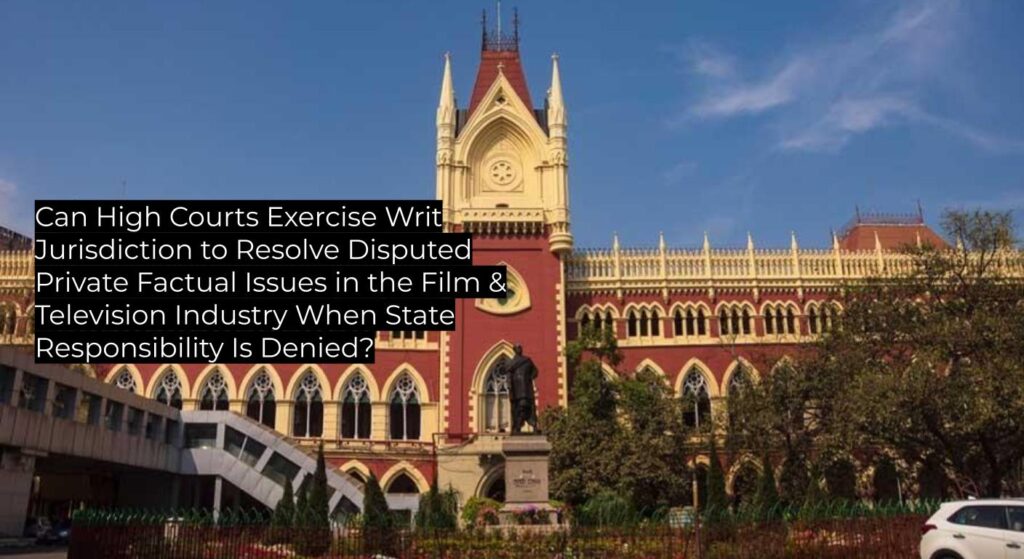
When deeply contested facts are raised among private parties, and the State refuses responsibility for operational matters in an industry, the High Court reaffirms the limits of its writ jurisdiction—holding such disputes are not amenable to writ adjudication; parties must pursue alternate remedies. Dismissal confirms existing precedent and is binding on all subordinate courts, particularly relevant to the entertainment sector.
Summary
| Category | Data |
|---|---|
| Case Name | WPA/7543/2025 of PROSENJIT MALLICK Vs STATE OF WEST BENGAL AND ORS. |
| CNR | WBCHCA0151242025 |
| Date of Registration | 01-04-2025 |
| Decision Date | 10-09-2025 |
| Disposal Nature | DISMISSED |
| Judgment Author | HON’BLE JUSTICE AMRITA SINHA |
| Court | Calcutta High Court |
| Precedent Value | Binding on all subordinate courts in West Bengal |
| Type of Law | Constitutional / Writ Law; Administrative Law |
| Questions of Law | Whether the High Court can adjudicate writ petitions involving disputed inter se factual issues among private parties in the film and television industry, particularly when the State denies responsibility. |
| Ratio Decidendi |
|
| Facts as Summarised by the Court |
The matter pertained to functioning issues in the film and television industry. The Principal Secretary, Information and Cultural Affairs Department, suggested formation of a committee; objections were raised; the State claimed no responsibility; all allegations were disputed. |
Practical Impact
| Category | Impact |
|---|---|
| Binding On | All subordinate courts in West Bengal |
What’s New / What Lawyers Should Note
- Reaffirms that writ petitions will not be entertained where material factual disputes exist between parties, especially in the absence of State liability or duty.
- Makes clear that the State’s refusal to accept responsibility for private disputes in an industry is determinative against writ relief.
- Lawyers representing clients in similar industry or administrative disputes should be prepared to pursue alternative remedies such as civil suits, rather than writ petitions, when facts are disputed and State responsibility is not accepted.
- Calls attention to the futility of seeking writ directions to government authorities to resolve purely private disputes within sectors like the film and television industry.
Summary of Legal Reasoning
- The Court observed that the petitioner sought resolution for issues faced in the film and television industry, but these were raised as inter se disputes, not against a statutory or administrative act of the State.
- The Principal Secretary provided a hearing and suggested setting up a committee, but this was objected to by the respondents and the State.
- The State, through submissions, denied any obligation or responsibility for resolving such disputes or for ensuring smooth functioning of the industry.
- The Court assessed the submissions and concluded that where all material facts and claims are disputed and the respondents contest every allegation, the writ jurisdiction cannot be invoked to decide such matters.
- Consequently, the Court dismissed the writ petition, leaving the parties free to seek alternative remedies under law.
Arguments by the Parties
Petitioner
- Sought intervention and redressal of problems faced in the film and television industry via writ jurisdiction.
Respondent No. 5
- Raised serious objections to the recommendations and the process.
Respondent Nos. 3 & 4
- Likewise disputed the factual basis and relief sought.
State
- Through senior counsel, expressly denied any responsibility or obligation to resolve private industry disputes.
- Asserted that the State could not be compelled to intervene in such matters.
Factual Background
The dispute originated within the film and television industry of West Bengal. The petitioner raised operational and functional grievances. The Principal Secretary, Information and Cultural Affairs Department, heard the parties and suggested the formation of a committee with eminent industry persons, but respondents raised substantial objections to this proposal. The State categorically denied any obligation to intervene in such inter se disputes. All factual claims and allegations were hotly contested, rendering the writ adjudication unworkable.
Statutory Analysis
The Court examined the scope of constitutional writ jurisdiction, particularly its limits in resolving disputed facts and private grievances absent clear statutory or administrative duty on the State. No new statutory interpretation or reading down/up was reported in the judgment.
Dissenting / Concurring Opinion Summary
No dissenting or concurring opinions were delivered; the judgment is single-authored.
Procedural Innovations
None reported. The Court referred the matter to administrative authorities initially, but upon objections and denial of State responsibility, declined to innovate on procedure.
Alert Indicators
- ✔ Precedent Followed – The decision reaffirms established principles restricting writ jurisdiction to non-disputed factual scenarios and clear statutory duties on the State; no new law made nor prior precedent overruled.