


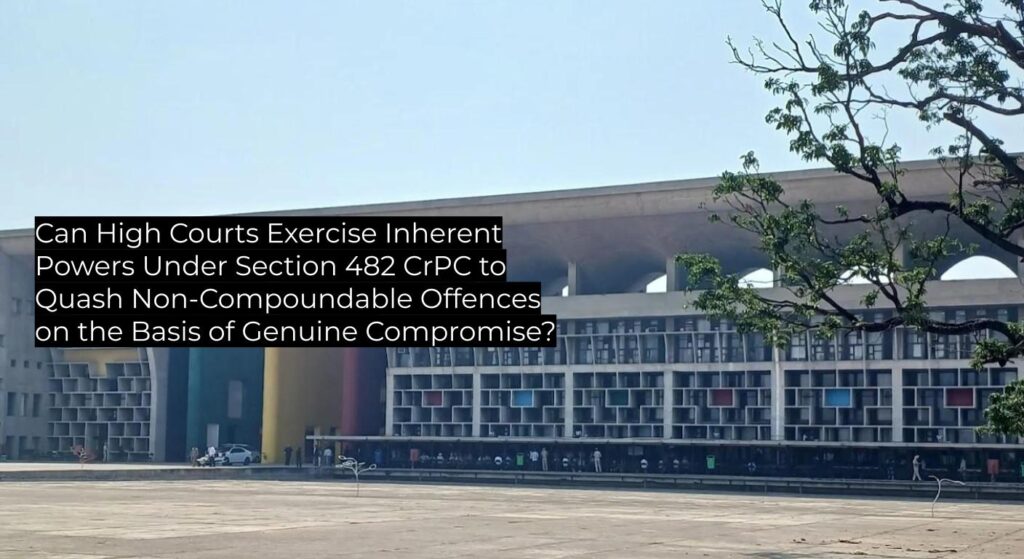
The High Court reaffirmed its power under Section 482 CrPC to quash non-compoundable offences where genuine compromise has been reached, following binding Supreme Court and Full Bench precedents. This judgment upholds existing law, clarifies that such power is not limited to matrimonial disputes, and serves as binding precedent for subordinate courts within the jurisdiction.
Summary
| Category | Data |
|---|---|
| Case Name | CRM-M/49440/2025 of SUBEG SINGH ALIAS SUKHDEV SINGH AND OTHERS Vs STATE OF PUNJAB AND ANOTHER |
| CNR | PHHC011412062025 |
| Date of Registration | 03-09-2025 |
| Decision Date | 30-10-2025 |
| Disposal Nature | ALLOWED |
| Judgment Author | MR. JUSTICE AMAN CHAUDHARY |
| Court | High Court of Punjab and Haryana |
| Precedent Value | Binding on subordinate courts in Punjab and Haryana; persuasive elsewhere |
| Overrules / Affirms | Affirms Supreme Court (Gian Singh) and Full Bench (Kulwinder Singh) |
| Type of Law | Criminal Procedure – Inherent powers, Quashing of criminal proceedings |
| Questions of Law | Whether High Court can quash FIRs in non-compoundable offences if parties have effected a genuine compromise and such quashing serves the ends of justice. |
| Ratio Decidendi |
The High Court has inherent power under Section 482 CrPC to quash non-compoundable offences if the dispute has been genuinely settled between the parties and such quashing would serve the ends of justice or prevent abuse of process. This power is not restricted to matrimonial cases. The exercise of this discretion must be governed by the need to secure justice and avoid misuse of the process of law. In the present case, since the compromise was found to be genuine and voluntary, and all accused were neither proclaimed offenders nor involved in other FIRs, quashing was held appropriate. |
| Judgments Relied Upon |
|
| Logic / Jurisprudence / Authorities Relied Upon by the Court | The court relied on the principle that inherent powers are of wide plenitude with no statutory limitation, and that these must be used to secure the ends of justice or to prevent abuse of process (as enunciated in Gian Singh and Kulwinder Singh). |
| Facts as Summarised by the Court | FIR No.208 dated 23.09.2021 was registered under Sections 325, 323, 427, 148, 149 IPC at Police Station Gharinda, District Amritsar Rural. Parties effected a compromise on 12.08.2025, which was verified by trial court as genuine and voluntary, with no accused declared a proclaimed offender or involved in other FIRs. |
Practical Impact
| Category | Impact |
|---|---|
| Binding On | All subordinate courts in Punjab and Haryana |
| Persuasive For | Other High Courts, Supreme Court, and courts outside Punjab and Haryana |
| Follows |
|
What’s New / What Lawyers Should Note
- Reaffirms that quashing of non-compoundable offences under Section 482 CrPC is permissible when a genuine compromise is reached and the ends of justice so demand.
- Clarifies that this power is not confined to matrimonial disputes alone; it extends to other cases where private parties have settled.
- Diligence in verifying the genuineness and voluntariness of the compromise remains essential—trial court’s report is pivotal.
- Lawyers can rely on this precedent, together with Gian Singh and Kulwinder Singh, to support quashing petitions in non-compoundable offences based on settlement.
Summary of Legal Reasoning
- The court first noted the settlement and the trial court’s verification that the compromise was genuine, voluntary, and free from coercion, with no accused being proclaimed offenders or involved in other FIRs.
- The court cited Kulwinder Singh (Full Bench) to affirm that inherent powers under Section 482 CrPC may be used to quash criminal proceedings even for non-compoundable offences, not limited to matrimonial disputes, when it is necessary to prevent abuse of process or to secure justice.
- The Supreme Court’s decision in Gian Singh was relied upon for the legal principle that inherent powers under Section 482 are distinct from the compounding power under Section 320 CrPC and may be invoked to prevent abuse or secure the ends of justice where compromise has occurred.
- Applying these principles, the court found that continuation of proceedings would serve no useful purpose and allowed the petition.
Arguments by the Parties
Petitioner:
- Sought quashing of FIR and proceedings in light of a compromise reached with the complainant.
- Submitted that all parties had settled voluntarily and the compromise was genuine.
Respondent (State):
No separate detailed argument extracted in the judgment text.
Factual Background
FIR No.208 was registered on 23.09.2021 at Police Station Gharinda, District Amritsar Rural, under Sections 325, 323, 427, 148, 149 of the IPC. The accused and complainant entered into a compromise on 12.08.2025. The compromise’s genuineness and voluntariness were certified by the trial court, which also noted that no accused was a proclaimed offender or facing other FIRs.
Statutory Analysis
- Section 482 of the Code of Criminal Procedure, 1973, was interpreted to uphold the High Court’s wide inherent powers to quash criminal proceedings for “ends of justice” or to prevent “abuse of process.”
- Section 320 CrPC (compounding of offences) was distinguished from inherent powers under Section 482, following Gian Singh, to clarify that Section 482 is not statutorily limited by the compounding provisions.
Alert Indicators
- ✔ Precedent Followed – The judgment follows binding Full Bench and Supreme Court authorities, confirming established law rather than changing it.