


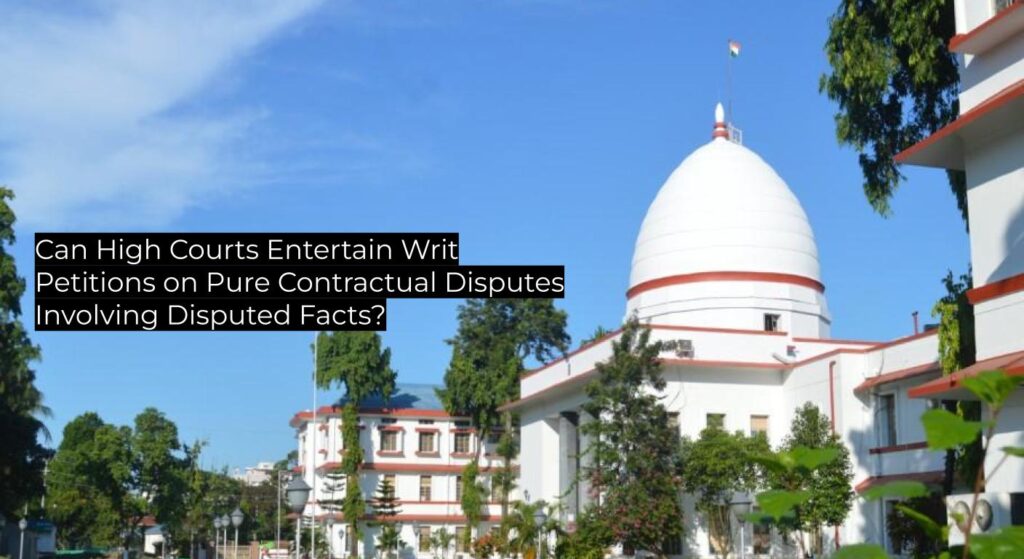
Reaffirming that Article 226 does not extend to fact-intensive private contracts, the Gauhati High Court follows Supreme Court precedents like Puna Hinda and Municipal Committee Katra; petitioners must pursue civil remedies, with time spent condoned for limitation.
Summary
| Category | Data |
|---|---|
| Case Name | WP(C)/143/2024 of Sh. P.C Vanlalawmpuia Vs The State of Mizoram r/b the Chief Secretary to the Govt. of Mizoram and 3 Ors. |
| CNR | GAHC030007732024 |
| Date of Registration | 11-12-2024 |
| Decision Date | 01-09-2025 |
| Disposal Nature | Dismissed |
| Judgment Author | HONORABLE MRS. JUSTICE YARENJUNGLA LONGKUMER |
| Court | Gauhati High Court (High Court of Assam, Nagaland, Mizoram and Arunachal Pradesh) |
| Bench | Single Judge Bench |
| Precedent Value | Affirms existing Supreme Court precedents limiting writ jurisdiction |
| Overrules / Affirms | Affirms |
| Type of Law | Constitutional law; administrative law; contract law |
| Questions of Law |
|
| Ratio Decidendi |
The court held that writ jurisdiction under Article 226 is not ordinarily available to resolve purely private contractual disputes involving complex, contested factual issues. Reliance on spot verification reports and measurements in road contracts demonstrates the need for oral evidence and specialized forums. In line with LIC v Escorts, Puna Hinda, and Municipal Committee Katra, High Courts must refrain from adjudicating disputes where public law elements are absent. The petitioner’s remedy lies in civil court or arbitration, with the time spent in writ proceedings condoned for limitation. |
| Judgments Relied Upon |
|
| Logic / Jurisprudence / Authorities Relied Upon by the Court | The court applied the distinction between public and private law actions under Article 226, holding that contractual obligations without public law character are unsuitable for writ remedy. It emphasized that disputed factual questions, such as road-measurement discrepancies, require specialized forums or oral evidence, not writ jurisdiction. |
| Facts as Summarised by the Court | The petitioner, as nominee of a deceased contractor, sought closure of 11 PMGSY road-construction contracts and release of dues under clause 55.2 GCC. Respondents, following an earlier HC order, released ₹7.40 crores but recovered alleged excess payments from one contract based on a spot verification report. The parties dispute the factual basis of those deductions and the exact amounts due. |
| Citations |
|
Practical Impact
| Category | Impact |
|---|---|
| Binding On | All subordinate courts within the jurisdiction of the Gauhati High Court |
| Persuasive For | Other High Courts and the Supreme Court on the scope of Article 226 writ jurisdiction |
| Follows |
|
What’s New / What Lawyers Should Note
- Gauhati HC reaffirms that disputed factual issues in private contractual disputes—such as measurement discrepancies—are not amenable to Article 226 writ petitions.
- Contracts lacking any public law character must be enforced via civil suit or arbitration, not by invoking writ jurisdiction.
- Time spent in pursuing improper writ petitions will be condoned for the purpose of limitation in subsequent civil proceedings.
- Writ courts will not delve into spot-verification or technical measurement controversies requiring oral evidence or expert testimony.
Summary of Legal Reasoning
- The court invoked LIC v Escorts to distinguish public law actions from private contractual obligations, observing that writ jurisdiction is confined to the former.
- It applied Union of India v Puna Hinda and Municipal Committee Katra to hold that disputed questions of fact—particularly road-measurement discrepancies—cannot be adjudicated under Article 226.
- The spot verification report on the “Phura-Vahai” project was contested, evidencing the need for evidence beyond documentary record, unsuitable for writ remedies.
- The absence of any public law element in the contract, combined with complex factual disputes, compels petitioners to seek civil or arbitral forums; the court dismissed the writ and condoned limitation.
Arguments by the Parties
Petitioner
- Claimed entitlement to close 11 PMGSY contracts and release all dues with 12.5% interest under clause 55.2 GCC.
- Alleged arbitrary refusal by respondents to close contracts and settle deposits/security.
- Relied on promissory and equitable estoppel (Suzuki Parasrampuria; DCM; Kasinka Trading; Pune Municipal Corporation).
Respondent (State)
- Asserted compliance with HC’s earlier order by releasing ₹7.40 crores (29.11.2024) and adjusting amounts per measurement disputes.
- Maintained that only ₹4,52,087 remains due, rest recovered as permitted under clause 53.1(i) GCC.
- Argued that contested spot-measurement findings and excess payments involve disputed facts not suitable for writ adjudication, per A.P Electrical.
Factual Background
The petitioner, as nominee of a deceased road-construction contractor under PMGSY, sought writ relief for closure of 11 contracts and release of pending dues under clause 55.2 GCC. Following a prior HC direction, respondents credited ₹7.40 crores to the petitioner’s account but recovered alleged excess payments based on a contested spot verification report for one contract. Disputes over measurement and quantum of dues, involving complex factual questions, led the Gauhati High Court to dismiss the writ petition, advising a civil or arbitral remedy and condoning limitation.
Statutory Analysis
- Article 226, Constitution of India: High Courts may issue extraordinary writs but generally should not adjudicate pure private contracts lacking public law character.
- Clause 55.2, GCC: Provides for contract closure without damages on contractor’s death if nominee unwilling; mandates settlement of performance and security deposits.
- Clause 53.1(i), GCC: Authorizes recovery of excess payments as a debt payable to the employer from any government works executed by the contractor.
Alert Indicators
- ✔ Precedent Followed – Affirms Supreme Court’s limitation of writ jurisdiction in private contractual disputes.
Citations
- Life Insurance Corporation of India v Escorts Ltd, (1986) 1 SCC 264
- Pune Municipal Corporation v Harakchand Misirimal Solanki, (2014) 3 SCC 183
- Kasinka Trading v Union of India, (1995) 1 SCC 274
- DCM Ltd v Union of India, (1996) 5 SCC 468
- Suzuki Parasrampuria Suitings Pvt Ltd v Official Liquidator, (2018) 10 SCC 707
- Union of India v Puna Hinda, (2021) 10 SCC 690
- Municipal Committee Katra v Ashwani Kumar, 2024 INSC 398
- A.P Electrical Equipment Corporation v Tahsildar, 2025 SCC Online SC 447