


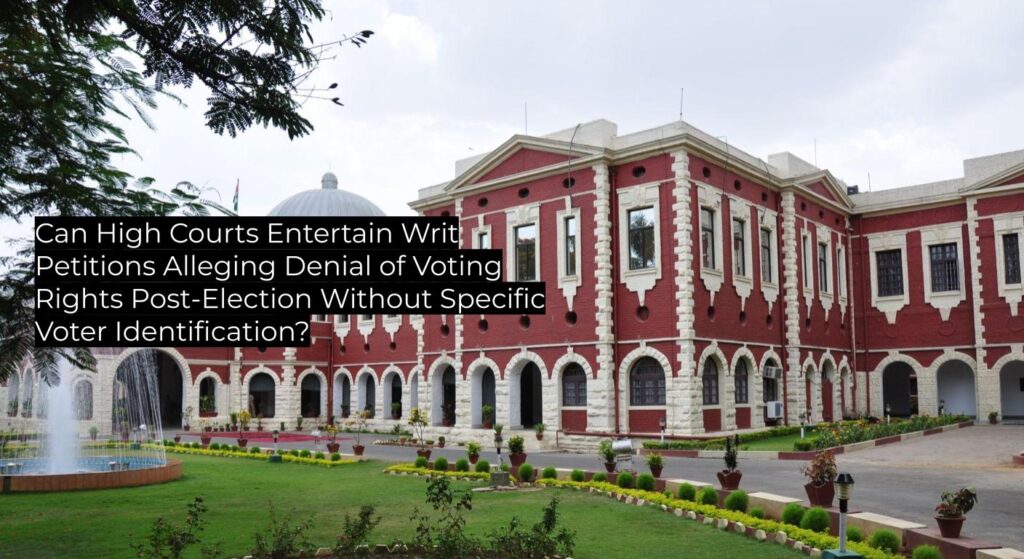
The High Court of Jharkhand reaffirmed that litigation alleging denial of constitutional voting rights must be supported by specific, verifiable details such as voter ID. Post-election writ petitions lacking foundational particulars are liable to be dismissed as vexatious, reinforcing the necessity for diligence and substantiation in election-related civil writs. The judgment serves as binding precedent in Jharkhand for handling similar procedural challenges and frivolous allegations concerning election processes.
Summary
| Category | Data |
|---|---|
| Case Name | WPC/5801/2025 of RAJESH KUMAR PANDEY Vs THE STATE OF JHARKHAND |
| CNR | JHHC010336132024 |
| Date of Registration | 10-10-2025 |
| Decision Date | 15-10-2025 |
| Disposal Nature | Dismissed |
| Judgment Author | Hon’ble Mr. Justice Rajesh Kumar |
| Court | High Court of Jharkhand |
| Precedent Value | Binding in Jharkhand High Court jurisdiction |
| Type of Law | Constitutional/Public Law |
| Questions of Law | Whether a writ petition claiming denial of voting right, filed after election results and without disclosure of voter identification, is maintainable? |
| Ratio Decidendi |
The High Court held that in the absence of specific particulars such as voter ID, and where the matter is raised only after declaration of election results, the petition is vexatious and not maintainable. The Court emphasized that constitutional rights must be claimed with adequate substantiation, and mere allegations unsupported by details are insufficient for judicial intervention. Costs were imposed for filing a frivolous petition. |
| Facts as Summarised by the Court |
The petitioner alleged he was denied his constitutional right to vote during the Lok Sabha 2024 elections due to polling officers closing machines early, and sought an enquiry and retrieval of CCTV footage. The petition was filed after declaration of results and did not mention the voter’s I.D. number. |
Practical Impact
| Category | Impact |
|---|---|
| Binding On | All subordinate courts in Jharkhand |
| Persuasive For | Other High Courts; may be noted as illustrative on procedural diligence |
| Overrules | None specified |
What’s New / What Lawyers Should Note
- The judgment clarifies that writ petitions alleging denial of voting rights post-election must disclose foundational particulars, including voter ID, to be maintainable.
- Filing a writ petition after election results, without substantive particulars, risks dismissal as vexatious and may attract costs.
- Lawyers should ensure election-related writs are well-supported with verifiable details to avoid summary dismissal.
Summary of Legal Reasoning
- The High Court examined the pleadings and noted the absence of critical particulars, notably the voter’s I.D. number.
- The Court observed that the petition had been brought only after the declaration of election results, undermining its bona fides.
- It characterized the lawsuit as vexatious litigation, emphasizing the need for specific, substantiated allegations in petitions invoking constitutional rights.
- On these grounds, the petition was dismissed with costs.
Arguments by the Parties
Petitioner
- Alleged denial of the constitutional right to vote due to early closure of voting machines by polling officers during Lok Sabha 2024 in Kanti.
- Sought a mandamus for inquiry against polling personnel and retrieval of CCTV footage covering polling hours.
Factual Background
The petitioner claimed he was denied his constitutional right to vote at Middle School, Kanti, during the 2024 Lok Sabha elections, alleging that polling officers closed the voting machines before the scheduled time. The petitioner sought directions for an inquiry and production of CCTV footage from the polling booth. The writ petition was filed after the declaration of election results and failed to disclose the petitioner’s voter I.D. number.
Statutory Analysis
The judgment focused on the nature of writ jurisdiction under Article 226 concerning enforcement of constitutional rights. It emphasized the procedural requirement for specific identification (such as voter I.D.) when alleging denial of fundamental rights in election matters. No statutory interpretation beyond this procedural threshold was undertaken.
Alert Indicators
- ✔ Precedent Followed – The judgment reaffirms established procedural diligence required in election-related writs and adheres to existing legal standards for maintainability of such petitions.