


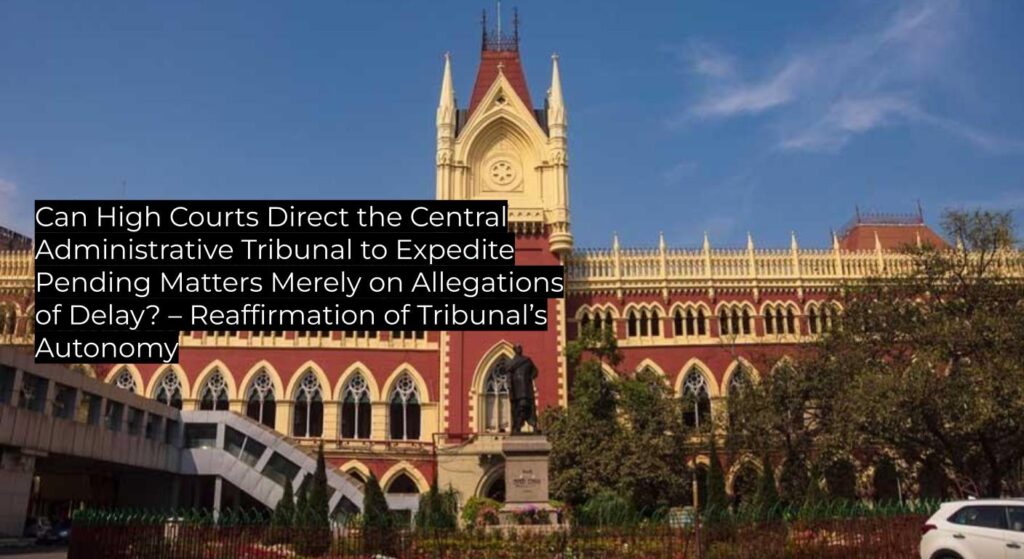
Calcutta High Court holds that directions to the Tribunal for expeditious disposal cannot be issued when adjournments occurred at the request of both parties; affirms established precedent upholding the Tribunal’s discretion in scheduling matters and preserves the Tribunal’s autonomy as a first-instance forum.
Summary
| Category | Data |
|---|---|
| Case Name | WP.CT/216/2025 of SUBHASIS SARKAR Vs UNION OF INDIA AND ORS. |
| CNR | WBCHCA0470622025 |
| Date of Registration | 26-09-2025 |
| Decision Date | 28-10-2025 |
| Disposal Nature | DISMISSED |
| Judgment Author | HON’BLE JUSTICE MADHURESH PRASAD, HON’BLE JUSTICE SUPRATIM BHATTACHARYA |
| Court | Calcutta High Court |
| Bench | HON’BLE JUSTICE MADHURESH PRASAD, HON’BLE JUSTICE SUPRATIM BHATTACHARYA |
| Precedent Value | Binding within Calcutta High Court’s jurisdiction; persuasive elsewhere |
| Type of Law | Administrative Law; Writs; Tribunal Procedure |
| Questions of Law | Whether a High Court should direct the Central Administrative Tribunal to expedite proceedings when adjournments have occurred at the request of both parties. |
| Ratio Decidendi |
The Calcutta High Court emphasised that directions to the Tribunal for expeditious disposal are unwarranted when case records reveal that adjournments were, at least in part, at the request of both parties. The Court deferred to the Tribunal’s right to control its own docket and did not intervene merely on a generalized allegation of delay. Instead, it suggested that parties may move the Tribunal for urgent listing, preserving the Tribunal’s autonomy to manage its proceedings. The writ petition was accordingly dismissed. |
| Facts as Summarised by the Court | The petitioner sought a direction from the High Court to the Tribunal for early disposal of a pending Original Application, alleging inordinate delays post-admission. However, orders annexed to the writ revealed adjournments at the request of both parties on at least two specified dates. |
Practical Impact
| Category | Impact |
|---|---|
| Binding On | All subordinate courts and tribunals within Calcutta High Court’s jurisdiction |
| Persuasive For | Other High Courts and similar writ proceedings concerning Tribunal dockets |
What’s New / What Lawyers Should Note
- The High Court clearly refused intervention based on allegations of Tribunal delay when records reflected adjournments at the request of both parties.
- Any request for expeditious listing should be first mentioned before the Tribunal itself.
- Practitioners must ensure their conduct (requests for adjournment) does not undermine subsequent pleas for judicial intervention alleging delay.
- Writ jurisdiction is not a remedy for every perceived delay before tribunals, especially where parties were themselves contributors to the adjournments.
Summary of Legal Reasoning
- The Calcutta High Court examined the prayer for a direction to the Tribunal for expeditious hearing.
- It scrutinized the record and found that adjournments had occurred at the behest of both sides on at least two occasions.
- The Court held there was “no occasion for passing any order as prayed for”, as the facts did not establish unilateral or unexplained delay by the Tribunal.
- The petitioner was left at liberty to approach the Tribunal for mentioning and seeking early disposal.
- The principle reinforced is that intervention under Article 226 in Tribunal scheduling will not be entertained absent exceptional reasons or party diligence.
Arguments by the Parties
Petitioner
- Sought a direction for expeditious disposal of the pending matter before the Tribunal.
- Alleged the matter, though admitted, had only been adjourned since 13.12.2022.
Respondent
- Relied on orders annexed to the petition showing adjournments were at the request of both parties on at least two subsequent dates.
Factual Background
The petitioner approached the High Court seeking an order to direct the Central Administrative Tribunal, Kolkata Bench, to expeditiously dispose of an admitted matter (Original Application). The records attached to the writ petition showed that after admission on 13.12.2022, adjournments were recorded, including on 01.05.2024 and 10.06.2024, at the request of both parties. The High Court noted these facts and declined to interfere.
Statutory Analysis
No specific statutory provision was interpreted in detail, but the High Court reaffirmed the established delimitation on writ jurisdiction over Tribunal procedures, emphasising that court orders for expeditious hearing require exceptional circumstances not present when parties have themselves contributed to adjournments.
Dissenting / Concurring Opinion Summary
No separate concurring or dissenting opinion was delivered; both Justices concurred in the judgment.
Procedural Innovations
No new procedural precedent or innovation was set in this decision.
Alert Indicators
- ✔ Precedent Followed – The High Court reaffirmed the established law that writ intervention for tribunal scheduling is unwarranted absent party diligence or exceptional delay attributable solely to the Tribunal.