


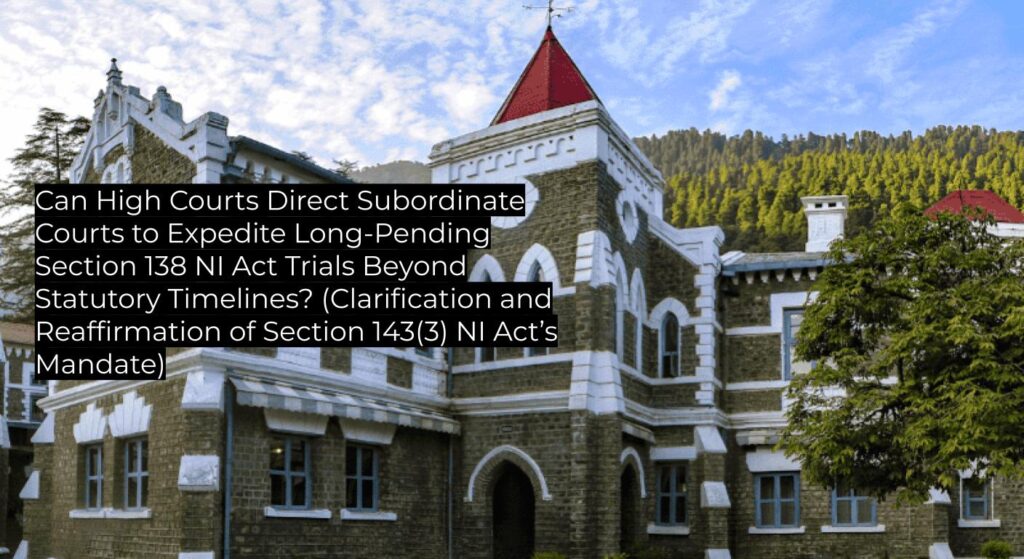
High Court affirms its power to direct expeditious trial of Section 138 NI Act cases pending beyond six months, reinforcing the statutory mandate of Section 143(3) and requiring subordinate courts to conclude such trials within one year from the order; this serves as a binding clarification for all subordinate courts handling Negotiable Instruments Act prosecutions.
Summary
| Category | Data |
|---|---|
| Case Name | C528/1883/2025 of ANIL PAL Vs RAJAT GUPTA |
| CNR | UKHC010166152025 |
| Date of Registration | 15-10-2025 |
| Decision Date | 17-10-2025 |
| Disposal Nature | DISPOSED |
| Judgment Author | Hon’ble Mr. Justice Pankaj Purohit |
| Court | High Court of Uttarakhand |
| Precedent Value | Binding on subordinate courts in Uttarakhand; clarificatory |
| Type of Law | Criminal Procedure (Section 138, 143 of Negotiable Instruments Act, 1881) |
| Questions of Law | Whether High Courts may direct subordinate courts to expedite Section 138 NI Act trials delayed beyond statutory timelines and enforce compliance with Section 143(3) NI Act rulings |
| Ratio Decidendi | The High Court observed that Section 143(3) NI Act mandates expeditious conclusion of Section 138 trials, with a six-month outer limit for disposal. Where trials are pending for years beyond the statutory period, the High Court may, in exercise of its supervisory jurisdiction, direct subordinate courts to conclude such trials within a fixed timeline—in this case, within one year from production of the order. This upholds the legislative mandate and ensures that delayed justice is addressed by positive judicial direction. |
| Facts as Summarised by the Court | Multiple Section 138 NI Act prosecutions by connected parties have remained pending in subordinate courts, in some instances since 2019; applicants sought directions to expedite trial completion. |
Practical Impact
| Category | Impact |
|---|---|
| Binding On | All subordinate courts in Uttarakhand dealing with Section 138 NI Act matters |
| Persuasive For | Other High Courts in India in similar Section 138 NI Act delay situations |
What’s New / What Lawyers Should Note
- High Court explicitly directed subordinate courts to conclude long-pending Section 138 NI Act trials within one year, reinforcing the statutory timeline in Section 143(3).
- Demonstrates the High Court’s willingness to enforce the expeditious trial mandate through binding directions.
- Lawyers may move similar applications for expedited hearing of aged Section 138 cases on account of this precedent.
- Delay beyond the statutory six months will be judicially scrutinized and time-bound orders can be requested.
Summary of Legal Reasoning
- The court recognized that Section 143(3) of the NI Act requires trials under Section 138 to be concluded as expeditiously as possible and, where feasible, within six months from filing of the complaint.
- The court reviewed the record and noted longstanding pendency in several Section 138 matters (some beyond six years).
- To safeguard the legislative intent of expeditious trial and prevent undue delay, the High Court exercised its jurisdiction to direct subordinate courts to attempt disposal as early as possible, fixing a maximum period of one year from the date of its order.
- The High Court thus used its supervisory and writ jurisdiction to reinforce the statutory command of Section 143(3) and mandated future compliance.
Arguments by the Parties
Petitioner
- Sought directions to expedite the proceedings in long-pending Section 138 NI Act cases.
- Emphasized statutory mandate for expeditious trial under Section 143(3) of NI Act.
- Pointed out pendency of cases as far back as 2019.
Respondent
- No distinct submissions of respondents are recorded in the judgment.
Factual Background
The applicants filed multiple applications stating that their criminal complaints under Section 138 of the Negotiable Instruments Act were pending before various subordinate courts, some since 2019. They contended these matters had not been concluded within the timeline mandated by law and prayed for expedited disposal as per the statutory direction under Section 143(3) of the NI Act.
Statutory Analysis
- Section 143(3) of the Negotiable Instruments Act requires that every trial under Section 138 be concluded as expeditiously as possible, and an endeavor be made to conclude it within six months from the date of filing the complaint.
- The court held that, given this provision and instructions from higher judicial authority, courts must adhere to the timeline except in exceptional circumstances.
Procedural Innovations
- The High Court issued a uniform direction in multiple connected matters through a common judgment, requiring all subordinate courts named to conclude pending Section 138 NI Act trials within one year from production of the order.
Alert Indicators
- ✔ Precedent Followed – The judgment follows and enforces the statutory timeline established under Section 143(3) of the NI Act, clarifying application in the face of delay.