


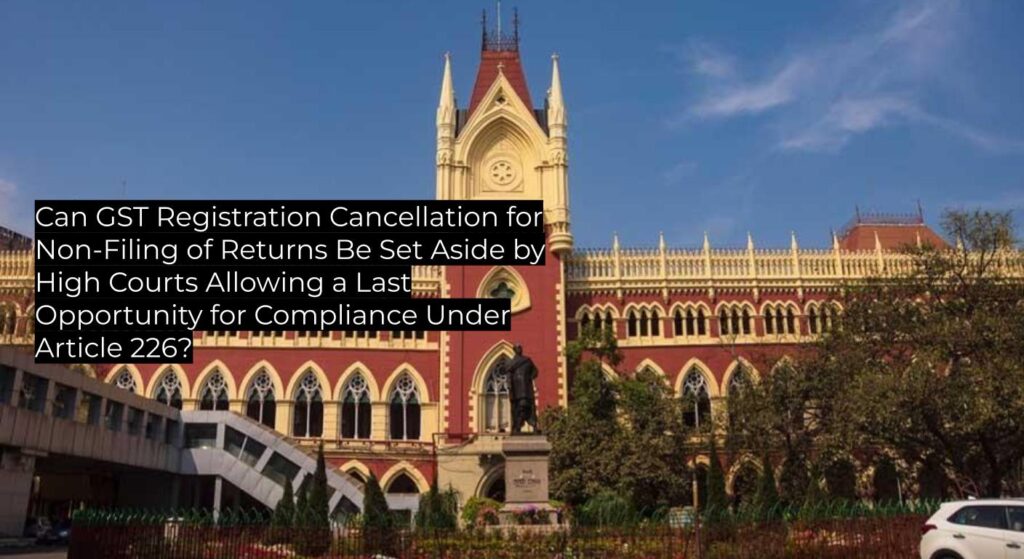
Calcutta High Court reaffirms that even after cancellation of registration for non-filing of GST returns, writ jurisdiction under Article 226 can be invoked to grant a final opportunity to file returns and regularise defaults, provided the petitioner complies with strict conditions. This aligns with prior Division Bench precedent, and functions as binding authority for subordinate courts and persuasive authority for GST tribunals and other high courts.
Summary
| Category | Data |
|---|---|
| Case Name | WPA/1996/2025 of M/S. JAGATBANDHU ENTERPRISE Vs THE DEPUTY COMMISSIONER OF STATE TAX, WEST BENGAL, SILIGURI CIRCLE AND ORS. |
| CNR | WBCHCJ0046842025 |
| Date of Registration | 08-09-2025 |
| Decision Date | 29-10-2025 |
| Disposal Nature | DISPOSED |
| Judgment Author | HON’BLE JUSTICE HIRANMAY BHATTACHARYYA |
| Court | Calcutta High Court, Circuit Bench at Jalpaiguri |
| Bench | Single Judge Bench |
| Precedent Value | Binding on subordinate courts; persuasive for other benches and courts |
| Overrules / Affirms | Affirms Division Bench precedent Subhankar Golder vs. Assistant Commissioner of State Tax, Serampore |
| Type of Law | Tax Law, GST Registration, Administrative Law, Constitutional Law (Article 226) |
| Questions of Law | Whether writ courts can grant relief against order cancelling GST registration for non-filing of returns by providing a final opportunity to comply. |
| Ratio Decidendi |
The High Court holds that, even where statutory remedy exists, in the interest of justice, an assessee whose registration is cancelled due to non-filing of returns is entitled to a final opportunity to remedy the breach by filing all pending returns and paying dues. This power may be exercised in writ jurisdiction, subject to strict compliance within a stipulated timeframe. The court follows and applies the prior Division Bench decision in Subhankar Golder. Failure to comply within the court-set window negates the relief in toto. The court further directs the GSTN portal to be opened to enable compliance. |
| Judgments Relied Upon | Subhankar Golder vs. Assistant Commissioner of State Tax, Serampore (Division Bench, 2024) |
| Logic / Jurisprudence / Authorities Relied Upon by the Court | Justice, opportunity to remedy procedural default, and alignment with existing Division Bench precedent. |
| Facts as Summarised by the Court |
Petitioner’s GST registration was cancelled for failure to file returns for six consecutive months. The petitioner approached the High Court over a year after the cancellation order, seeking opportunity to regularise its status. The State contended an alternative statutory remedy was available and delay barred relief, but the court decided to grant a last chance for compliance in the interest of justice, subject to strict conditions. |
Practical Impact
| Category | Impact |
|---|---|
| Binding On | All subordinate courts and authorities within the territorial jurisdiction of Calcutta High Court |
| Persuasive For | Other high courts, GST appellate tribunals, and potentially the Supreme Court |
| Follows | Subhankar Golder vs. Assistant Commissioner of State Tax, Serampore (Division Bench, 2024) |
What’s New / What Lawyers Should Note
- Reaffirms that High Courts exercising writ jurisdiction can set aside GST registration cancellation orders (for non-filing of returns) even if there is alternate statutory remedy and delay, where justice requires.
- Relief is strictly conditional: All pending returns must be filed, and all due tax, interest, fine, and penalty must be paid within a fixed timeframe (here, three weeks from receiving the order).
- GST portal opening directions can be sought to enable compliance within court-mandated time.
- Non-compliance within the stipulated period results in automatic vacation of the relief granted and dismissal of the writ; no further reference to court is needed.
Summary of Legal Reasoning
- The court examined the order cancelling the petitioner’s GST registration for non-filing of returns over six months and noted applicant’s failure to file returns triggered the administrative action.
- Petitioner placed reliance on the Division Bench ruling in Subhankar Golder, which established that an opportunity should be given to remedy the breach.
- The respondents (State and CGST) argued statutory appeal remedy existed, and relief should be denied due to delay, but the court held that, in the interest of justice, writ jurisdiction is still available to grant a last opportunity to comply, following existing precedent.
- The judgment imposed strict compliance conditions: filing all returns and payment of outstanding dues within three weeks, failing which relief would automatically lapse.
- The court further ordered GST authorities to open the necessary portal to enable compliance.
Arguments by the Parties
Petitioner:
- Relied on the Division Bench judgment in Subhankar Golder to submit that an opportunity must be given to redress the breach (non-filing of returns).
- Sought setting aside of the cancellation order and restoration of registration subject to compliance.
Respondent (State):
- Argued the impugned cancellation order was appealable, and petitioner should have taken that statutory remedy.
- Contended that petitioner delayed approaching the Court (over one year since cancellation), thus relief should be denied.
Respondent (CGST Authorities):
- Supported State’s objection on maintainability due to existence of alternate remedy and delay.
Factual Background
The petitioner’s GST registration was cancelled by the Deputy Commissioner, Siliguri, on May 16, 2024, due to failure to file returns for six consecutive months. The petitioner approached the High Court under Article 226 after more than a year, requesting restoration of registration. The core contention was whether a final opportunity could be granted to cure the breach. The court examined the order, heard all sides, and granted conditional relief as per precedent.
Statutory Analysis
- The judgment deals with the powers under Article 226 of the Constitution regarding administrative tax orders (specifically, cancellation of GST registration under the GST Act due to non-filing of returns).
- No explicit interpretation or reading down of GST statute sections is detailed, but reliance is placed on the necessity of opportunity for compliance and the ability to provide such under writ jurisdiction.
Procedural Innovations
- Ordered that the GSTN portal be opened by authorities to enable the petitioner to file pending returns and discharge liabilities within the stipulated period.
- Relief was made strictly conditional and self-executing: failure to comply within fixed time results in automatic failure of relief, without need for further court order.
Alert Indicators
- ✔ Precedent Followed – Existing Division Bench precedent (Subhankar Golder) on remedying GST registration cancellation is reaffirmed.