


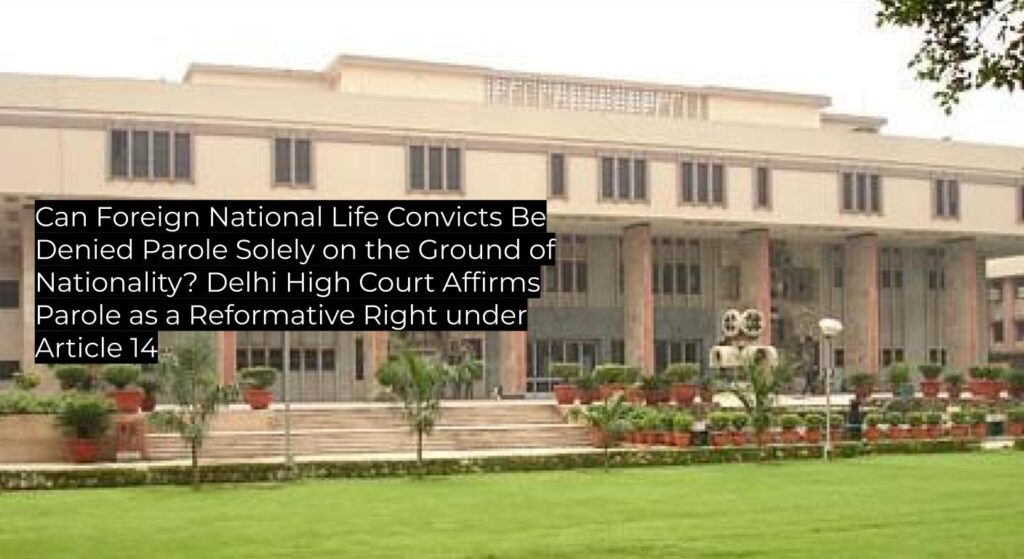
Delhi High Court clarifies that foreign nationals cannot be deprived of parole on grounds of nationality alone if other eligibility conditions are met; affirms parity in parole rights under Article 14 and interprets Delhi Prison Rules, 2018 to require a case-by-case assessment. The ruling upholds existing legal principles and provides binding authority within Delhi’s jurisdiction for parole applications by foreign national convicts.
Summary
| Category | Data |
|---|---|
| Case Name | W.P.(CRL)/2764/2025 of JAHANGIR@EKKA@IBRAHIM Vs THE STATE GOVT OF NCT OF DELHI |
| CNR | DLHC010632352025 |
| Date of Registration | 30-08-2025 |
| Decision Date | 01-09-2025 |
| Disposal Nature | Petition allowed and parole granted for four weeks with specific conditions |
| Judgment Author | HON’BLE DR. JUSTICE SWARANA KANTA SHARMA |
| Court | High Court of Delhi |
| Bench | HON’BLE DR. JUSTICE SWARANA KANTA SHARMA (Single Judge) |
| Precedent Value | Binding on subordinate courts in Delhi |
| Overrules / Affirms | Affirms the requirement for reasoned, case-specific parole assessment for foreign nationals under Rule 1211 of Delhi Prison Rules, 2018 |
| Type of Law | Criminal Law; Prison Law; Constitutional Law (Article 14) |
| Questions of Law | Whether a foreign national life convict can be denied parole solely on grounds of nationality and risk of absconding, or whether Article 14 requires parity in parole eligibility. |
| Ratio Decidendi | The Court held that parole, as a reformative process, cannot be denied solely because the applicant is a foreign national. Rule 1211 of the Delhi Prison Rules, 2018 requires a case-by-case assessment, and a foreign national convict must be considered for parole on the same principles as others, subject to satisfaction of eligibility criteria and sufficient safeguards. The mere apprehension of absconding, without clear basis from verifications, cannot by itself justify exclusion. Article 14 of the Constitution guarantees equal treatment, and nationality-based prejudice in parole matters violates this equality. The petitioner’s verified local address, satisfactory jail conduct, and more than 18 years of custody were salient factors justifying the grant of parole. |
| Judgments Relied Upon | The Court referenced principles contained in the Delhi Prison Rules, 2018 regarding the aims and objectives of parole and cited Article 14. |
| Logic / Jurisprudence / Authorities Relied Upon by the Court | Interpretation of Rule 1211 and Rule 1197–1200 of Delhi Prison Rules, 2018; Article 14 of the Constitution. The Court emphasized the reformative and rehabilitative objectives of parole, the requirement to avoid discriminatory grounds, and that verifiable residence and past conduct should be material factors. |
| Facts as Summarised by the Court | The petitioner, a Bangladeshi national, is serving concurrent life sentences following convictions in two cases. He completed over 18 years and 6 months in custody with more than 5 years’ remission and had satisfactory prison conduct. His previous parole was granted in 2024. He sought parole to maintain social ties, proposing residence with his verified married sister in Delhi. The State opposed parole, citing nationality and risk of absconding, but verification confirmed the sister’s residence and marriage to an Indian citizen. |
Practical Impact
| Category | Impact |
|---|---|
| Binding On | All subordinate courts and authorities in the NCT of Delhi regarding parole applications by foreign national convicts. |
| Persuasive For | Other High Courts and prison/parole authorities considering parity and Article 14 in parole of foreign nationals. |
| Overrules | None specified. Affirms careful, principle-based consideration per existing law. |
| Distinguishes | Distinguishes general presumption of absconding risk for foreign nationals from case-specific verification and ensures no mechanical denials. |
| Follows | Follows the aims and principles set out under Delhi Prison Rules, 2018; relies on equality mandate in Article 14. |
What’s New / What Lawyers Should Note
- The judgment clarifies that parole for foreign national convicts cannot be denied solely on the ground of nationality or generic apprehensions of absconding.
- A detailed, case-by-case assessment — including verification of proposed local residence and prison conduct — is required.
- Article 14 prohibits nationality-based prejudice; lawyers can now cite this decision to challenge blanket denials of parole to foreign nationals.
- Confirmed that satisfactory jail conduct, length of actual incarceration, and a verified Indian address are strong grounds for granting parole, even to foreign nationals.
- The Delhi Prison Rules must be interpreted harmoniously with constitutional equality.
Summary of Legal Reasoning
- The Court assessed the petitioner’s eligibility for parole by analyzing the relevant provisions of the Delhi Prison Rules, 2018, especially Rule 1211 and the objects set out in Rules 1197–1200.
- The Court noted the key reformative purposes behind parole: preserving family ties, social reintegration, and incentivizing good prison conduct.
- Article 14 of the Constitution was invoked to reinforce the principle of equality before the law, cautioning against any discriminatory denial of parole based on nationality, unless supported by individualized reasoning.
- The State’s principal objection — likelihood of absconding — was weighed against facts: the petitioner’s verified sister’s residence in Delhi, her Indian citizenship, previous parole compliance, and the petitioner’s satisfactory prison record.
- The Court emphasized that apprehensions should not substitute for evidence, and parole denials must be justified by specific circumstances, not stereotypes.
- It thus ordered parole with rigorous conditions (bond, address verification, local reporting, movement restrictions, and communication requirements), balancing reformation with public safety.
Arguments by the Parties
Petitioner
- Petitioner has remained in judicial custody for over 18 years with satisfactory conduct.
- Both life sentences are running concurrently by court order.
- Previous convictions in other matters are either for periods already undergone or resulted in acquittals.
- Sought parole for familial reasons, to reside with his verified married sister in Delhi.
- Parole is a reformative measure and an opportunity for social reintegration.
- Denial of parole to a foreign national solely on nationality grounds violates Article 14.
Respondent (State)
- Parole application was denied for valid reasons: petitioner is a foreign national and at risk of absconding.
- Noted petitioner’s past failure to surrender after dismissal of appeal.
- Acknowledged that comprehensive verification was conducted of the petitioner’s sister’s address, her marriage to an Indian citizen, and residence.
- Ultimately left the decision to the Court on overall facts and circumstances.
Factual Background
The petitioner, a Bangladeshi national, was convicted in two separate cases (FIR No. 254/2003 and FIR No. 41/2011), both resulting in life sentences ordered to run concurrently. Over 18 years and 6 months have been spent in custody, with satisfactory conduct throughout. He previously failed to surrender after his appeal was dismissed, but since March 2011, he has been continuously incarcerated. The petitioner sought parole to stay with his married sister in Delhi, whose residence and Indian marital ties were fully verified. The State opposed parole primarily due to concerns about absconding owing to his nationality.
Statutory Analysis
- Delhi Prison Rules, 2018:
- Rule 1211: Sets out that foreigners are ordinarily not to be granted parole except in special circumstances and subject to government approval and valid permission to stay in India.
- Rules 1197–1200: Outline the objectives of parole — enabling continuity with family/community life, promoting self-confidence and discipline, and helping inmates overcome incarceration’s adverse effects.
- Constitution – Article 14: Equality before law; parole policy must not discriminate solely on the basis of nationality.
The court interpreted these provisions to require a case-by-case, evidence-based approach, not blanket or prejudicial exclusions.
Procedural Innovations
- The judgment required stringent verification (address, family ties, residency status) as a prerequisite to parole for a foreign national.
- Explicitly imposed reporting, bond, and movement restriction conditions to mitigate any risk of absconding.
Alert Indicators
- ✔ Precedent Followed – The court reaffirmed and applied established principles under the Delhi Prison Rules and Article 14 regarding parole policy and non-discrimination.