


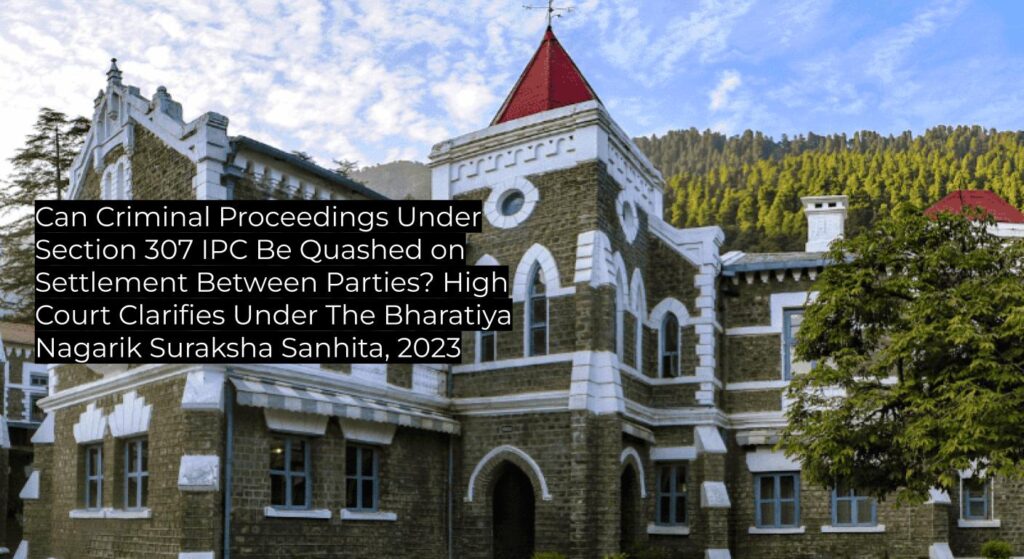
The Uttarakhand High Court affirms that even for non-compoundable offences like Section 307 IPC (Attempt to Murder), proceedings may be quashed in appropriate cases where parties have resolved their disputes. The judgment upholds earlier discretion-based precedent, emphasizing the primacy of justice over technical objections, and serves as binding authority for courts in Uttarakhand.
Summary
| Category | Data |
|---|---|
| Case Name | C528/1725/2025 of SALMAN Vs STATE OF UTTARAKHAND |
| CNR | UKHC010152662025 |
| Date of Registration | 23-09-2025 |
| Decision Date | 29-10-2025 |
| Disposal Nature | ALLOWED |
| Judgment Author | HON’BLE MR. JUSTICE ALOK KUMAR VERMA |
| Court | High Court of Uttarakhand |
| Bench | Single Judge Bench (Justice Alok Kumar Verma) |
| Precedent Value | Binding on subordinate courts within Uttarakhand |
| Overrules / Affirms | Affirms established principles regarding quashing on settlement in serious offences |
| Type of Law | Criminal Law, Procedural Law (Bharatiya Nagarik Suraksha Sanhita, 2023) |
| Questions of Law | Whether proceedings under non-compoundable sections (such as 307 IPC) can be quashed on settlement between parties under Section 528 of BNSS, 2023. |
| Ratio Decidendi | The Court held that, notwithstanding that Section 307 IPC is non-compoundable, the ends of justice may require quashing of criminal proceedings under Section 528 BNSS if the parties have reached a voluntary, pressure-free settlement. The Court emphasized the resolution of private disputes, peaceful relations between parties, and lack of opposition from the victims as a ground for quashing. The opposition of the State, relying solely on the non-compoundable nature of the offence, is not decisive. The Court exercised its inherent power to quash proceedings in the interest of justice, recognizing reconciliation and lack of further grievance. |
| Logic / Jurisprudence / Authorities Relied Upon by the Court | The decision is based on the totality of circumstances, voluntary settlement, peaceful relations, and the discretion under Section 528 BNSS for quashing proceedings in the ends of justice. |
| Facts as Summarised by the Court | FIR dated 26.06.2021 alleged beating by four accused (applicant not named). Applicant and complainants reached a voluntary settlement, submitted compounding application and affidavits, and jointly sought quashing of proceedings. State objected on ground of non-compoundability under Section 307 IPC. |
Practical Impact
| Category | Impact |
|---|---|
| Binding On | All subordinate courts within Uttarakhand |
| Persuasive For | High Courts in other states (on exercise of inherent powers for quashing in non-compoundable offences) |
What’s New / What Lawyers Should Note
- The Uttarakhand High Court holds that proceedings under non-compoundable offences (including Section 307 IPC) may be quashed under Section 528 of BNSS, 2023, when victims and accused settle voluntarily and without coercion.
- State opposition based solely on non-compoundability is insufficient if the complainants support quashing and peaceful settlement has been achieved.
- Lawyers may cite this judgment in quashing petitions involving similarly serious, non-compoundable offences where private parties have settled.
- The practical consideration is whether the ends of justice are served by terminating the proceedings—not strictly the technical bar against compounding.
Summary of Legal Reasoning
- The Court noted that the applicant was not named in the FIR and the dispute was of a private nature, arising out of an altercation resulting in injuries.
- All affected parties (victims and accused) appeared through video conferencing and confirmed a voluntary settlement, submitting compounding applications and affidavits absolving the applicant.
- The State opposed quashing solely on the ground that Section 307 IPC is non-compoundable.
- The Court assessed the “totality of the matter” and prioritized the interests of justice, noting that the parties were now living in harmony.
- Applying discretion under Section 528 of the Bharatiya Nagarik Suraksha Sanhita, 2023 (analogous to Section 482 CrPC), the Court concluded that continuation of proceedings would not serve justice given the amicable settlement.
- The entire proceedings were thus quashed, based on both the private nature of the dispute and absence of any further grievance from the complainants.
Arguments by the Parties
Petitioner:
- The parties have amicably settled their private dispute.
- Compounding application and affidavits filed voluntarily and without pressure.
- Both accused and complainants are living peacefully.
- Requested quashing of all pending proceedings.
Respondent (Complainants):
- Affirmed the existence of an amicable settlement.
- Expressed no further grievance against the applicant.
- Explicitly requested quashing of proceedings.
State:
- Opposed quashing proceedings on the ground that Section 307 IPC is non-compoundable under law.
Factual Background
The case arose from an FIR dated 26.06.2021 filed by the complainant, alleging that they and others were beaten and injured by four accused persons. The applicant was not named in this FIR. During the course of proceedings in Sessions Trial No. 40 of 2024, the applicant and the complainants reached an amicable and voluntary settlement, filing a compounding application and affidavits to that effect. The complainants supported the quashing application, while the State objected based on the offence’s non-compoundable nature.
Statutory Analysis
- Section 528, Bharatiya Nagarik Suraksha Sanhita, 2023: The judgment explains and applies the inherent power of the High Court to quash criminal proceedings to meet the ends of justice, even for offences that are non-compoundable under law.
- Section 307, Indian Penal Code, 1860: Noted as non-compoundable, but the Court asserts that this technical bar does not prevent quashing if justice so demands and the parties have reconciled voluntarily.
Procedural Innovations
The judgment permitted all parties to appear and be identified via video conferencing for confirming the voluntary nature of the compromise and settlement.
Alert Indicators
- ✔ Precedent Followed – The Court reaffirms and applies existing legal principles, granting discretion to quash even non-compoundable offences in the interests of justice where parties have settled.