


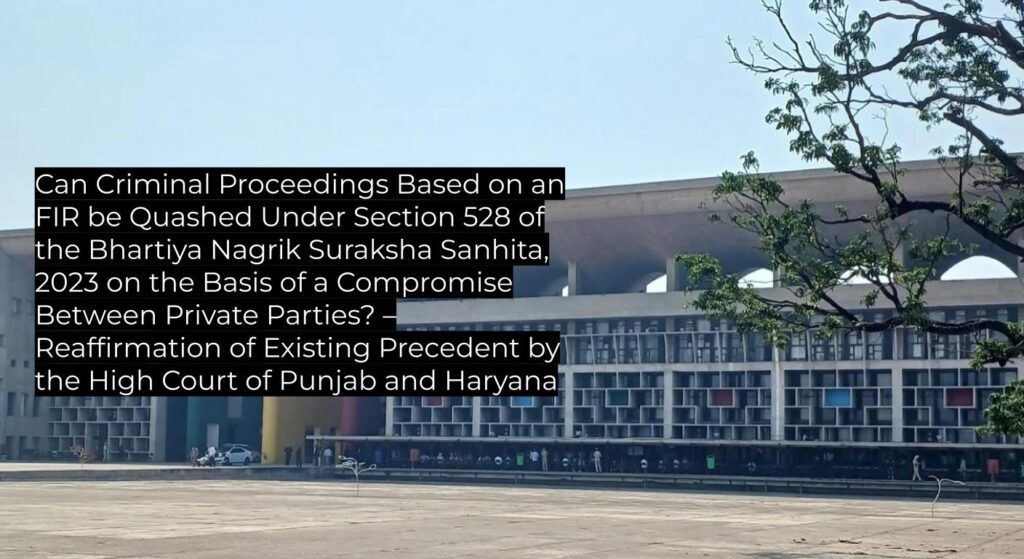
The High Court of Punjab and Haryana reaffirmed that criminal proceedings arising out of private disputes can be quashed under Section 528 of the BNSS, 2023 when parties effect a genuine compromise, following prior Supreme Court and Full Bench High Court precedents. This judgment upholds the existing legal position and serves as binding authority for subordinate courts in Punjab and Haryana, providing clarity for cases involving settlements during investigation or trial.
Summary
| Category | Data |
|---|---|
| Case Name | CRM-M/44158/2025 of KULDEEP SINGH AND OTHERS Vs STATE OF PUNJAB AND OTHERS |
| CNR | PHHC011239152025 |
| Date of Registration | 11-08-2025 |
| Decision Date | 10-09-2025 |
| Disposal Nature | DISPOSED OF |
| Judgment Author | Ms. Justice Rupinderjit Chahal |
| Court | High Court of Punjab and Haryana |
| Precedent Value | Binding on subordinate courts in Punjab and Haryana |
| Overrules / Affirms | Affirms existing precedents (Kulwinder Singh; Gian Singh) |
| Type of Law | Criminal Law; Section 528 BNSS, 2023; Compounding of offences |
| Questions of Law | Whether criminal proceedings under specified sections can be quashed on basis of compromise |
| Ratio Decidendi |
The Court held that criminal proceedings arising out of private disputes can be quashed under Section 528 BNSS, 2023 if a genuine compromise has been effected voluntarily and without coercion or undue influence. In reaching this decision, the Court explicitly followed the principles set by the Full Bench in Kulwinder Singh and others v. State of Punjab and another (2007) and as approved by the Hon’ble Supreme Court in Gian Singh v. State of Punjab and others (2012). The State counsel and private respondents did not dispute the voluntary nature of the compromise. Given these factors, the continuation of trial court proceedings was held to be purposeless, resulting in quashing of the FIR and all subsequent proceedings. |
| Judgments Relied Upon |
|
| Logic / Jurisprudence / Authorities Relied Upon by the Court |
The Court relied on Full Bench and Supreme Court pronouncements regarding quashing of proceedings based on settlement in compoundable matters. The voluntary and genuine nature of the compromise was confirmed by the Magistrate’s report. The legal principle is that continuation of criminal proceedings is not warranted when private parties have amicably settled their dispute and the State does not object. |
| Facts as Summarised by the Court |
FIR No. 0232 dated 12.12.2024 was registered under Sections 117(2), 115(2), 3(5) of the BNS, 2023 at Police Station Lambi, District Sri Muktsar Sahib. The petitioners and the complainant/affected parties reached a compromise on 27.05.2025, which was verified as genuine and free of coercion by the Judicial Magistrate. Both the State and private respondents accepted the fact of compromise. |
Practical Impact
| Category | Impact |
|---|---|
| Binding On | All subordinate courts in Punjab and Haryana |
| Persuasive For | Other High Courts and courts applying Section 528 BNSS, 2023 |
| Follows |
|
What’s New / What Lawyers Should Note
- Reaffirms that FIRs and proceedings can be quashed under Section 528 BNSS, 2023 on the basis of a voluntary and genuine compromise, following established precedents.
- The genuineness of compromise must be verified by the Magistrate; absence of dispute by the State strengthens the case for quashing.
- Lawyers can cite this order as binding precedent in similar compromise-based quashing petitions in Punjab and Haryana.
Summary of Legal Reasoning
- The Court considered a petition under Section 528 of BNSS, 2023 seeking quashing of an FIR based on a compromise between the petitioners and the complainant/respondents.
- The Court previously directed the parties to record their statements before the Magistrate, who subsequently verified that the compromise was voluntary and genuine.
- The State counsel and private respondents did not contest the compromise or its genuineness.
- Relying on the legal principles established in the Full Bench decision in Kulwinder Singh and its approval by the Supreme Court in Gian Singh, the Court held that when criminal proceedings are arising out of a private dispute and have been settled amicably, continuation of prosecution is unnecessary.
- The petition was accordingly allowed, and all proceedings arising from the disputed FIR were quashed.
Arguments by the Parties
Petitioner
- Sought quashing of the FIR and related criminal proceedings on the basis of a settlement/compromise between the parties.
- Highlighted that the compromise was voluntary and without any coercion.
Respondent (State)
- Did not dispute the compromise.
Respondent Nos. 2 and 3
- Accepted the fact of compromise between parties.
Factual Background
The case involved an FIR No. 0232 dated 12.12.2024, registered under Sections 117(2), 115(2), and 3(5) of the Bhartiya Nagrik Suraksha Sanhita, 2023 at Police Station Lambi, District Sri Muktsar Sahib. The parties effected a compromise on 27.05.2025, whose genuineness was verified by the Judicial Magistrate, Gidderbaha. No party objected to the compromise, and the State as well as respondent Nos. 2 and 3 supported the quashing of proceedings.
Statutory Analysis
- Section 528 of the Bhartiya Nagrik Suraksha Sanhita, 2023 was invoked for the quashing of criminal proceedings.
- The Court followed the settled interpretation that allows quashing of criminal proceedings when the parties have settled their dispute amicably and verified the genuineness of compromise through judicial process.
Dissenting / Concurring Opinion Summary
No dissenting or concurring opinions are reflected in the judgment.
Procedural Innovations
- The Court directed parties to record compromise statements before a Magistrate, who was tasked with verifying and reporting the genuineness of the settlement.
- The quashing order was passed only after receiving the Magistrate’s report confirming the voluntary nature of the compromise.
Alert Indicators
- ✔ Precedent Followed – The judgment affirms and applies existing law as laid down by the Full Bench of the High Court and by the Supreme Court.