


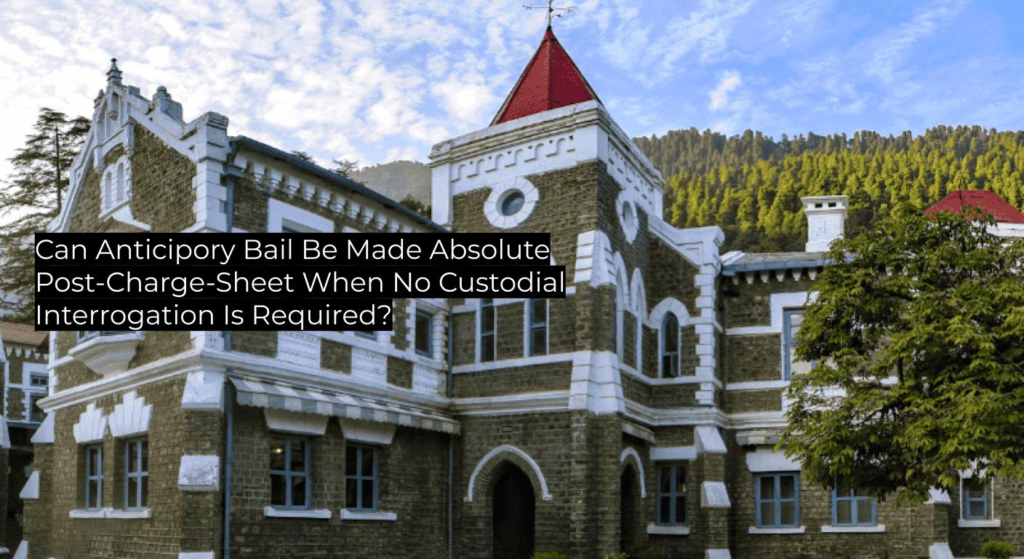
The Uttarakhand High Court answers in the affirmative—anticipatory bail can be made absolute once the charge-sheet is filed and custodial interrogation is unnecessary, reaffirming personal liberty under Article 21 and providing a binding precedent on bail conditions in healthcare-sector FIRs.
Summary
| Category | Data |
|---|---|
| Case Name | ABA/311/2025 of GAURAV AGARWAL Vs STATE OF UTTARAKHAND |
| CNR | UKHC010041212025 |
| Decision Date | 18-08-2025 |
| Disposal Nature | ALLOWED |
| Judgment Author | Hon’ble Mr. Justice Alok Kumar Verma |
| Court | High Court of Uttarakhand |
| Bench | Single-Judge Bench |
| Type of Law | Criminal Procedure (Anticipatory Bail under Section 438 CrPC) |
| Questions of Law | Whether anticipatory bail should be granted and made absolute post-charge-sheet when no custodial interrogation is required. |
| Ratio Decidendi | The court held that personal liberty under Article 21 is a precious fundamental right and should be curtailed only when imperative. Once a charge-sheet is filed and no custodial interrogation is needed, interim bail may be made absolute without commenting on merits, subject to conditions ensuring attendance, no undue influence, and no foreign travel. |
| Logic / Jurisprudence / Authorities Relied Upon by Court | Emphasis on Article 21 protection of personal liberty. |
| Facts as Summarised by the Court | The applicant, a doctor running an empanelled hospital under the Atal Ayushman Uttarakhand Yojna, allegedly failed to follow patient-identification and record-keeping protocols, was penalised and de-empanelled, and sought anticipatory bail after payment of the penalty and filing of the charge-sheet. |
| Citations | 2025:UHC:7247; CNR UKHC010041212025 |
What’s New / What Lawyers Should Note
- The court reaffirms that anticipatory bail can be granted or made absolute after charge-sheet filing when custodial interrogation is no longer necessary.
- Personal liberty under Article 21 is emphasized as “very precious” and must be curtailed only when conditions imperatively demand.
- Interim bail orders may be made absolute without adjudicating the merits, provided strict conditions (attendance, no inducement or threats, no foreign travel) are imposed.
- Absence of criminal antecedents, local residency, and compliance with interim bail conditions strengthen applications for making bail absolute.
Summary of Legal Reasoning
- The court opened by underscoring the fundamental nature of personal liberty under Article 21, stating it should be restricted only when imperative.
- It noted that once a charge-sheet is filed and no custodial interrogation is required, the main justification for denial of anticipatory bail falls away.
- The applicant’s lack of previous criminal record, permanent local residence, and adherence to interim bail conditions were taken as supportive factors.
- Without entering into the merits of the allegations, the interim bail granted earlier was made absolute.
- Specific conditions were imposed—regular court attendance, prohibition on undue influence, and prior permission for foreign travel—to balance liberty and the interests of justice.
Arguments by the Parties
Petitioner (Applicant):
- Allegations are false and penalty of ₹1,67,400 was paid before the FIR.
- No criminal antecedents; permanent local resident; no flight risk.
- Charge-sheet filed, so no risk of evidence tampering.
- Interim bail conditions granted on 05 April 2025 have been fully complied with.
Respondent (State):
- Opposed anticipatory bail on record.
- Acknowledged that charge-sheet has been filed; conceded no custodial interrogation is necessary.
Factual Background
The applicant, a cardiologist, ran Krishan Hospital empanelled under the Atal Ayushman Uttarakhand Yojna. The FIR alleged he treated patients without obtaining telephonic patient-identification numbers, failed to record clinical notes and discharge reports, and did not personally examine several patients. As a result, a penalty of ₹1,67,400 was imposed and the hospital’s empanelment was cancelled. The applicant paid the penalty before the FIR and, after charge-sheet filing, sought and obtained interim anticipatory bail, which was later made absolute by the High Court.
Statutory Analysis
- Section 438 of the Code of Criminal Procedure (anticipatory bail) was applied in light of the post-charge-sheet stage.
- Article 21 of the Constitution was highlighted to stress the inviolability of personal liberty and the necessity of curtailment only when strictly required.
Alert Indicators
- ✔ Precedent Followed – Existing law on anticipatory bail under Section 438 CrPC and Article 21 is reaffirmed.
Citations
- 2025:UHC:7247
- CNR UKHC010041212025