


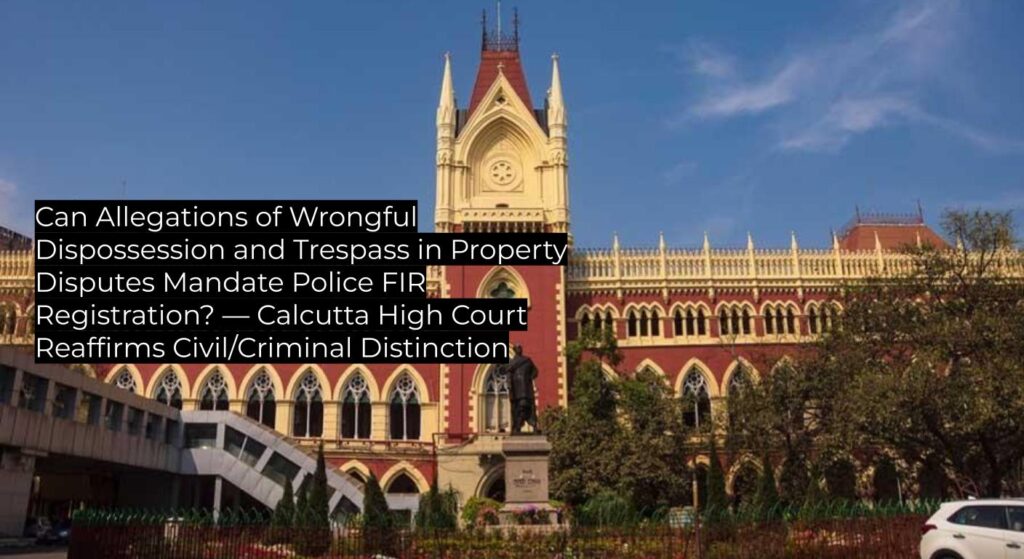
The Calcutta High Court clarifies that mere allegations of wrongful dispossession and trespass relating to immovable property, when presented as private disputes between individuals, do not automatically warrant mandatory FIR registration by police authorities unless the complaint discloses a cognizable offence; reaffirms established precedent distinguishing civil disputes from criminal liability. Serves as binding authority for writ petitions seeking police intervention in property matters.
Summary
| Category | Data |
|---|---|
| Case Name | WPA/1994/2025 of SANJAY KUMAR BASHAK Vs THE STATE OF WEST BENGAL AND ORS. |
| CNR | WBCHCJ0046792025 |
| Date of Registration | 08-09-2025 |
| Decision Date | 29-10-2025 |
| Disposal Nature | DISPOSED |
| Judgment Author | HON’BLE JUSTICE HIRANMAY BHATTACHARYYA |
| Court | Calcutta High Court, Circuit Bench at Jalpaiguri, Appellate Side |
| Bench | HON’BLE JUSTICE HIRANMAY BHATTACHARYYA |
| Precedent Value | Binding within jurisdiction for writ petitions on similar facts |
| Type of Law | Criminal Procedure / Civil Law intersections in property disputes |
| Questions of Law | Does an allegation of wrongful dispossession and trespass in a property dispute compel police registration of an FIR, or is the issue triable only under civil law? |
| Ratio Decidendi | The Court held that when disputes pertain to wrongful dispossession and trespass regarding immovable property between private parties, and the facts indicate a purely civil dispute, police authorities are not compelled to register an FIR. Relief under writ jurisdiction is not warranted for what is essentially a civil dispute. However, if the police independently discern from the complaint any disclosure of a cognizable offence, it remains open to act per law. |
| Facts as Summarised by the Court | The petitioner alleged inaction by police after his complaint of wrongful dispossession and illegal trespass by private respondents relating to immovable property. The complaint stated the respondents forcibly evicted him and denied him access. Police and private respondents argued the dispute was civil. Court found the dispute to be purely civil in nature and not amenable to relief under writ jurisdiction. |
Practical Impact
| Category | Impact |
|---|---|
| Binding On | All subordinate courts and authorities in West Bengal in relation to similar writ petitions involving property disputes |
| Persuasive For | Other High Courts adjudicating on writs seeking police FIRs in civil property disputes |
What’s New / What Lawyers Should Note
- Reaffirms that mere allegations of wrongful dispossession or trespass in property matters do not, without more, oblige police authorities to register an FIR.
- Clarifies that writ jurisdiction will not be invoked in disputes that are essentially civil in nature, even when dispossession is alleged.
- The option remains open for police to act if a cognizable offence is disclosed, but that determination rests with police authorities, not the writ court in civil disputes.
Summary of Legal Reasoning
- The Court examined the complaint and writ petition, noting the core allegations centered on dispossession and denial of property access allegedly by private respondents.
- It recorded the petitioner’s claim of wrongful dispossession and illegal trespass, but found these acts arose in a dispute strictly between private parties over immovable property.
- The bench reasoned that such disputes are civil in nature. As such, there is no automatic obligation for police authorities to register an FIR unless, upon their own scrutiny, the complaint reveals a cognizable offence.
- The Court declined relief under Article 226 given the purely civil complexion of the matter, but allowed police to independently act if criminality is apparent.
Arguments by the Parties
Petitioner
- Alleged inaction by police in failing to register an FIR despite a complaint detailing wrongful dispossession and illegal trespass from property by private individuals.
Respondent (State and Private Respondents)
- Contended that the dispute is purely of a civil nature involving immovable property and does not warrant police intervention through FIR registration.
Factual Background
The petitioner lodged a complaint with the police on June 28, 2025, alleging that in August 2024, certain private respondents unlawfully entered his immovable property, forcibly evicted him, and remained in wrongful possession, denying him access. The police took no action to register an FIR. The petitioner moved the High Court seeking a writ to compel police action. The State and private respondents countered that the issue was a civil dispute over possession.
Statutory Analysis
- The Court examined the threshold for police registration of an FIR in the context of civil disputes relating to immovable property.
- Found that in the absence of clear disclosure of a cognizable offence (as required by Code of Criminal Procedure), mere allegations of dispossession between private parties do not mandate police intervention.
- No interpretation, reading down, or constitutional provision was set out beyond detailing police duties aligned with standard criminal procedure.
Dissenting / Concurring Opinion Summary
No dissenting or concurring opinions are recorded in the judgment.
Procedural Innovations
No new procedural innovations are set by this judgment.
Alert Indicators
- Precedent Followed – The Court reaffirms the requirement that only cognizable offences, as per established criminal procedure, necessitate FIR registration and distinguishes civil property disputes from those obligations.