


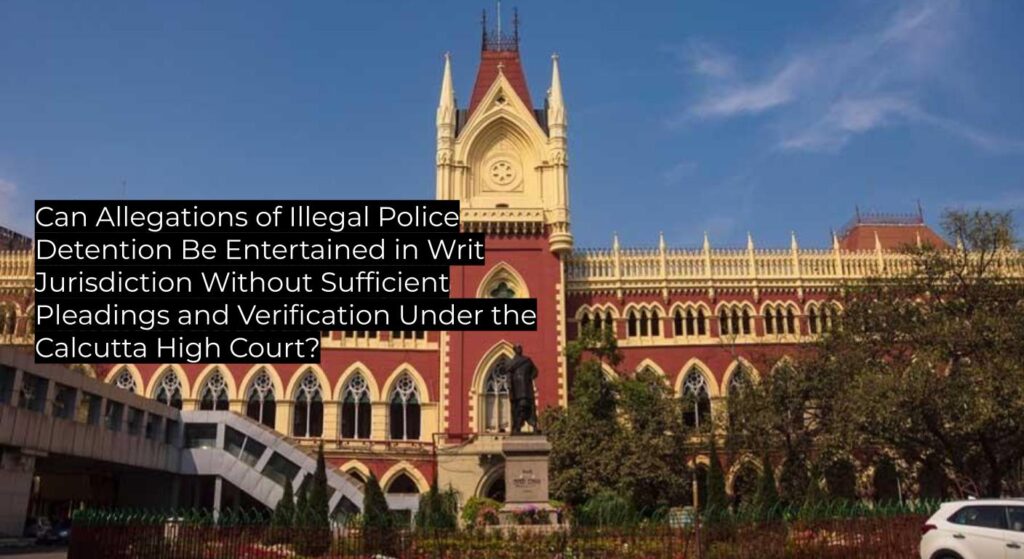
The Calcutta High Court reaffirmed that allegations of illegal detention must be supported by clear, verified pleadings; otherwise, writ relief may be denied and the petitioner directed to approach the appropriate Magistrate. The Court followed existing procedural principles, confirming that mere assertions without proper verification or evidence cannot be the basis for extraordinary writ relief, thereby upholding the order of the Single Judge. This serves as binding authority for courts within the jurisdiction and clarifies procedural expectations in cases alleging unlawful police action.
Summary
| Category | Data |
|---|---|
| Case Name | MAT/1621/2025 of SWAPAN DAS Vs STATE OF WEST BENGAL AND ORS. |
| CNR | WBCHCA0456632025 |
| Date of Registration | 18-09-2025 |
| Decision Date | 27-10-2025 |
| Disposal Nature | DISPOSED |
| Judgment Author | HON’BLE JUSTICE DEBANGSU BASAK, HON’BLE JUSTICE MD. SHABBAR RASHIDI |
| Court | Calcutta High Court |
| Bench | Division Bench: HON’BLE JUSTICE DEBANGSU BASAK & HON’BLE JUSTICE MD. SHABBAR RASHIDI |
| Precedent Value | Binding authority within West Bengal |
| Overrules / Affirms | Affirms Single Judge’s order in WPA 17509 of 2025 |
| Type of Law | Constitutional Law / Writ Jurisdiction |
| Questions of Law | Whether insufficiently verified allegations of illegal detention can be ground for writ relief regarding unlawful police detention. |
| Ratio Decidendi |
The Court held that writ relief against alleged illegal detention requires proper, verified and substantiated pleadings. Since the appellant’s claim was not verified as true to his knowledge but only as “matters of record,” and was unsupported by sufficient material, the Single Judge was correct in refusing to grant writ relief and directing the appellant to pursue alternative remedies before the Magistrate. The Division Bench found no reason to interfere with the Single Judge’s decision. |
| Facts as Summarised by the Court |
The appellant alleged illegal detention by police on May 10, 2025, claiming in the writ petition (paragraph 8) that he and his family were detained for a day. The Single Judge considered both the allegation and the police report, ultimately allowing the appellant to seek relief before the jurisdictional Magistrate. Upon appeal, the Division Bench observed that paragraph 8 was not verified as true to the appellant’s knowledge and noted the appellant failed to establish unlawful detention. |
Practical Impact
| Category | Impact |
|---|---|
| Binding On | All subordinate courts in West Bengal |
| Persuasive For | Other High Courts considering writ petitions for police excesses/detention |
| Follows | Confirms and follows the procedural expectations set by prior decisions on writ jurisdiction and verification requirements. |
What’s New / What Lawyers Should Note
- Reinforces that material allegations in a writ petition must be properly verified as true to the petitioner’s knowledge, especially in matters of alleged illegal detention by police.
- Clarifies that mere assertions, without proper verification and evidentiary support, are insufficient for relief under writ jurisdiction.
- Confirms that where pleadings are insufficient or not duly verified, courts may direct the petitioner to seek remedy before the appropriate Magistrate rather than grant relief in writ.
- Lawyers must ensure all facts pleaded—especially allegations of police misconduct—are substantiated and verified, otherwise relief may be denied at the threshold.
Summary of Legal Reasoning
- The Court scrutinised the pleadings and found that the appellant’s claim of detention was pleaded in paragraph 8 of the writ petition but was not verified as being true to the appellant’s knowledge—only as “matters of record”.
- The Division Bench observed that the Single Judge had meticulously considered both the appellant’s allegations and the police report.
- The Bench emphasised it is the petitioner’s obligation to properly plead and verify any factual allegations when seeking writ relief, particularly in allegations of illegal detention.
- In the absence of adequate verification and substantiation, the court agreed with the Single Judge’s decision to direct the appellant to seek remedies before the Magistrate, rather than interfere via writ relief.
- Accordingly, the Division Bench found no valid reason to disturb the Single Judge’s order and dismissed the appeal.
Arguments by the Parties
Petitioner
- Alleged that he, along with his wife and children, was illegally detained by police for a day on May 10, 2025.
State (Respondent)
- Relied on the police report and challenged the adequacy of the petitioner’s pleadings and evidence regarding the alleged detention.
Factual Background
The appellant filed a writ petition alleging that on May 10, 2025, he and his family were illegally detained by the police for one day. The relevant allegation was made in paragraph 8 of the writ petition, but was not verified as true to the appellant’s knowledge. The Single Judge, after considering the allegations and the police report, permitted the appellant to approach the jurisdictional Magistrate for appropriate relief. The appellant challenged this order in appeal.
Statutory Analysis
- The Court considered the requirements under constitutional law for seeking writ relief, particularly in the context of habeas corpus and allegations of illegal detention.
- Emphasised the importance of the procedural requirement for verified affidavits in writ petitions, particularly where questions of personal liberty and police conduct are raised.
- Clarified that non-verified or insufficiently substantiated pleadings cannot be the sole basis for granting relief under writ jurisdiction.
Dissenting / Concurring Opinion Summary
No dissenting or separate concurring opinions are recorded in the judgment.
Procedural Innovations
No new procedural innovations, directions, or alterations to existing practice have been introduced in this judgment.
Alert Indicators
- ✔ Precedent Followed – Existing law regarding veracity and sufficiency of pleadings in writ petitions is affirmed.