


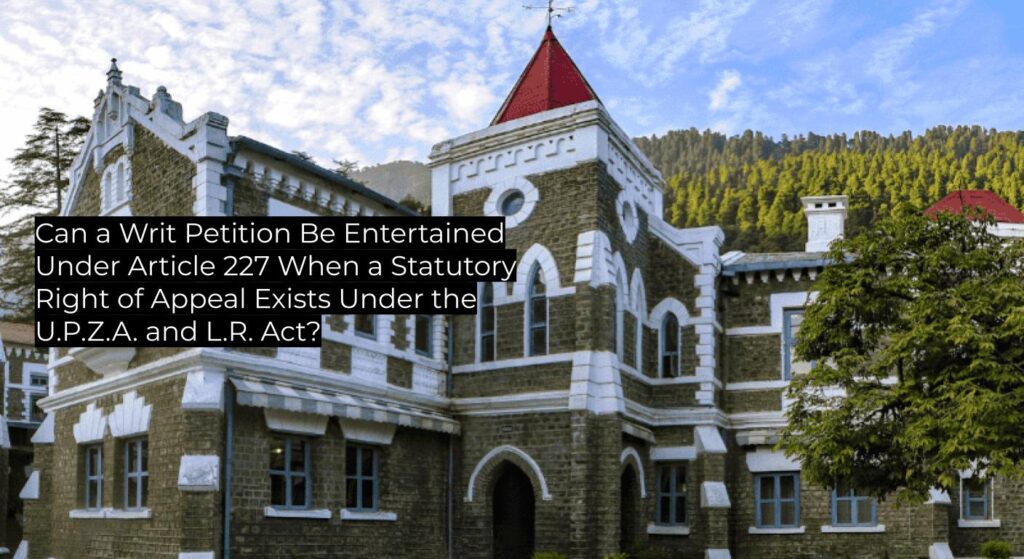
The High Court of Uttarakhand reaffirmed that a writ petition challenging an order passed under Section 176 of the U.P.Z.A. and L.R. Act is not ordinarily maintainable under Article 227 if an effective statutory appeal exists under Section 331 of the Act. The court declined to entertain the writ, citing the adequacy of the prescribed remedy, and clarified that cited Supreme Court exceptions did not apply on the present facts. The judgment maintains settled precedent and is binding on subordinate courts.
Summary
| Category | Data |
|---|---|
| Case Name | WPMS/705/2024 of JITENDRA KUMAR Vs RAJANI AGGARWAL |
| CNR | UKHC010036372024 |
| Date of Registration | 14-03-2024 |
| Decision Date | 30-10-2025 |
| Disposal Nature | DISMISSED |
| Judgment Author | HON’BLE MR. JUSTICE PANKAJ PUROHIT |
| Court | High Court of Uttarakhand |
| Precedent Value | Binding on subordinate courts in Uttarakhand |
| Overrules / Affirms | Affirms established legal principles regarding writ maintainability where statutory remedy exists |
| Type of Law | Procedural / Civil / Land Revenue |
| Questions of Law | Whether a writ can be entertained under Article 227 of the Constitution when a statutory right of appeal exists under Section 331 of the U.P.Z.A. and L.R. Act. |
| Ratio Decidendi |
The court held that where a statute provides an effective right of appeal (Section 331, U.P.Z.A. and L.R. Act), a writ petition under Article 227 should not be entertained. The High Court distinguished the present case from the Supreme Court precedents cited by the petitioner (Whirlpool, Godrej Sara Lee, etc.), finding that none of the exceptions—enforcement of fundamental rights, violation of natural justice, complete lack of jurisdiction, or challenge to vires—were present. The statutory appellate route must be exhausted before invoking writ jurisdiction, unless established exceptions are met. |
| Judgments Relied Upon |
|
| Logic / Jurisprudence / Authorities Relied Upon by the Court | Reiterated self-imposed limitations on writ jurisdiction under Articles 226/227, emphasizing that statutory remedies should not be bypassed when adequate and effective, except in stated exceptional circumstances (per Supreme Court authority) |
| Facts as Summarised by the Court |
The petitioner challenged an order dated 09.02.2024 passed by the Assistant Collector, 1st Class, Haridwar, in a proceeding under Section 176 of the U.P.Z.A. and L.R. Act. A preliminary objection was raised by the respondent, submitting that a statutory appeal is available under Section 331 of the Act. The petitioner argued writ maintainability citing pure questions of law and Supreme Court judgments, but the High Court found the precedents inapplicable, noting the existence of an effective statutory remedy. |
Practical Impact
| Category | Impact |
|---|---|
| Binding On | All subordinate courts in Uttarakhand |
| Persuasive For | Other High Courts evaluating maintainability of writ petitions when statutory appellate remedies exist under similar land/revenue statutes |
| Follows |
|
What’s New / What Lawyers Should Note
- Re-emphasizes that writ petitions under Article 227 will not be entertained where a statutory appellate remedy under Section 331 of the U.P.Z.A. and L.R. Act exists, except in the exceptional circumstances recognized by the Supreme Court.
- Supreme Court exceptions (e.g., for enforcement of fundamental rights, violation of natural justice, lack of jurisdiction, or challenge to vires) were held inapplicable on the facts.
- Lawyers must carefully assess whether any such exception truly applies before bypassing available statutory appellate remedies.
- Citing Supreme Court precedent does not guarantee writ entertainability—factual applicability is crucial.
Summary of Legal Reasoning
- The High Court observed that Section 331 of the U.P.Z.A. and L.R. Act prescribes a statutory appeal against orders under Section 176, as detailed in Schedule II.
- Noted that the Supreme Court (e.g., Whirlpool, Godrej Sara Lee, Assistant Commissioner of State Tax, Indian Hume Pipe Co. Ltd., Union of India v. State of Haryana) has established that writ jurisdiction is ordinarily not to be exercised when adequate and effective statutory remedies exist.
- However, the Supreme Court has also recognized exceptions: enforcement of fundamental rights, lack of jurisdiction, violation of natural justice, or challenge to the vires of a statute.
- The petitioner did not demonstrate that the present case fell within any recognized exception; the issues did not involve pure questions of law, nor was there a violation of jurisdiction or natural justice.
- Therefore, the High Court dismissed the writ petition, reiterating the principle that statutory remedies must be exhausted, and the cited precedents were found inapplicable on these facts.
- The judgment concluded by allowing liberty to pursue appropriate remedy as per law.
Arguments by the Parties
Petitioner
- Contended writ petition involved a pure question of law.
- Sought to rely on Supreme Court decisions (Whirlpool, Godrej Sara Lee, etc.) to support writ maintainability despite existence of statutory remedy.
Respondent no.1
- Raised preliminary objection: Statutory appeal available under Section 331 (read with Schedule II) of the U.P.Z.A. and L.R. Act.
- Asserted that writ jurisdiction should not be invoked as the petitioner was attempting to bypass the statutory appellate process.
Factual Background
The petitioner filed a writ petition under Article 227 challenging the order dated 09.02.2024 passed by the Assistant Collector, 1st Class/Sub-District Magistrate, Haridwar in a suit for division of a holding (proceeding under Section 176, U.P.Z.A. and L.R. Act). Respondent no.1 objected, arguing that a statutory appeal as per Section 331 of the Act was the proper remedy. Petitioner contended the High Court should decide pure legal questions under writ jurisdiction instead.
Statutory Analysis
- Section 176, U.P.Z.A. and L.R. Act: Governs suits for the division of a holding of a bhumidhar.
- Section 331, U.P.Z.A. and L.R. Act (read with Schedule II, Entry 16): Prescribes the appeal route from orders passed by the Assistant Collector (1st Class) in Section 176 proceedings—first appeal to the Commissioner, second appeal to the Board.
- The court applied a straightforward reading—when such a statutory remedy exists, writ petitions should not be entertained unless exceptions affirmed by the Supreme Court apply.
Dissenting / Concurring Opinion Summary
No dissenting or concurring opinion is recorded in the judgment.
Procedural Innovations
No procedural innovations are recorded in the judgment.
Alert Indicators
- ✔ Precedent Followed – When existing law is affirmed.