


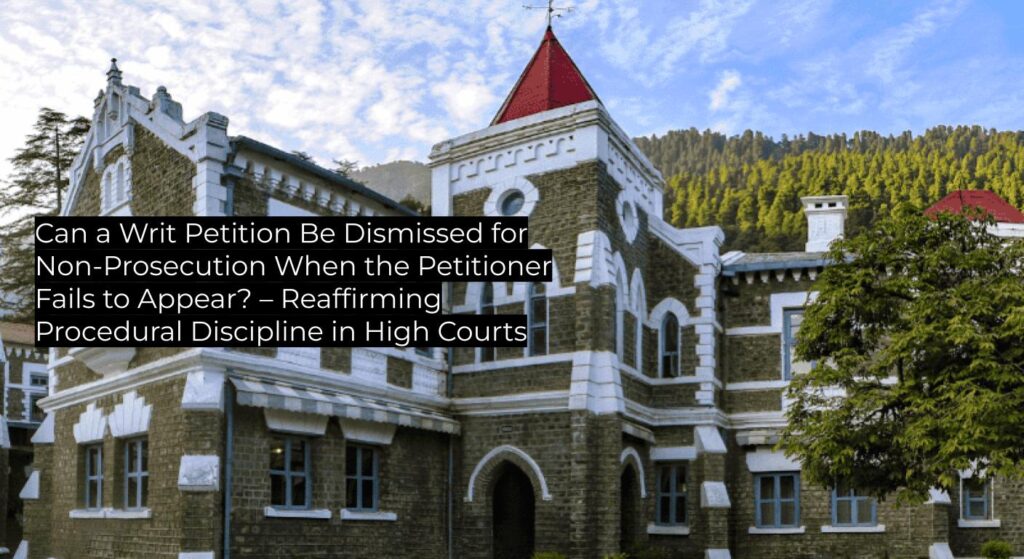
The Uttarakhand High Court reaffirmed that writ petitions may be dismissed for non-prosecution if the petitioner fails to prosecute the case, upholding existing procedural precedent. This judgment maintains procedural discipline and may be cited as binding authority within the jurisdiction of the Uttarakhand High Court and as persuasive authority elsewhere.
Summary
| Category | Data |
|---|---|
| Case Name | WPMS/169/2015 of SACHIN KUMAR Vs KUNWAR PAL |
| CNR | UKHC010002712015 |
| Date of Registration | 20-01-2015 |
| Decision Date | 10-09-2025 |
| Disposal Nature | DISMISSED IN DEFAULT |
| Judgment Author | Hon’ble Mr. Justice Pankaj Purohit |
| Court | High Court of Uttarakhand |
| Precedent Value | Binding within Uttarakhand High Court; persuasive for other jurisdictions |
| Questions of Law | Whether a writ petition may be dismissed for non-prosecution when the petitioner fails to appear or prosecute their case. |
| Ratio Decidendi |
The High Court reiterated that adherence to procedural requirements, including diligent prosecution of cases, is vital. Where the petitioner or their counsel fails to appear, the Court is empowered to dismiss the petition for non-prosecution. Maintaining procedural discipline is necessary for the proper administration of justice. Interim orders passed earlier in such petitions stand vacated upon dismissal in default. |
| Facts as Summarised by the Court |
On the date of hearing, the matter was taken up after being revised in the list; no one appeared for the petitioners. Counsel for the respondent was present. Both writ petitions were dismissed for non-prosecution. Any interim orders were vacated. |
Practical Impact
| Category | Impact |
|---|---|
| Binding On | All subordinate courts within Uttarakhand jurisdiction |
| Persuasive For | Other High Courts and the Supreme Court when considering similar procedural defaults |
What’s New / What Lawyers Should Note
- The judgment reinforces that non-appearance of the petitioner or their counsel may lead to dismissal of the petition for non-prosecution.
- Any interim relief previously granted in such petitions will automatically stand vacated upon dismissal.
- Lawyers must ensure presence or proper representation to avoid adverse procedural outcomes.
- This case may be cited to defend or challenge dismissals on grounds of non-prosecution in writ proceedings.
Summary of Legal Reasoning
- The Court revised the list and proceeded to hear the matter.
- Observed that none appeared on behalf of the petitioners.
- The respondent’s counsel was present.
- In view of continued default in appearance by the petitioner, the Court exercised its authority to dismiss both writ petitions for non-prosecution.
- The judgment stated that any interim order granted earlier would stand vacated upon such dismissal, maintaining procedural consistency.
Arguments by the Parties
Petitioner
- No appearance; no arguments were presented on the date of hearing.
Respondent
- Counsel appeared and was prepared to proceed; specific arguments not recorded as the matter was disposed of for non-prosecution.
Factual Background
Both writ petitions were listed and revised for hearing. On the hearing date, no one appeared on behalf of the petitioners, while counsel for the respondent was present. Subsequently, the Court dismissed the writ petitions for non-prosecution and vacated any interim orders.
Statutory Analysis
- The judgment operates within the established procedural law governing writ petitions before the High Court.
- No new statutory interpretation or statutory provision analysis was undertaken; the order relies on the procedural prerogative of courts to dismiss matters for non-prosecution.
Procedural Innovations
- The judgment follows established procedure for dismissal of cases due to non-prosecution and vacation of interim orders; no new procedural precedent was set.
Alert Indicators
- ✔ Precedent Followed – The judgment reaffirms and applies established procedures regarding dismissal for non-prosecution and vacation of interim orders.